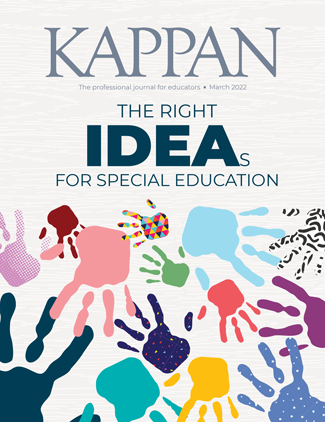
The Individuals with Disabilities Education Act (IDEA) — along with its predecessor, the Education for All Handicapped Children Act (EHA) — is widely viewed as one of the 20th century’s most important pieces of civil rights legislation. When EHA was passed in 1975 (with strong bipartisan support), it opened the doors of the nation’s schoolhouses to millions of children who’d long been denied access to public education, while also creating many of the resources and legal protections that children with disabilities, and their families, continue to rely on today. And on any number of measures — inclusion in general education classrooms, high school graduation rates, post-school employment, and many others — outcomes for students who receive special education services have improved over the last 4½ decades.
And yet, IDEA often seems to receive just as much criticism as praise. For one thing, the federal government has never funded special education at anything close to the levels it promised in 1975. For another, although Congress is supposed to reauthorize the law every five years, it is now 18 years (and counting) since the last reauthorization, and a host of serious concerns about IDEA’s design have piled up since them.
When it was reauthorized in 1990, and renamed IDEA, the law was expanded to include new programs for infants and toddlers, greater emphasis on educating students in their neighborhood schools, and more support for research on special education. And when it was reauthorized in 2004, provisions were added to improve the identification of children with disabilities and strengthen the preparation of special education teachers. But in the intervening years, many advocates have come to believe that the law needs a much more significant overhaul.
In the years leading up 1975, the education of children with disabilities was widely seen as a civil rights imperative, notes Catherine Voulgarides in this month’s Kappan. But when it came time to craft legislation, Congress opted to focus mainly on procedural matters — who would be eligible for special education services, which kinds of services schools must provide, how states would ensure that districts and schools were delivering them as intended, and so on. As a result, argues Voulgarides, IDEA has spawned a massive bureaucracy that is preoccupied with monitoring school systems’ procedural compliance with the law, while doing little to ensure that special education programs actually provide the equitable, high-quality services that civil rights advocates have always called for.
Likewise, Michael Wehmeyer, also in this issue, laments how slow the progress has been toward providing truly equitable access to high-quality learning opportunities for children with disabilities. Reflecting on the 47 years since the law was enacted (and almost that long since he began his career in special education), he concludes that the time has come to challenge one of the basic assumptions on which IDEA was founded, the idea that special education should be viewed as a separate kind of education, different in nature from the education provided to other children.
Nobody knows whether Congress will take up the reauthorization of IDEA any time in the foreseeable future. But when it does, chances are that advocates will push for a genuine debate about and reconsideration of the law’s fundamental goals and assumptions, not just another round of tinkering around the edges.
This article appears in the March 2022 issue of Kappan, Vol. 103, No. 6, pp. 4.

ABOUT THE AUTHOR

Rafael Heller
Rafael Heller is the former editor-in-chief of Kappan magazine.