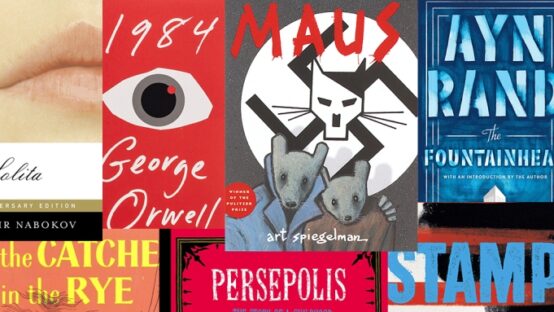
Recent book bans are troubling, but the indignance they evoke is misguided. Education reporters should add nuance rather than fanning outrage.
By Cafeteria Duty
So, I guess we’re banning books again.
My first reaction is confusion.
Why would anyone complain about a YA novel that “depicts sexual activity” when the actual search history of any 13-year-old boy’s phone would make his parents’ eyes melt? And why are people so angry about the bans, which are clearly symbolic?
But most of all, the feeling I’m left with is dismay.
Dismay that, yet again, a major education issue dominating the news reveals just how little everyone understands or is willing to say out loud about what actually happens inside most American classrooms.
The most common reaction from educators when they hear about another book banning isn’t indignation. It’s a shrug.
All that said, I’m no fool. As the pandemic occupies less and less of our collective attention, and as we near the midterms, there will be more book bans. And there will be more coverage.
That being the case, these stories might as well benefit from insights into how books in high school and middle school classrooms are actually taught, mitigating the alarmist tone that often inflects these stories that I’ve been seeing.
But more importantly, they will also remind readers (and the reporters themselves) that some of the largest obstacles to learning in American classrooms are rather mundane.
Yet again, a major education issue dominating the news reveals just how little everyone understands or is willing to say out loud about what actually happens inside most American classrooms.
As reporters continue to report on these bans, they should point out that not all of them are the same and that the complexity of novels, students’ tendency to avoid assigned readings, and the logistical challenges of teaching long books can complicate our romanticized notion of what actually happens in classrooms — and what presents a threat.
1: Not all bans are created equal
To begin, reporters should distinguish between the two main types of bans: books yanked from library shelves and books struck from a curriculum.
The sheer volume of books in a library and the near certainty that any supposedly objectionable viewpoint or theme found in one book will be found on another shelf nearby (or online) means that bans that target library titles are more than likely symbolic and therefore probably politically motivated.
This might be a moot point to those who see all bans as existential threats, but practically speaking, banning books from school library shelves won’t achieve their stated ends, and as such, don’t warrant as much coverage as bans that target books from a curriculum.
2. Not all themes are taught for each book that’s assigned
Which is not to say bans that go after books meant for a curriculum — like the recent challenges to Toni Morrison’s Beloved — justify breathless coverage.
In these cases, reporters would do well to remember that, as poet Wallace Stevens reminds us, there are 13 ways of looking at a blackbird.
If a parent takes issue with a particular scene or theme in a novel, we should not assume that scene or theme is going to be taught. That is, how books are read in school — selectively, with great difficulty — is not the same as how we adults read them.
This insight is obvious to educators but probably odd or counterintuitive to everyone else.
Novels lend themselves to multiple interpretations — what English teachers fondly call “themes.” Novels may have dominant themes — the comprehensive destruction of slavery on the self in Beloved, e.g. — but no novel demands the reading of one theme to the exclusion of all others.
How a teacher decides to teach a novel is a deliberate choice that depends on a constellation of factors: the teacher’s interest or capability; the age, skill level, interests, or background of the students; the learning goals of the unit; and the unifying theme of the curriculum, among others. Add time constraints and how little students actually read (more on that in a minute) and not every chapter or scene is discussed or even read because not every chapter or scene needs to be.
So, when a parent mounts a complaint about a book, reporters would do well to investigate how or even if teachers will be addressing that theme. Talk to the teachers or the department chair. The controversy may be full of sound and fury, signifying nothing. Stories should note that.
3. Don’t over-romanticize book-reading in school
Most students read very little outside of class.
I cannot stress enough how enormous of an obstacle this presents to the successful execution of a book unit, or in the very least, one that doesn’t drag on for an interminable eight weeks with the teacher force marching her bored captives to the very last page with entire periods of halting read-alouds and coerced silent reads.
Students’ obstinate refusal to read outside of class transcends class, race, skill, gender, age, and even time. And don’t blame the internet; there was never a golden literary age when most students did not find creative ways to fake their way through reading assignments. (When people tell me fondly that they read The Grapes of Wrath in high school, I think, No, your teacher assigned it.)
What does this have to do with book bans? Many individuals — especially those of us who did well in school and who often comprise the corps of individuals who grow up to write about school — have a romantic notion of what happens in English classes. Still others have a mistaken notion about what happens in classrooms.
Individual books rarely change students’ lives. The reality is messier and less epiphanic than we remember, or what we see on TV. As a result, the specter of a book ban can seem worse than it actually is.
Reporters might talk to teachers, department chairs, or administrators about how novel studies in their school actually go. Reporters might talk to concerned parents, too, about how they think book units go. Or maybe talk to students about their experiences reading books for school that are now under threat of a ban of some kind.
4. Don’t mistake the map for the territory
Teachers’ unit plans rarely go according to, well, plan. There are exactly 10 trillion possible things that can happen to interrupt the seamless progress of a unit, and at least 15,000 of them happen before the end of your first class.
What’s more, the variety and quality of units is pretty vast, so one class’s reading of Romeo and Juliet may amount to passively watching clips from the 1996 Baz Luhrmann movie while answering questions on a worksheet, while others may have them act out the scenes, while still another’s may engage students in a close analysis of the play’s punny language.
One idea for reporters is to follow up when a book has been targeted for a ban. Ask for the unit in question and observe a few classes of the book being taught. Are the classes following the trajectory planned for in the unit, or did the teacher change course?
Effective teaching is as much the result of careful planning as it is of flexibility.Good teachers know what they’re doing in two weeks, but great teachers don’t know what they’re doing tomorrow. Look at student work and ask students about it. Then tell your readers what you saw or learned.
Many individuals — especially those of us who did well in school and who often comprise the corps of individuals who grow up to write about school — have a romantic notion of what happens in English classes.
All of this, then, is not to suggest that the messy, unpredictable dynamics of classrooms render book bans absurd because hardly any learning gets done and who cares about books, anyway.
On the contrary, these four points are to remind outsiders, especially journalists who write about education, that the messy, unpredictable dynamics of a classroom demand we question our impressions of what we think happens in classrooms.
The claims about American classrooms implicit within book bans oversimplify the reality, and our own memories of school can all too often romanticize that reality, too.
Classrooms are a black box, but reporters can pry them open, with care. What they show us might worry us, but I can guarantee it’s never as bad as what the harshest critics believe. And we might see that there are actually bigger problems to solve.
Related from The Grade:
People are fighting. Is that news?
Author Amanda Ripley laments the rise of ‘conflict’ journalism
Previously from this author:
The media obsession with ‘bad kids’
ABOUT THE AUTHOR

Cafeteria Duty
Cafeteria Duty is a New York City-based educator and newsletter writer. Follow @Cafeteria_duty. Check out the newsletter: https://cafeteriaduty.substack.com/