In this week’s newsletter: Schools come up with new ways to stay open amid the Omicron surge. How to improve coverage of substitute teachers and union-district conflicts. And one reporter shares her ed beat BFF story.
RETHINKING SCHOOL SAFETY
The big story of the week, according to us:
While Detroit, Flint, Minneapolis, Maryland’s Montgomery County, and several Utah districts have gone remote due to cases, staffing shortages, and quarantine requirements, most of the nation’s schools remain stubbornly open for in-person learning — and a small but growing crop of states and districts are moving towards group testing, “mask to stay” protocols, and creative staffing. They include liberal enclaves like Marin County, Calif. and Madison, Wis.:
🔊 Lawmakers are rewriting rules as schools grapple with teacher shortages (NPR)
🔊 Mass. relaxes contact tracing in schools that offer rapid tests (The Boston Globe)
🔊 Most Philly schools are returning to in-person classes (Philly Inquirer)
🔊 Educators work to keep classrooms open despite COVID surge (WBUR)
🔊 Some Colleges Loosen Rules for a Virus That Won’t Go Away (New York Times)
🔊 Vegas teachers offered retention bonuses amid COVID-19 spike (AP)
🔊 Parents and retirees teach class as omicron sidelines faculty across nation (Bloomberg News)
🔊 Palo Alto Schools Stay Open Thanks to Parent Volunteers (Wall Street Journal)
🔊 Oklahoma will allow state employees to work as substitute teachers to fight shortages (NPR)
DIVERGENT RESPONSES IN CA; MASS PRE-K LAGS BEHIND ALABAMA
The best education journalism of the week, plus a runner-up and some bonus stories.
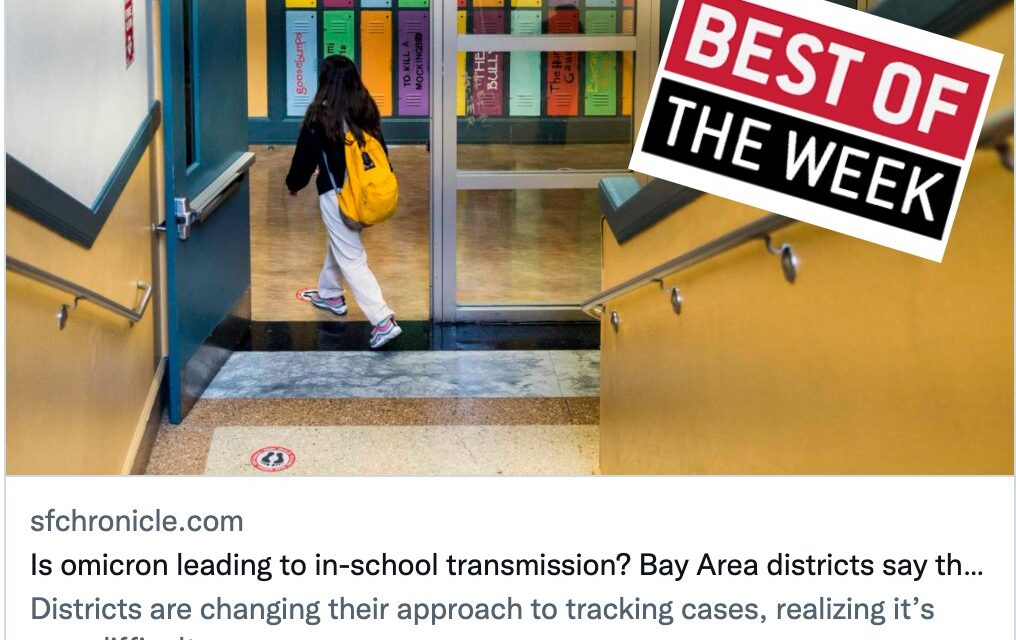
🏆 BEST: The best story of the week is the poorly headlined story Is omicron leading to in-school transmission? Bay Area districts say there’s no way to know by Jill Tucker in the San Francisco Chronicle. In it, Tucker compares nearby Northern California districts who are heading in wildly different directions in their COVID responses. Marin and Palo Alto are moving away from contact tracing, notification letters, and quarantines, while San Francisco is continuing with the more traditional approach. According to Tucker, Palo Alto is “among the first to take the leap into what has quickly become a new stage of the pandemic for some districts.” However, Tucker notes that this shift means letting go of the desire to track cases and figure out schools’ role in transmission.
🏆 RUNNER-UP: This week’s runner-up is Families in Alabama have free, full-day prekindergarten while many Mass. families can only dream of it by Naomi Martin and Jenna Russell in the Boston Globe. “While Alabama ranks much lower than Massachusetts on most education metrics, experts say it is serving its children and families far better in at least one important area: prekindergarten,” Martin and Russell write. In Massachusetts, pre-K is largely only available to families who can spend an average of $15,000 a year. In Alabama, 44 percent of 4-year-olds are being served regardless of income. This story upends a lot of people’s assumptions about the quality of education in both states — something Russell strives to do in her reporting, she once told me — and also highlights an issue often left out of mainstream education coverage: early education. “It’s important to look at how different places handle difficult education issues in ways that could be models for other communities,” Martin told us. We also love comparison stories, and this one is an excellent example of how to do it right, including Russell actually reporting on the ground in Birmingham.
BONUS STORIES:
🏆 Revising America’s Racist Past (EdWeek)
🏆 Some Kids Have Returned to In-Person Learning Only to Be Kicked Right Back Out (Hechinger Report via The Nation)
🏆 The OTHER angry parents (Hechinger Report)
🏆 Her University Celebrated Her Inspiring Story. Then It Started Asking Questions. (Chronicle of Higher Ed)
🏆 ‘Abbott Elementary’ gets an ‘A’ in its first season (The Undefeated)
Did someone forward you this? You can sign up here. Or, you can view this newsletter in your browser.
SUBSTITUTE TEACHERS & CHICAGO BLIND SPOTS
New commentary from The Grade
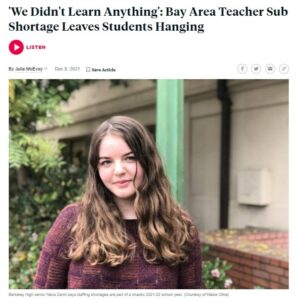
Above: Julia McEvoy’s December story on Bay Area sub shortages for KQED.
Substitute teachers are playing an important role during the pandemic, especially during this latest Omicron surge when so many teachers are quarantining. But coverage of substitute teaching has often been superficial and repetitive, write two contributors who specialize in helping districts rethink their sub programs. They share several ways to write stories that get deeper, and give some examples of districts that are doing things differently.
Also: You already know that Chicago schools were shut down for five days. But why did the shutdown start so abruptly — and end so abruptly? That’s a story that has gone under-told, notes contributor Steve Rhodes, who notes ongoing problems with coverage union claims and decisions: “Grill the mayor, by all means. But grill the CTU, too,” he writes. According to a leaked union slide deck, the union backed off quickly because the shutdown was so divisive among members. An anonymous teacher’s account suggests that too many teachers were going in to work despite the shutdown for it to hold up.
MEDIA TIDBITS
Thought-provoking commentary on the latest coverage.
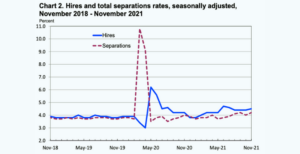
Above: “Dire warnings about teacher shortages are a constant in education policy (stretching back years before the pandemic),” tweeted Century Foundation fellow Conor Williams. “But you should always check with Chad Aldeman before you panic.”
📰 ‘RESET’ ON COVID SAFETY (& COVID COVERAGE): A small but growing set of states (including Vermont and Massachusetts) and districts (including Madison and Berkeley) are revamping their school safety approach during Omicron, notes Boston Globe columnist Kara Miller. Some news outlets seem to be rethinking their school COVID coverage, too. One useful strategy has been to compare adjacent districts, which Chalkbeat’s latest national newsletter does, comparing all-remote Newark with in-person NYC. (The SF Chronicle did the same, comparing Marin and San Francisco.) Alas, a few outlets like the Atlanta Journal Constitution, the Boston Globe, and New Orleans’ The Lens are still doing things the old way, focusing on case count numbers that seem increasingly meaningless.
📰 MOST-DISCUSSED OF THE WEEK: Opinion pieces, analysis, and personal essays often dominate the education discussion each week, for better or worse. This week’s unusually large crop includes The Cult of Masked Schoolchildren (in Tablet), Progressives Must Reckon With the School-Closing Catastrophe (in New York Magazine), The Real Roots of the Debate Over Schools During Covid (in NYT Opinion), Don’t blame teachers or unions (in the Philadelphia Inquirer), I’m A Public School Teacher: The Kids Aren’t Alright (via Bari Weiss), and America has failed to learn from the safe opening of classrooms abroad (in The Economist).
📰 SECOND JOBS AND HARASSMENT: A couple of ed reporters are reminding their readers what is — and isn’t — “just part of the job” of a reporter. “Being harassed is not simply ‘part of the job’ of being a journalist,” tweeted Bethesda Beat’s Caitlynn Peetz, “and we have to stop perpetuating the idea that it is.” Capital Gazette education reporter Rachael Pacella survived the 2018 attack that killed five of her colleagues but has had to take a second job to make ends meet, as reported in this Washington Post story about the paper. Neither harassment nor low pay should be accepted as “part of the job,” and newsrooms need to do better by their reporters.
Looking for media commentary and analysis all day, every day? Follow me at @alexanderrusso.
PEOPLE, JOBS
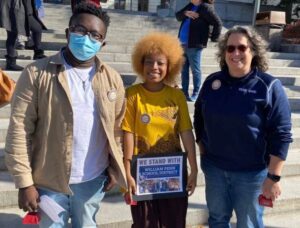
Above: Kudos to these Pennsylvania high school journalists, who created their own podcast to cover the state’s education funding trial. “If you’re a student in the school, you know what’s going on, you know the issues,” said student co-host Paul Vandy (left).
🔥 Job openings: EdWeek is looking for an assistant managing editor to lead a team of reporters covering K-12 education. The AP is starting a new education initiative, and so far there are job openings for a reporter, a data journalist, and a news director. The Baltimore Sun has an opening for an education reporter. The Seattle Times is still looking for an Ed Lab reporter. The Boston Globe is hiring a data journalist and a digital producer for their Great Divide team. Politico California is hiring an education reporter. WBEZ Chicago is hiring an education reporter. And WBUR Boston public radio is still looking for an education editor.
🔥 Expansions: In addition to the forthcoming AP initiative, Chalkbeat has expanded its higher ed coverage, now helmed by Colorado’s Jason Gonzales and Indiana’s Stephanie Wang. Congrats!
🔥 Irony of the week: Chicago Tribune reporter Gregory Pratt was slammed by some teachers when he published a Chicago Teachers Union slide deck explaining its short-lived school shutdown, despite the obvious relevance of the information he shared — or, as Mike Antonucci noted, the fact that Pratt is the head of the Tribune reporters union.
🔥 Departures: So long, Kenya Hunter, who’s leaving the Richmond Times-Dispatch and the ed beat to report on health in her hometown for Capital B Atlanta. Here’s what she had to say about her time in Richmond: “Because of Richmond, my love for movement in journalism has grown. I’ve become more firm in my mission to put communities at the center of my coverage, connecting history to present. … What a blessing it has been to be a vessel of change at the paper of record in the former capital of the confederacy. I know my ancestors are proud.”
🔥 Anniversaries: Congrats to the Chicago Sun-Times’ Nader Issa, who has done some truly excellent work in his five years at the paper. “It somehow feels like it’s been both much longer and shorter than that,” he tweeted.
MEDIA APPEARANCES

Above: Don’t miss this Ida B. Wells Society event on Jan. 26 on investigating racism and racial inequality, featuring Aaron Morrison and Andale Gross, who cover race and ethnicity for the AP. Sounds like there will be lots of useful stuff for education reporters.
⏰ Media appearances: Catch NPR’s Anya Kamenetz on Morning Edition earlier this week talking about how Omicron is wreaking havoc at daycare centers. It was the only time an interviewee of hers has ever cursed on air, she says! Also talking about Omicron and young children, KPCC’s Mariana Dale was on the station’s AirTalk program. And the San Francisco Chronicle’s Jill Tucker was on the paper’s Fifth & Mission podcast asking if Oakland Unified’s vaccine mandate for students is working.
⏰ Extracurriculars: The New York Times’ Nikole Hannah-Jones just finished her second week of the 1619 Freedom School project. “This is the most important thing I’ve ever done,” she tweeted. Meanwhile, a handful of education reporters including EdWeek’s Evie Blad, the New York Times’ Erica Green, and US News’ Lauren Camera are half-joking about offering to help out by substitute teaching. “About two phone calls into this story,” wrote Blad, “I thought about walking to the elementary school down the street to see if they needed a tired education reporter to serve as a substitute.”
⏰ ICYMI: CT Public TV released an hour-long segment on how the pandemic is reshaping education in Connecticut, featuring work by investigative reporter — and veteran of the ed beat — Jacqueline Rabe Thomas. You can rewatch it several times this weekend. And WBUR On Point is back with their first education episode in a while: Making sense of the COVID strategy in America’s schools.
THE KICKER
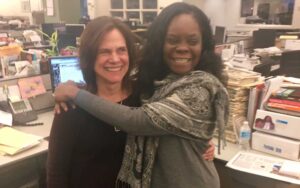
“There are few on this earth who believed in me more than Liz Bowie,” the New York Times’ Erica Green tweeted about her former Baltimore Sun colleague, who’s leaving the Sun for the Baltimore Banner. “She knew I could do this before I did.”
That’s all, folks. Thanks for reading!
Reply to this email to send us questions, comments or tips. Know someone else who should be reading Best of the Week? Send them this link to sign up.
Using Feedly or FlipBoard or any other kind of news reader? You can subscribe to The Grade’s “feed” by plugging in this web address: http://www.kappanonline.org/category/the-grade/feed/.
Read more about The Grade here. You can read all the back issues of The Grade’s newsletter, Best of the Week, here.
By Alexander Russo with additional writing from Colleen Connolly.
ABOUT THE AUTHOR
Alexander Russo
Alexander Russo is founder and editor of The Grade, an award-winning effort to help improve media coverage of education issues. He’s also a Spencer Education Journalism Fellowship winner and a book author. You can reach him at @alexanderrusso.
Visit their website at: https://the-grade.org/