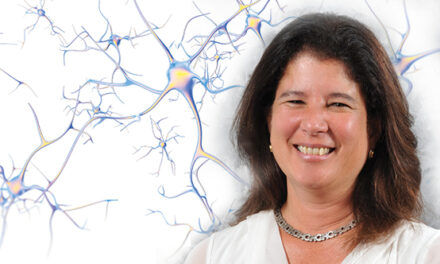
Sky Marietta is an assistant professor at the University of the Cumberlands, in Williamsburg, Kentucky, and director of the Learning Commons, a peer-based program to support the academic achievement of vulnerable college students. She also is the owner of Moonbow, a group of three small businesses that support Appalachian artists and suppliers in Corbin, Harlan, and Williamsburg.
Marietta grew up in Appalachian Kentucky, the fifth of her parents’ seven children. She went to college at Yale, became a teacher on the Navajo Nation, and then went on to receive her doctorate at the Harvard Graduate School of Education (HGSE) in child development, with a focus on language and literacy. Rural communities have been central to her work — her dissertation examined the differences between early literacy development in urban and rural poor communities, and she taught a class on rural education at HGSE as a postdoctoral fellow and lecturer. After finishing her doctorate, she launched an early childhood program in Harlan County, Kentucky, and worked as a specialist for Kentucky’s Cooperative Extension program. She has written three books, including Teaching Advanced Literacy Skills (co-authored with Emily Phillips Galloway and Nonie Lesaux), Making Assessment Matter (with Nonie Lesaux), and Rural Education in America: What Works for Our Students, Teachers, and Communities (with Geoff Marietta), which was published in 2020.
Marietta lives with her husband, Geoff, their sons Harlan and Perry, and two dogs. She blogs about their lives and businesses at www.kentuckymoonbow.com.
Phi Delta Kappan: To begin, tell us a bit about what’s driven you to study and write about rural education.
Sky Marietta: I grew up in a rural area. For generations, my family has lived in Appalachian Eastern Kentucky. And, you know, when you grow up in a place, you don’t think of it as being unusual; it’s just where you live. But then for college I went to Yale, which is in an urban environment, and I couldn’t help but see that New Haven, Connecticut, was very different from where I was from. Plus, I was a psychology major, and I started reading about all of these risk factors associated with childhood poverty. It was such a shock to discover that people like me are expected to have bad outcomes. I mean, I qualified for free lunch every year, I was the fifth of seven children in my household, and when I was growing up, OxyContin was ravaging the area. But it wasn’t until I went to college that I understood how different life can be in America. I remember one time in class, we were talking about the psychological impacts of drug abuse, and I looked around at my classmates, and I suddenly realized, Oh my goodness, you don’t know any people who have a drug addiction! So that drove me to ask how, exactly, my community was different from others. Why were my professors so interested to hear about my childhood, as though I had grown up in a strange place? What was distinct about Eastern Kentucky?
Then, after college, I taught in New Mexico, at a school in the Navajo Nation. And of course, rural New Mexico is very different from rural Appalachia. But it didn’t take long to realize that in one sense, they were quite similar: Both of these rural places were basically invisible to state and federal policy makers. Clearly, decisions about our educational programs and initiatives were being made by people who didn’t live in the area, didn’t understand the community, and didn’t know what kinds of resources would be helpful to local teachers and students. So, that led me to graduate school to study rural education.
Kappan: When you got there, did you discover a whole community of people who shared your interests, or did you find that rural education was being overlooked by researchers, too?
Marietta: I found some kindred spirits. But, overall, it seemed to me that researchers weren’t paying nearly enough attention to rural education, and I continue to think that’s the case. Where we are in the field today is a lot like where medical researchers were 50 years ago, when they assumed that if a treatment worked for, say, white men, then it must work for everybody else, too. In education, we still tend to think of poverty as this single, monolithic condition, as though growing up poor in New York City were exactly the same as growing up poor in rural New Mexico or rural Kentucky. But is that really true? Instead of assuming that all poor students need exactly the same kinds of supports and interventions, shouldn’t we aim for a nuanced understanding of their particular needs?
For instance, my research has focused mainly on early literacy development, specifically how kids in my poor rural community might differ from kids living in poor urban neighborhoods. I spent about seven years doing qualitative research in low-income parts of Eastern Kentucky, observing young children with their families, to understand how their home literacy environment matches or doesn’t match what goes on in school. With colleagues, I also tested a sample of kindergartners on a range of early literacy skills, so we could compare them with a sample of children from an urban area.
We found that poor children in Eastern Kentucky tend to receive pretty good early literacy instruction in school. Most of the kids in our sample ended the kindergarten year testing at about the 2nd-grade level on phonics skills and basic comprehension. And on nationally normed state reading tests, children in the area — some of the poorest districts in the country — are scoring at about the national average. The prevailing wisdom, based on research in urban schools, is that students in the poorest school districts aren’t receiving good instruction and need interventions to help them catch up in reading. But that’s clearly not the case in Eastern Kentucky.
So then we have to ask, if poor kids in this area are getting effective literacy instruction, and if their reading scores are solid in 4th grade, then why do they have some of the lowest rates of college degree attainment in the country? If their literacy skills are strong, what else might explain why they’re not moving on through higher education? One possibility is that not many jobs in the area require an advanced degree, so if you want to stay in the area (and most American adults choose to live within 20 miles of where they grew up), what’s the incentive to go to college? And if that’s the case, what sorts of interventions would be appropriate for students in Harlan County, Kentucky, where I live? If the goal is to help them succeed, then maybe we should be focusing on economic development, for example, as a pathway to more advanced literacy instruction. It’s a mistake to assume that our students need the same supports and programs as poor students in Lexington or Louisville, much less New York City.
There are many more Black, Latinx, Asian American, and Indigenous people living in rural communities than you might think.
Kappan: This is a prominent theme in your book, Rural Education in America, the idea that if we want to improve educational outcomes in poor rural areas, then we’ll need to know much more about each community’s history, demographics, economic conditions, and so on, so as to provide supports and services that make sense for them. But while you warn against making broad generalizations about the educational needs of children growing up in poverty, you also point out that poor rural schools all over the country tend to be struggling with the same challenges.
Marietta: Absolutely. It’s true that every rural community is unique, and it’s also true that rural communities everywhere face some of the same problems. In at least a couple of ways, it does make sense to generalize about the needs of poor rural school districts. For instance, let’s start with broadband access. During the pandemic, everybody’s been talking about the need to make sure students can connect to the web, and for years we’ve been hearing about “last mile” initiatives meant to connect people in rural areas. But still, around a third of people living in rural America have lousy, if any, access to the internet, and they pay more for low-quality, slow service. Sure, there are some programs underway in various parts of the country to improve access, but we haven’t really treated this as a national policy priority, and we still haven’t made a major, coordinated effort to build out this infrastructure. Personally speaking, since moving back to Harlan County six years ago, I haven’t seen any major improvements. It’s clear, also, that we can’t rely on the marketplace to fix this problem, since it’s not profitable to extend cables all the way out to remote locations. And while some people are hopeful about satellite-based internet services, that won’t necessarily work for us here in the mountains and could be many years off.
So, for most rural areas, lack of broadband access has been a very big problem, and it became much worse when schools shut down because of COVID. I know last year was a struggle even in places that have great internet service, but think about what kids have gone through in places like Eastern Kentucky. For instance, at the local school my kids attend, about 30% of the students have no at-home internet access at all, and most of the others have limited service that doesn’t allow them to stream content, which means they can’t watch a video or participate in Zoom calls. We also have very limited data services for mobile devices, which means you can’t necessarily hop onto a meeting using a phone or tablet. So, for our school, the only option was to send packets of materials for students to work on at home or to use simple online services, like Google Forms, that didn’t tax bandwidth. My younger son was in 1st grade last year, and for him and his classmates, 1st grade was mostly a series of five-page packets. During the 11 months of shutdowns, they never got to hear their teacher read a book out loud or participate in a discussion with their peers. I think we’ve only just begun to understand how difficult the pandemic has been for kids and teachers all over the country, but I’m particularly worried about kids who’ve been cut off completely, without even the option to connect online.
Kappan: Other than limited broadband access, what other big challenges do rural students and teachers tend to face?
Marietta: The other big problem is that rural schools tend to be severely underfunded. It starts with the fact that, in most states, local schools depend mainly on revenue from property taxes. Well, in my area, the median home value is around $45,000. We just don’t have the tax base to support the kinds of programs and services that we need, especially given that so many of our students live in poverty. The lowest funded school district in, say, Massachusetts, has a healthier budget than the highest funded districts in states like Mississippi and Kentucky, and it’s not hard to see that the states with more funding tend to have higher levels of educational achievement, too.
But the funding problem goes well beyond local property taxes. Rural schools also tend to be shortchanged by their states and the federal government. Partly, this has to do with how the government defines a “rural” county or district. There are a lot of places, all over the country, that are obviously rural, in any normal sense of the word, but that have been classified as urban by the Census Bureau. In our book, for example, we discuss Saint Louis County in Minnesota. It’s a very large county that includes something like 700,000 acres of wildlands, and most of the area has a very low population density. But the city of Duluth happens to be tucked away in the county’s far-southern corner, and Duluth skews the population figures for the county as a whole. So, as far as the Census Bureau is concerned, you can leave Duluth and drive 60 miles north to Crane Lake, population 100, and you’re still in an urban environment.
According to the U.S. Department of Education — which relies on the Census Bureau’s calculations — about 20% of public school students live in rural areas. But the real number has to be much higher than that, since so many rural places are mislabeled as urban. As a result, a lot of rural schools are not eligible for federal funds that are supposed to go to them. Something similar happens with Title I. States have discretion to decide where to distribute those funds, and they tend to allocate the bulk of that money to the biggest city in its county. If you look at how Title I funds are distributed in Kentucky, for example, you’ll see that Louisville gets a disproportionate amount of support, relative to the size of its student population, while rural areas outside Louisville get much less. This is because most Title I formulas focus on the number of children living in poverty in a community, rather than the proportion of children living in poverty.
And rural schools tend to be neglected by philanthropy, too. Not only are there fewer foundations located in rural areas, but there are also fewer of the sorts of nonprofit organizations that foundations tend to support. So, for instance, for every $4,000 in charitable giving that goes to education-related initiatives in San Francisco, we get something like $43 in Appalachian Kentucky and the Deep South.
What all of his means is that we can’t afford resources and services that you might think of as essential, like new textbooks or science materials or early education programs. For example, I was recently talking with somebody who’s interested in strengthening preschool education in Harlan County, and she said, “Show me the local Head Start center.” Well, we don’t have one. There are literally no center-based options for infants and toddlers in the area.
Kappan: We’ve been talking about the challenges facing rural schools, but as you’ve often argued, it’s just as important to focus on strengths and assets. So, what are the advantages of teaching and learning in a rural area? What might come as a surprise to people who’ve only lived in cities and suburbs?
Marietta: I suspect that a lot of people would be surprised by the quality of many rural schools. In my community, for instance, it’s true that we have high poverty rates, high rates of addiction to opioids, and very low rates of college degree attainment, and our schools are lacking in basic resources. But still, if you visit a random school in the region, you’ll see a lot of excellent classroom instruction. It’s important to understand that in many rural communities, teaching jobs are considered very good jobs, and they attract talented people who’ve attended college and graduate school. As a result, a lot of rural school districts, even ones that are very poor, have a strong and stable teaching force, and that’s a tremendous asset.
I think a lot of people would also be surprised to see just how central a role rural schools play in the life of the community. And I’m not just talking about entertainment, like watching high school sports or the school musical. Those things are important. But schools also serve as health clinics, distribute food and clothing, and provide a lot of services you might look to nonprofit organizations for in the city. Plus, teachers and administrators tend to know the kids and families they work with. In K-12 education, we often talk about the need for greater family and community engagement, but those relationships are often already quite strong in rural districts.
For a lot of your readers, though, the biggest surprise may be how diverse and integrated many rural districts are. In part, I’m talking about racial diversity — there are many more Black, Latinx, Asian American, and Indigenous people living in rural communities than you might think, given how the media portrays us. Plus, some rural areas have fast-growing immigrant populations, especially from Latin American countries. But I’m also talking about the kinds of socioeconomic and political diversity that we don’t see in many urban and suburban schools today, given how segregated our cities have become. If you live in a place that’s not heavily populated, then your school is going to serve all the families who live there: Black, white, rich, poor, liberal, conservative . . . We don’t have enrollment zones. People can’t separate themselves by moving a mile down the road and sending their kids to a different school. If there’s just one school in the district, then that’s where all of the children go. Whatever their backgrounds, they all learn in the same classroom, play on the same playground, and get to know each other as individuals.
That encourages much more open dialogue and debate than you see in many urban and suburban schools. Recently, for instance, our older son, who’s in middle school, has been arguing about the Black Lives Matter movement with friends. They’ve been getting into these passionate debates about racism, and they disagree with each other a lot, but they’re fine with disagreement. The same thing happened when they started talking about vaccine mandates in the school. Our community has very low vaccination rates, and a lot of people are opposed to mandates. But, you know, the kids just went ahead and talked about the issue in class. They came at it from very different perspectives, but they listened to each other, they argued, and they moved on. And they are still friends.
Social psychologists keep telling us that one of the best ways for our country to become less polarized is to encourage more personal interactions with people from different backgrounds. Well, before we moved here, we spent several years living in Cambridge, Massachusetts, and to be honest, it was impossible to find anybody to disagree with. Nearly everybody was in the same sociopolitical bubble. But in Harlan Country, a lot of people are conservative, some people are liberal, and it turns out to be no big deal to argue with your neighbors, even about thorny issues like gun control, Black Lives Matter, and mask mandates. That’s how it was when I was growing up here, too. If somebody put a Confederate flag on their porch, I went ahead and told them why I thought that was wrong. When you have long-term relationships with people, it’s easier to speak your mind without worrying so much about how they’ll react. I wouldn’t want to pretend that there aren’t truly racist or hateful people out there; sure, there are, and you can’t have a reasonable conversation with everybody. But with most people, you can argue and make a connection and get past this idea that we’re divided into separate camps. And I think that’s an important asset for our schools.
Kappan: To recap, then, you’ve argued that education policy makers and researchers haven’t looked closely enough at rural parts of the country, and you’ve argued that if they had a more nuanced understanding of the specific needs and strengths of particular rural communities, they’d be in a much better position to make appropriate decisions about school funding, resources, interventions, and the like. Is that what you mean in your book when you call for a “rural-centered” approach to educational improvement?
Marietta: Yes and no. We do recommend that policy makers take a much more strategic approach to working with rural communities. It’s important that they learn about the local history, get to know the people who live there, look at the local data, get a complete picture of local needs and assets, and so on. But the goal isn’t to get outsiders to make better decisions on behalf of rural communities. The real goal is to put the local community at the center of the decision-making process.
I think people are beginning to realize that we’re more complex than the way we’ve always been portrayed.
For instance, part of what we mean by a “rural-centered” approach is that school improvement funds should be brought into the community. Typically, if a foundation or government agency is interested in helping Harlan County, they’ll give a grant to a nonprofit organization in Lexington. I joke about it being a sort of trickle-down theory of rural development — urban nonprofits get all the money, hire all the experts, and suck up all the administrative overhead costs, while promising that some of the benefits will eventually trickle down to my community. But if you think about it, that doesn’t make a whole lot of sense. By analogy, imagine there’s a foundation that wants to support economic development in a Black neighborhood. Should it give all of its grant money to a team of white economists in another part of the city? Of course not. But that’s basically what goes on all the time with rural education.
And it’s not just about the funding. In my community, we also have an urgent need to cultivate local leadership, investing in people who can develop the skills and expertise you might find at the Lexington nonprofit, but who live and work here. Now, of course, you don’t want to silo off rural communities and prevent them from working with outside experts. If the best person to help us improve our schools happens to be in New York City, then we should reach out to them. It’s just that we don’t want 90% of the expertise to come from Lexington or New York, or to see 90% of the funding go to outside organizations, which is what has always happened. The balance shouldn’t be so skewed that we never develop our own organizations and leaders.
I think a lot of people from outside the region also have the misconception that rural communities just don’t have much talent to cultivate. But that’s nonsense. What we don’t have is the administrative support to apply for grants, and we don’t have the know-how of people who’ve already applied for dozens of them. The fundraising system is set up to favor large organizations that have won grants in the past, not to seek out and engage with people in communities that haven’t done so yet. It’s a catch-22: Without funding, it’s hard to create organizations and cultivate leaders within the local community; and without those organizations and leaders, it’s hard to bring in funding.
Kappan: Do you have any examples of places that have managed to escape from that catch-22?
Marietta: In our book, we describe a great example from northern Minnesota. In the small, rural town of Grand Rapids, there’s a community foundation — the Blandin Foundation — that was created by a family that owned a lumber mill there. In 2004, a group of local women persuaded the foundation to make a long-term commitment to supporting better childcare in the county. Not only did they create new childcare centers, but they also turned it into a career pipeline. Young mothers start out working part time in the center, but they also get tuition support and, over time, they end up with a bachelor’s degree and more opportunities.
Most of the time, foundations want to see a perfect grant application, and they want to see proof that the applicant has won a big grant before. But here, local people decided what kind of programs they needed, and the foundation’s goal was to give them the funds and get out of their way, letting them develop their expertise, become community leaders, make connections, and build out their work. This strategy isn’t complicated, but it’s going to take a real adjustment for a lot of funders to work this way.
Kappan: So, when you talk about a “rural-centered” approach, you don’t just mean that other people should understand the needs of local communities. You’re after something a little more radical than that, something like rural self-determination, right?
Marietta: Yes. If you live in a rural area, you constantly get this message that there’s something inherently flawed about your community, and if you have the chance to leave, then you should take it — you know, move to a big metropolitan area and assimilate into a whole other way of being. For decades, we’ve been hearing about rural brain drain, and the implication is that if you’re smart, you’re going to get out of your little town. And, presumably, the people who are left behind in rural communities are flawed and not capable of much.
Over the last few years, with all the anxiety about a rural-urban divide, we’ve begun to see heightened media attention to rural communities, and I think people are beginning to realize that we’re more complex than the way we’ve always been portrayed. But you’re right, it’s not enough to be understood. What we really need is investment, economic development, better jobs that young people can aim for, stronger local institutions, more opportunities to develop local leadership, and more chances to take advantage of our assets and strengths.
This article appears in the December 2021/January 2022 issue of Kappan, Vol. 103, No. 4, pp. 31-36.

ABOUT THE AUTHOR

Rafael Heller
Rafael Heller is the former editor-in-chief of Kappan magazine.