Female education reporters often get asked about their parental status. Here an education journalist explains why it’s not a question she’s going to answer anymore.
By Ruth Serven Smith, editor of the AL.com Education Lab
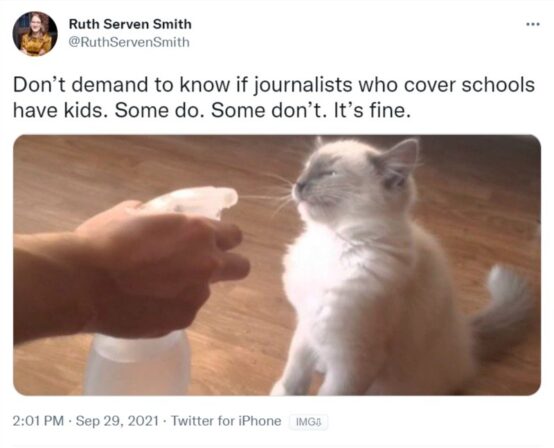
A few days ago on Twitter, I set off a discussion about parenting and education journalism:
“Don’t demand to know if journalists who cover schools have kids,” I wrote. “Some do. Some don’t. It’s fine.”
The responses came, fast and furious — many of them from education journalists and educators.
My initial thought was that “I don’t mind it if it’s part of a normal conversation; people naturally lean on personal questions.”
After thinking about it for a few days, I still believe it’s fine for sources to ask. Reporters may want to answer, particularly if they’re open about their partners, children, or other parts of their personal life.
But I don’t plan to do so, because I think most reasons for asking and answering are too intertwined with problematic ways we treat women, parents, and children in society.
I still believe it’s fine for sources to ask. Reporters may want to answer, particularly if they’re open about their partners, children, or other parts of their personal life. But I don’t plan to do so.
Reporters are used to asking people potentially intrusive questions — and sometimes fielding personal questions in return.
Until I moved to the South, I don’t remember being asked if I had children, as part of work or during casual conversations. Maybe it’s because I can still blend in with college students if needed.
Recently, though, the kids question has come up in several formats related to my work — during in-person conversations, as part of interviews, and during several interactions on social media.
One instance was perfectly fine and normal: A mom, talking about their child’s nervousness about COVID protocols, asked if I had a kid in a school in the area. I said I did not and we moved on.
Other instances, though, have been less friendly and have been phrased as a challenge, rather than a request for context or common ground. None have crossed the line into harassment, but other instances of being harassed online and in-person for my work probably factor into my wariness.
This summer, a man called to talk after a routine story about a school considering dropping the name of Robert E. Lee. He asked if I grew up in Alabama, and I said no. He asked if I had kids in schools, and I said I didn’t think that mattered.
He continued to press, until finally I asked why he thought being an alumni of that particular school, or a different school in Alabama, or having kids at all, mattered. Had I gotten something wrong in the story?
Up until this point the conversation was cordial, but then it turned; the assumption that I was childless also seemed to lead to other negative assumptions about my politics and role in society. He felt free to ask me personal questions and make assumptions, but when I asked his name, he hung up.
Up until I was thinking about this column, I hadn’t even grouped that interaction into negative reader feedback. Considered against other issues I’ve had to report to authorities, it was pretty calm. It’s certainly milder than issues women of color, LGBTQ journalists, and parents face every day — but I do think it’s one example of how blurry the lines can be between personal and professional personas.
Up until this point the conversation was cordial, but then it turned; the assumption that I was childless also seemed to lead to other negative assumptions about my politics and role in society.
If I were a parent, I would be proud to be one. But a brief stint working for an employment lawyer in 2020 brought home to me that discrimination based on gender and pregnancy, which are protected classes, and parental status, which is typically not, is still rampant in our culture.
Intrusive questions aren’t just an issue in a workplace setting; how we, as a society, talk about being a parent and who is expected to care about and for children have broader implications. After Tweeting about it, I followed up and asked a few other journalists if they had thoughts.
Madeline Fox, a reporter for Wisconsin Public Radio, said her stock response is “No, but I have children I care about.”
“I’d just say generally that it absolutely depends on context,” she told me later. “We ask people a ton of questions, many of them very personal, in interviews, so I think it’s only fair when people ask me if I’m a parent in that context.
“I do feel a little defensive when it comes up because I think it is a question that comes up in bad faith as a way to be dismissive of (especially female) education reporters who don’t have kids,” she said.
“I think it is a question that comes up in bad faith as a way to be dismissive of (especially female) education reporters who don’t have kids.” – Reporter Madeline Fox.
As with several similar questions related to family in our culture, any answer — whether to a source or in a job interview — tends to put women in particular in a double bind.
Do you disclose that you have kids and risk people thinking you have one foot out the door to becoming a stay-at-home parent? Or say no, and risk people thinking you also have one foot out the door to the next job?
Education journalists may be more likely to encounter this question from sources than folks on other beats. We work with children, and, while women make up roughly 40% of news media employees, they constitute 65% percent of education journalists, according to the latest report from the Education Writers Association.
One of my former editors, Aaron Richardson, said he only got challenged once or twice when he covered education and typically responded that he too had once been in school.
“Parents often quite rightly assume that being a parent is the highest level of being able to critique education, and they wrap up how much they love their kids with everything their kid interacts with,” he told me later.
“But I don’t think I need to be a parent or even have an interest in being a parent to know how schools work and have an interest in making them better.”
He said he believes women are more likely to be the target of pointed questions.
“It just generally goes with how people view women in any job they’re in,” he said. “Women get unfair double standard questions no matter where they’re at.”
I also checked in with a reporter on my team, Trisha Powell Crain, who is a parent and got started in journalism by way of advocacy at her children’s schools (an experience that is super valuable).
She said she “truly never gets asked” if she has kids in schools during her reporting and suggested her age when she started writing for formal news outlets may be a reason. Her daughter, who is a teacher, does get asked if she’s a parent.
It also seems possible that some of the character traits associated with female teachers — nurturing, empathetic — also get patterned onto people who spend a lot of time in schools for other jobs.
I wasn’t able to find much research available online about the perceptions of parents who are, say, teachers and pediatricians, and whether women who are parents in those roles are seen as more or less effective at work; some research has been conducted among mother-teachers in Israel and the United Kingdom.
Doctors, unsurprisingly, say it’s incredibly hard to be a parent and manage workplace expectations. There are also reports of people who are child-free and are expected to pick up the slack at work — though I think those often operate from a false baseline of how much work other employees actually do as well as how much time women who are parents typically put into housework and childcare duties.
Parents are great and have huge insight into all corners of work and society. But I don’t need to be one to be a good journalist who cares about the well-being of families and children.
Parents are great and have huge insight into all corners of work and society. If I ever become one, I’m sure it will change and shape the way I think about my work. But I don’t need to be one to be a good journalist who cares about the well-being of families and children.
In this regard, I agree with U.S. News’ Lauren Camera, who wrote a piece for The Grade not too long ago saying that she didn’t think being a parent makes her a better education journalist.
One last point: I’ve talked to countless parents who have related just how stressful the last two years have been. I understand why some parents may want to know if a journalist is a caregiver before getting into personal decisions about childcare, schools, masks, vaccines, and other COVID decisions.
That type of question, though, is actually relevant to the topic at hand and is one of the situations in which I think some give-and-take about the reporter’s own experience and life is only fair.
Previously from The Grade
On motherhood and education journalism (Lauren Camera)
Covering communities that are not your own (Lee Romney)
11 reporters share their own back-to-school decisions
Parents, here’s how to talk more effectively with reporters (Amy Silverman)
ABOUT THE AUTHOR

Ruth Serven Smith
Ruth Serven Smith is the editor of the AL.com Education Lab. She’s also a proud Okie. and an alum of @mujschool. You can follow her at @RuthServenSmith.