|
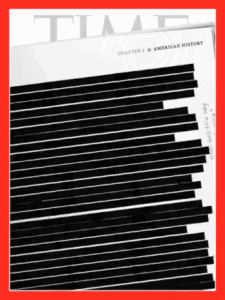
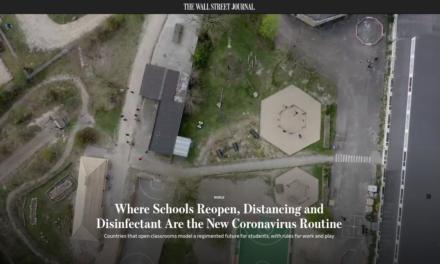
Above: TIME Magazine’s latest cover story tackles the big education story of the day: Inside the Fight Over What Kids Learn About America’s History by Olivia B. Waxman.
📰 “NEEDLESS SUFFERING” FROM REMOTE LEARNING: Slowly but surely, reporters are inching toward deeper questions about the risks and impacts of last year’s school shutdowns. Last weekend, NPR’s Lourdes Navarro asked now-former Biden COVID guru Andy Slavitt about “needless suffering” from prolonged systemic school closings. “I mean, yes, 600,000 Americans dead — it’s a colossal, unfathomable number,” said Navarro. “But in addition to that tragedy, was there also a lot of needless suffering? I’m thinking about school kids and parents who are wondering if schools really needed to be closed so widely. I mean, should they have been?”
📰 GUN VIOLENCE AND REMOTE LEARNING: I don’t want to do anything to exaggerate school gun violence (which remains rare) or to overstate any possible connection between school gun incidents and prolonged remote learning (which is unproven), but the Post’s John Woodrow Cox is reporting that this spring saw a small but notable surge in school gun incidents that could be related to the prolonged school shutdown. “The boy had unraveled during the pandemic, as had so many other children across the country,” writes Woodrow Cox about one student who brought a gun to school and shot it off, hoping to be killed. “His family had moved to a new home, leaving behind the friends he’d made in their old neighborhood. He’d finished elementary school on a computer screen and started middle school the same way.” Worth exploring.
📰 HOW TO INTERVIEW KIDS: Some great insights from education reporters for interviewing kids and including them in your stories: “1. Leave your pride at the door,” tweeted former Houston Public Media education reporter Laura Isensee, riffing off advice she recalled from NPR’s Cory Turner. “2. Actually listen 3. Remember the goal is to capture kids as kids.” Isensee added, “you’re there to listen and really are interested in what they are saying, you’re not just eavesdropping.” Added former Texas Tribune education reporter Aliyya Swaby: “I’ve heard some reporters lament that kids, especially younger ones, are not ‘quotable.’ Which often means they don’t talk like adults. And duh! They’re not adults. That’s why you’re talking to them.” Check out the whole thread!
📰 A RACIAL RECKONING IN EDUCATION REPORTING? “I think the field of journalism needs to diversify its ranks across the board in order to improve reporting on issues about race in education,” Black Education Research Collective director and Columbia University professor Sonya Douglass Horsford told me via email in response to a query about last week’s much-discussed Casey Parker story about Black homeschooling in the New Yorker. “There is an entire perspective missing from dominant coverage of educational inequality and it will require a racial reckoning and awakening in education reporting to change it, whether Black homeschooling or another other education practice, policy, or issue.” You can follow her here.
📰 OSTER PROFILE HIGHLIGHTS NYT CHALLENGES: I won’t belabor the point, but this week’s New York Times profile of Emily Oster failed to give sufficient credit to the Brown economist for her prescient efforts to consider school reopening and contrasted sharply with reporter Dana Goldstein’s previous profiles of teachers union head Randi Weingarten crediting her with much and criticizing her for little. This is not the kind of education journalism that we need from one of the nation’s top news outlets.
Did someone forward you this newsletter? You can sign up here.
|
PEOPLE, JOBS
Who’s going where & doing what?
|
|
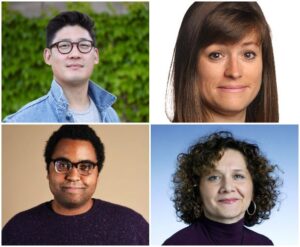
| ABOVE: Clockwise from top left, CALmatters’ Joe Hong, Politico’s Jessica Calefati, Chalkbeat’s Mónica Rhor, and the Washington Post’s Emmanuel Felton.🔥 New hires: CalMatters has a new K-12 reporter: Joe Hong, who previously covered education for KBPS and the Desert Sun Media Group in California. For his first story for CalMatters, he wrote about record enrollment in summer school and asked, is it enough? Philadelphia Inquirer investigative reporter Jessica Calefati is returning to the education beat, joining Politico to report on higher education. In a personal essay introducing herself as Chalkbeat’s newest story editor, Mónica Rohr writes: “How, I often wondered, would my parents have weathered a year like this when I was in elementary school? Would I have been one of the kids holding on by a thread?” Congrats to former Spencer fellow Emmanuel Felton who will be the new race and ethnicity reporter at the Washington Post and is still working on his book about the experiences of Black children being bused to white schools outside Boston.
🔥 Jobs: The Wall Street Journal is hiring a national K-12 reporter to replace Tawnell Hobbs, who is now a senior writer working on special projects, education editor Chastity Pratt tells us. And BuzzFeed is looking for someone to fill Felton’s shoes on the inequality beat now that he’s headed to the Post.
🔥 Bad news! The Wall Street Journal’s Leslie Brody, who has covered New York City metro education issues for several years, was among those who lost their job when the paper axed the Greater New York team this week. “It’s been a great ride, with a fun, savvy, spirited bunch of colleagues who always pitched in to help each other,” Brody told us. “It’s a shame to see the team disbanded.”
🔥 Standing with Sawchuk: As noted by colleague Andrew Ujifusa, the outpouring of support for EdWeek’s amazing Stephen Sawchuk has been great to see. Sawchuk described receiving horrible antigay comments in response to a video explainer he did recently. “I know this is all part of the game, but it really hurts, and it really bothers me,” he wrote. Read supportive comments from other education journalists and add your own.
🔥 Parting wisdom: “Long hours tweeting from the back of a school board meeting don’t win awards, but as an education reporter, you’ll see the actual impact of your work on the schools and students you cover,” KCUR education reporter Elle Moxley tells us. After seven years at KCUR, Moxley is moving on to work for Kansas City Public Schools. Her advice for education reporters? Join EWA; learn the history of desegregation in your district; take time to engage with parents, community leaders, and teachers, and do your research on housing policy. She also told us the story she’s most proud of is The Goodbye Kids, cowritten with Barb Shelly about kids who switch schools frequently. |
|
|
EVENTS
What just happened & what’s coming next?
|
|
| ⏰ Yes, that was friend of education journalism Tyler Kingkade on NPR’s Fresh Air just the other day, talking about his investigation into the forces behind the current critical race debate.⏰ Join Clubhouse on Sunday, June 27, for a discussion of the condition of public schools. Register here. If you missed yesterday’s critical race theory webinar from EWA, there’s video soon! Catch up on EWA Radio’s Lessons from the Educational Equity Beat here.
⏰ Attention, young journalists! Apply to be part of NPR’s NexGenRadio. The project offers five days of training in digital and audio journalism. Some will be in-person and some online this year. The first deadline to apply — for OPB in Portland — is tonight!
Did someone forward you this newsletter? You can sign up here. |
|
|