0
(0)
This is an archive of the weekly newsletter. Go here for the original, complete with images.

REOPENING POLITICS

The best education journalism of the week

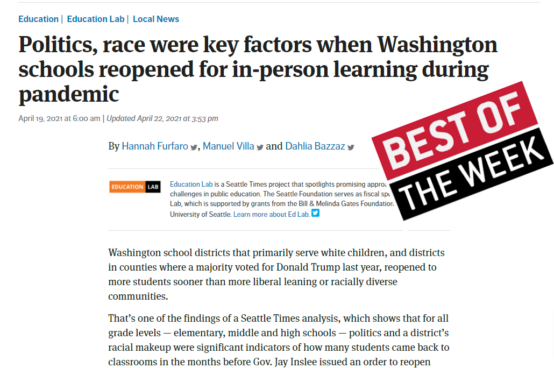
🏆 The best story of the week is the Seattle Times’ Politics, race were key factors when Washington schools reopened for in-person learning during the pandemic. Written by Hannah Furfaro, Manuel Villa, and Dahlia Bazzaz, it details how areas of the state with stronger unions and weaker support for Donald Trump were much more likely to use remote learning — and how disconnected reopening decisions were from COVID death rates, “suggesting that health indicators didn’t always drive decisions.”

While this story is familiar, the Seattle Times’ version features insights from around the state, along with national experts and data from a number of studies. It also makes an attempt to get a response from the teachers union — appropriate given the political nature of the dynamic being described. Strong work.

To get daily education headlines and education news events, follow @thegrade_.

STORIES OF THE WEEK
This week’s big stories for K-12 education include school reopening successes and struggles, enhanced summer school planning, and frantic efforts to make use of massive federal aid:

🔊 Opening schools increases parent comfort with in-person learning, study says. (NYT)🔊 Virtual to in-person school: We followed a teacher to see how it’s going (USA Today)

🔊 D.C. expanding in-person learning. But most of the new seats will be in the wealthiest schools. (WP)

🔊 Students face ‘Zoom in a room’ after 500 teachers and aides win medical exemptions (SF Chronicle)

🔊 Some San Diego schools use “overflow” rooms to fit in students learning in-person (Union Tribune)

🔊 School board goes ‘nuclear,’ tells teachers to return to classrooms April 29 (East Bay Times)

🔊 Parents are powerless’: Students face being held back after a year of remote learning (Politico)

🔊 As the school year ends, many districts expand summer school options (WP)

🔊 Biden’s mammoth education agenda would expand the federal role from cradle to college (WP)

🔊 How San Diego’s 10 Largest Districts Spent Millions in Coronavirus Aid (VOSD)

For other big stories this week, see Media Tidbits two sections below.

HOW SCHOOLS TREAT KIDS LIKE ADAM
New from The Grade
Adam Toledo’s death is a tragedy — and it’s also an education story. A month after his death, we should know more about how he was treated by the schools he attended than we do.

I’m hoping someone will cover this story, and so I pulled together some questions about Adam Toledo’s education, including how many different schools did he attend and was his IEP appropriate and being implemented?

These questions are all the more important given the well-known school-to-prison pipeline and the fact that Chicago is under corrective action for failing to provide adequate SPED services to kids like Adam.

For previous examples of this kind of reporting after a police shooting of a young BIPOC person, consider Dana Goldstein on Michael Brown’s high school or Laura Meckler on George Floyd’s experience of high school.

MEDIA TIDBITS

Thought-provoking commentary on the latest coverage.

Above: Thanks, The Atlantic. Now how about doing one about The School Super-Spreader Outbreak That Never Happened?

📰 GROWING COMPLAINTS ABOUT MEDIA HYPE: There’s a small but growing chorus of complaints about media coverage of the pandemic these days — both generally and when it comes to education. Over the weekend, HBO’s Bill Maher delivered a blistering critique of what he described as ‘panic porn’ that’s contributed to politicized school reopening decisions. Last week’s On The Media show from WNYC highlighted the “fuzzy math and misleading language” that has characterized vaccine side effects coverage, echoing an earlier NPR story about the problem of misleading vaccine death coverage. Last but not least, The Atlantic features writer Tom Bartlett questioning the surge of teen suicides that have been reported in the past year — in Las Vegas or anywhere else.

While potentially misleading stories may be few in number, the enormous numbers of pageviews and social media shares they generate can make them appear ubiquitous — and create an impression that the storylines are true. Two of the top ten most-shared school COVID stories of the past three months are about teachers dying of COVID, a relatively rare occurrence. The third-most shared story is about teen suicides in Las Vegas. “Just because the story is everywhere, doesn’t mean the risks are,” reminds OTM’s Breaking News Consumer’s Handbook.

📰 EXAGGERATING SCHOOL SELECTIVITY: It’s bad enough that NYC has such an obviously inequitable selective high school admissions system. What makes it even worse is that the New York Times and other news outlets have presented the district’s numbers in a misleading way that could be discouraging kids from applying, according to this new CJR piece from Columbia’s Samuel Abrams. “The tendency to exaggerate the selectivity of certain schools is ubiquitous in media, ensnaring not just the Times but also Post and, to a lesser degree, The Wall Street Journal, Philadelphia Inquirer, Washington Post, and Times-Picayune,” according to Abrams. “Why are you referencing the NYT when you mean DOE?” responded the Times’ Eliza Shapiro earlier this morning. “We use DOE data.”

📰 HEALING THE BREACH BETWEEN TEACHERS AND COMMUNITIES OF COLOR: The new docu-series from PBS called Philly DA focused on efforts to revamp criminal justice in Philadelphia raises the inevitable comparisons between cops, teachers, and their unions. The show, which begins with the election of a reform-minded district attorney in 2017, depicts many of the challenges that reform-minded school superintendents have faced, among them recalcitrance from inside the central office, community concerns about safety and the pace of change, and open opposition from union leadership.

Comparison between teachers and cops are nothing new, though most of the time they come from reformers and conservatives. Lois Weiner’s 2014 Jacobin piece is a notable exception, exploring some of the parallels between police unions and teachers’ unions from the left. “Healing the breach between teachers unions & communities of color means first admitting there is one,” wrote Weiner. “Teachers unions have to acknowledge the complicity of the education establishment in allowing segregated, unequal schooling.”

Asked what progress had been made since 2015, Weiner replied, “I’m inspired by the movement that’s arisen and won so many victories, yet see what’s not been done. We face chilling new dangers #unions must understand in order to protect BIPOC kids and communities.” Read more about that here and here. Or follow the reactions to Minnesota teacher Tom Rademacher’s recent comment that teachers aren’t any less racist than cops. The difference is that “we don’t carry guns and that our damage is done quieter and over the space of years.”

📰 NDA’s IN EDUCATION: Did you know that NDA’s (non-disclosure agreements) are used by districts to prevent parents from talking about the services that they’ve won for their children with disabilities? Me, neither. But that’s what I’ve been told recently, and it seems like a big, under-covered story that many parents (and taxpayers) would want to know more about. To get started, check out Laura McKenna’s story for The 74 and this CT Examiner story. Efforts have been made to limit the use of NDA’s in #MeToo cases. Maybe that’s something that should be considered for SPED cases, too.

PEOPLE, JOBS
Who’s going where & doing what?
Above: Yes, that’s The 74’s Linda Jacobson (bottom left). She’s everywhere these days.

🔥 Congrats to the Boston Globe’s Sarah Carr, who’s won an O’Brien Fellowship that will allow her to dig deep next academic year “on an education equity issue I’ve long been passionate about.” Congrats also to The Tampa Bay Times’ Kathleen McGrory and Neil Bedi, who were named 2021 Finalists in the Goldsmith Prize for Investigative Reporting for Targeted.

🔥 Job moves: Julianne Welby is now editing education at WNYC public radio, replacing longtime editor Patricia Willens, who’s now covering a bunch of other things. You can follow Welby here. Yasmine Saba Askari is now covering education for MinnPost. Follow her at @YasmineAskari. In case you missed it, AP has hired Annie Ma, based in Charlotte, North Carolina, to cover leadership, funding and access in education, “as well as what is taught in classrooms, to show the impact of inequity and the efforts to address it.”

🔥 New gigs: The 74 has just hired Marianna McMurdock as its 2021 Editorial Fellow beginning June 1. She’s an Ed Trust alum who’s based out of San Diego and Boston for the time being. You can follow her on Twitter @marianna221b. Chalkbeat Detroit alum Eleanore Catolico is going to be part of the Maynard Institute’s storytelling cohort this year.

🔥 Odds and ends: WAMU’s Christian Zapata is writing about racial disparities in special education for students with dyslexia in Fairfax County. “If any persons of color out there have a child currently taking special education classes please reach out!” Big congrats to Greg “Babbo” Toppo on the birth of his first grandchild.Did someone forward you this newsletter? You can sign up here. 

EVENTS
What just happened & what’s coming next?
Above: Just published: Jo Napolitano’s new book, “The School I Deserve,” is now out, and you can read an excerpt in The 74. Congrats, Jo!

⏰ Appearances: The Florida education journalism dream team of Scott Travis (Sun Sentinel), Colleen Wright (Miami Herald), and Andrew Marra (Palm Beach Post) were on WLRN not too long ago, talking about how prepared  South Florida schools are for a return to 100% of students this fall. The segment starts at the 28-minute mark. The Boston Globe’s Bianca VĂĄzquez Toness and Jenna Russell were on a panel about schools reaching vulnerable students like those depicted in their recent story about English learners who are new to this country.⏰ The 74’s Linda Jacobson was on a recent panel about dis-enrolled kids and how to get them back, hosted by PPI and Reinventing America’s Schools. Erica Green’s recent Yale SOME talk is now watchable via video replay. I’m told a transcript is in the works.

⏰ Upcoming: EWA’s national conference is coming up in early May, featuring “three half-days of conversations, training, and presentations.” Are you registered?


THE KICKER

“In many places with local QAnon officials, those sounding the alarm are teenagers,” tweeted TIME correspondent Vera Bergengruen, who wrote QAnon Candidates Are Winning Local Elections. Can They Be Stopped? “They’re so frustrated/baffled by why adults aren’t taking conspiracy theorists more seriously.”
That’s all, folks. Thanks for reading!

Reply to this email to send us questions, comments or tips. Know someone else who should be reading Best of the Week? Send them this link to sign up.

Using Feedly or FlipBoard or any other kind of news reader? You can subscribe to The Grade’s “feed” by plugging in this web address: http://www.kappanonline.org/category/the-grade/feed/.

Read more about The Grade here. You can read all the back issues of The Grade’s newsletter, Best of the Week, here.

By Alexander Russo with additional writing from Michele Jacques and Colleen Connolly.

ABOUT THE AUTHOR

Alexander Russo

Alexander Russo

Alexander Russo is founder and editor of The Grade, an award-winning effort to help improve media coverage of education issues. He’s also a Spencer Education Journalism Fellowship winner and a book author. You can reach him at @alexanderrusso.

Visit their website at: https://the-grade.org/

How useful was this post?

Click on a star to rate it!

Average rating 0 / 5. Vote count: 0

No votes so far! Be the first to rate this post.