|
| DEBATING SOCIAL DISTANCING REQUIREMENTSThe big education story of the week #1 |
|
WHAT’S “REOPENING” REALLY MEAN?
The big education story of the week #2 |
|
THE LOST YEAR
The big education story of the week #3 |
|
CNN HOST TREATS TEACHERS UNION HEAD WITH KID GLOVES
New from The Grade |
|
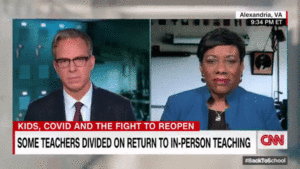
| During CNN host Jake Tapper’s recent interview with NEA head Becky Pringle (above), Tapper tried but failed to make the segment worthwhile. He let Pringle dodge his questions, bulldoze right through his fact-checking, and run out the time with long answers.Most of all, he failed to ask her sharp questions that might have yielded newsworthy results. Of course, CNN isn’t the only outlet struggling with how to cover teachers unions. Read my analysis here, including strategies for handling tough interviews and recommended questions. |
|
DISTURBING RESULTS WHEN A NEWSPAPER EXAMINES ITS SCHOOLS COVERAGE
New from The Grade |
|
| There is lots to admire about how the Kansas City Star reviewed its own flawed coverage of the district’s efforts to limit and roll back integration of the school system in the years after Brown, failing to hold local officials accountable.Don’t miss KC Star education reporter Mara Rose Williams’ scathing reporting that reveals the bias, missteps, and missed opportunities to represent all Kansas City stakeholders.
“There were no stories of the effects on Black families … No stories about how the decisions made in courtrooms and boardrooms affected their lives.” |
|
| MEDIA TIDBITSThought-provoking commentary on the latest coverage. |
|
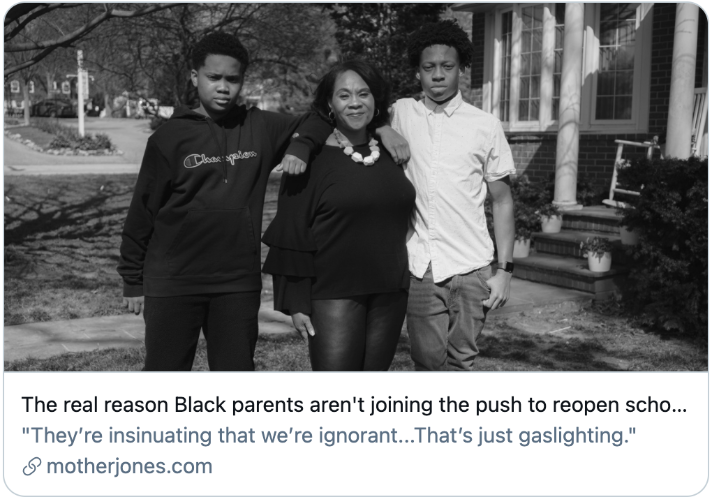
| 📰 TWO IMPORTANT PIECES ABOUT BLACK PARENTS AND SCHOOL REOPENING: The first is from Melinda Anderson in Mother Jones, describing decades-long mistreatment of Black kids by school systems. “What sets so many Black parents apart is the acute distrust underlying their doubts—doubts shaped by generations of racial discrimination and institutional inequality,” writes Anderson. The second is from Ohio State’s Vladimir Kogan, who finds a dramatic effect on parents’ views of reopening depending on whether it’s being offered by their schools. “When schools reopen, public opinion changes,” according to Kogan. “More than 40 percent of those who had initially said they wanted to keep their child home came around when their own school ultimately reopened.” Providing access to reopened schools will reduce but not eliminate Black reluctance to sending their kids back, according to Kogan.📰 SUCCESS STORIES: Reopening in a pandemic isn’t easy or without risk. But a handful of recent stories show how it’s being done. These include How One Ohio School District Bridged the Divide and Reopened Classrooms and Florida Schools Reopened Without Becoming Covid-19 Superspreaders, both from the Wall Street Journal. “School reopenings ended up being safer than many feared,” said Andrew Spar, president of the Florida Education Association, a teachers union that unsuccessfully sued Florida to try to stop the executive order. Another success story: Northern California’s largest school district is reopening campuses. How they did it in the Sacramento Bee.
📰 NEW REOPENING INFO AT NEXT WEEK’S SUMMIT: As US News’ Lauren Camera and others have noted, the lack of accurate data about reopening has been a thorn in everyone’s side for months now. So what new information will reporters get at the U.S. Department of Education’s National Safe School Reopening Summit on Wednesday? I’m told that the first wave of school reopening survey data will be available, and it will give us information on three different kinds of reopening: remote, hybrid, and full-time in person. The survey will also tell us what percentage of students are receiving less than one day, one to two days, three days a week, four to five days a week, or no actual in-person instruction. But we won’t learn the number of minutes or hours of in-person instruction that kids are getting, and the USDE survey won’t provide information about the form of the in-person instruction (i.e., how much is in-person teaching and how much is Zoom in a room with the teacher remote). Here’s the survey instrument with questions about the amount and type of instruction being provided. |
|
 |
PEOPLE, JOBS
Who’s going where & doing what? |
|
| Above: Shout-out to local journalists John Woolfolk (left) at the San Jose Mercury News and Michael Elsen-Rooney at the New York Daily News, who are both putting out a lot of good stories lately, looking for the right stuff and holding everyone accountable.🔥 You should also follow Samantha Douty at the Victoria Advocate, who gets a lot of praise from her fellow Texas ed reporters. And check out the Pennsylvania-based Morning Call’s three-part series on one district’s handling of education in the pandemic, from the student exodus from public schools to how private schools kept their doors open to a rise in homeschooling.
🔥 When veteran journalist Jenny Anderson switched from covering Wall Street to education she was “shocked how little the world cared.” She hopes the pandemic changed that, but I’m not so sure.
🔥 Longtime education writer Linda Wertheimer tweeted about an education story that she says is going uncovered in the Boston area: the challenge of implementing a quick two-week turnaround from remote to in-person schooling.
🔥 Texas Tribune reporter Aliyya Swaby is leaving her post. She tweeted: “I’ve loved covering #txed and I’m thankful to all who shared vulnerable stories and helped me decode policy.” Congrats to her, tears for us. She says that the outlet is going to hire another education reporter. No word on what she’s doing next.
🔥 “If it’s not good for the kids, it’s not good.” That’s SF Chronicle reporter Jill Tucker’s self-described guiding principle. Others might not, but I tend to agree.
Did someone forward you this newsletter? You can sign up here. |
|
EVENTS, DEADLINES, APPEARANCES
What just happened & what’s coming next? |
|
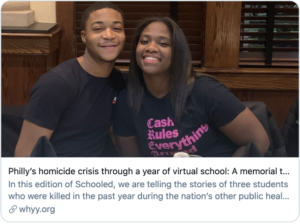
| Above: WHYY is out with a new podcast on Philadelphia’s homicide crisis through a year of virtual school. “I really don’t think that he would have been killed if they were at school,” one mom said.⏰ KPCC education reporter Kyle Stokes was on NPR last week to talk about LAUSD’s reopening deal. And WNYC’s Jessica Gould was on a half-hour segment on Monday looking back at the year for NYC schools.
⏰ A handful of outlets including AL.com, the Dallas Morning News, and the Fresno Bee partnered with the Solutions Journalism Network to produce a series called “Learning from Lockdown.” Some standouts? The Christian Science Monitor’s Sarah Matusek writes about the legacy of remote learning, the Dallas Morning News’ Emily J. Donaldson describes districts learning from each other. Check it out. They’re having a virtual event for it on March 31.
⏰ Want $5K for one feature story? The Hechinger Report seeks partnerships with local newsrooms in the West. Deadline: April 11. Details here.
⏰ Part 2 of The Daily’s Odessa series — this one on the Texas high school’s football team and marching band — is out. Look for Part 3 soon.
⏰ EWA is holding a webinar Tuesday on how to use a new data tool that reveals disparities in school spending, with EdWeek’s Daarel Burnette II and WSJ education editor Chastity Pratt.
⏰ Books! Amanda Ripley’s new book “High Conflict” is coming out next month and will also be available as an audiobook. |
|
 THE KICKER THE KICKER |
|
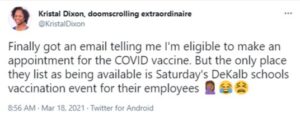
| Good news and bad news for Atlanta Journal-Constitution education reporter Kristal Dixon. Who else is getting their vaccines this week? |
|
| By Alexander Russo with additional writing from Michele Jacques and Colleen Connolly. |
|
|
|
|
|
|