Some Bay Area news outlets can’t figure out what to do with a viral video accusing a teachers union leader of COVID hypocrisy.
By Alexander Russo
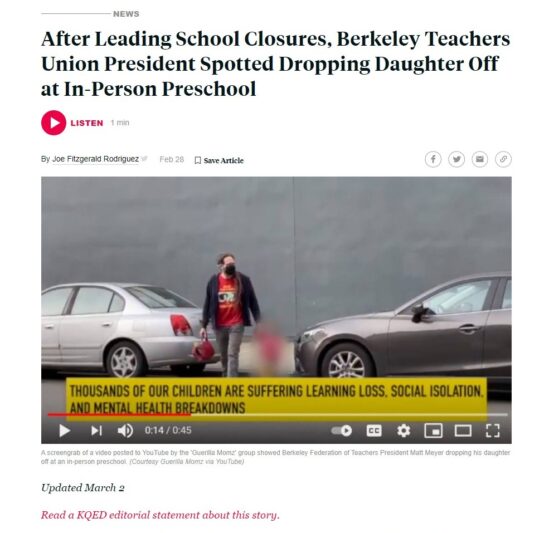
On Sunday, an anonymous group of parents released a video alleging to show the leader of the Berkeley Federation of Teachers walking his kid to a private in-person preschool.
The video denounced the union leader for hypocrisy because district schools remain shut in part because of union safety demands. It quickly started to go viral on outrage-loving Twitter and YouTube and was then picked up by news outlets once the union leader confirmed his identity.
However, the resulting news coverage created intense debate over whether the union leader’s decision was indeed hypocritical — and whether covering the video was journalistically appropriate.
Was the union leader (a teacher) a public figure? Was it appropriate to publish an anonymous attack ad? Was his school choice decision relevant? Was the video an invasion of privacy, doxxing, or stalking?
While I have some concerns about the anonymity of the group that produced the video, it seems obvious that the story is worth covering, and that the video is at the heart of the story. The head of the union has been a public figure opposing the reopening of schools. His actions are a matter of public interest.
Sure, the video puts his actions in the worst possible light. But nobody’s privacy is being invaded. Reported properly, with identities and facts confirmed – including some effort to establish the legitimacy of the anonymous group – the video illustrates the increasingly heated discussions over which kids get in-person schooling.
Above: The controversial video
Nonetheless, two local outlets are addressing the topic in strikingly different, somewhat puzzling ways:
After originally reporting the video on Sunday, KQED public radio stripped the embedded video from its original post and added a contradictory editor’s note.
That same day, the nonprofit Berkeleyside outlet posted a long explanation saying that it knew about the private preschool situation long before the video but didn’t think the story was newsworthy and wouldn’t be covering it.
To me, neither approach is clear or satisfactory. KQED made the right decision to cover the story as responsibly as it could, but confused matters by removing the video the way it did. Berkeleyside’s belated explanation for not covering the story is incoherent and unconvincing (and has the contradictory effect of, well, covering the story).
Rather than making a strong, clear journalistic decision and sticking with it, KQED and Berkeleyside seem to be splitting hairs and making a mess of things. It’s a story. You should cover it. Or don’t. But don’t try to have it both ways.
These decisions illustrate a chronic challenge for education journalism, which sometimes seems confounded by heated criticism with no consensus viewpoint.
Rather than making a strong, clear journalistic decision and sticking with it, KQED and Berkeleyside seem to be splitting hairs and making a mess of things.
For a breaking news story produced on a weekend, the original KQED piece has a lot of strong points. It confirms the union leader’s identity. It’s clear and specific about the facts. And it features a broad variety of opinions and perspectives.
“In a breaking news situation like that, it’s a delicate balance between providing as much context as possible and publishing the story as quickly as possible,” said KQED’s Joe Fitzgerald Rodriguez, who worked on the story with the help of education reporter Vanessa Rancaño and others.
It also featured a screencap from the video as the top image and embedded the video in the body of the story.
Fitzgerald estimates that the team spent three or four hours reporting the piece before publishing “to take a little more time to get more voices.”
But he couldn’t tell me how the decision was made to run the story in the first place, or what if any concerns editors may have had from the start. “You need to ask my editors about that,” he said.
Eventually, I would have the chance to do that – and would be surprised by what I heard.
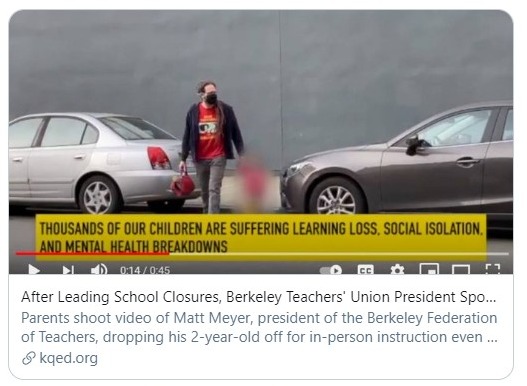
Above: KQED’s original story, with the editorial statement included and the video removed.
Over the next two days after the KQED story went live, many local outlets followed suit – including the San Jose Mercury, SF Chronicle, local TV stations, and a smattering of national outlets.
However, it turns out that KQED was not satisfied with how its story was being received.
On Tuesday, the station posted a link at the top of the story to a two-paragraph editorial statement declaring that the situation depicted in the video was newsworthy and that the reporting it had produced was solid, but that the embedded video “didn’t add to the journalistic value of the story” and was being replaced with a link.
“We erred in embedding it in the first place,” noted the statement.
To me, this was an unnecessary, unsatisfactory action to take, raising as many questions as it answered. If the parent’s actions are newsworthy and the reporting is solid, then why isn’t the video of him in action also newsworthy?
Also, the story doesn’t really exist without the video, which prompted the coverage in the first place. And the reported story isn’t all that much changed by removing the embedded form of the video but leaving up a screenshot and a link. The video is still there, just hidden away.
This kind of hair-splitting decision doesn’t really change anything or satisfy anyone, though it does protect the journalists who reported the story originally rather than hanging them out to dry.
This kind of hair-splitting decision doesn’t really change anything or satisfy anyone, though it does protect the journalists who reported the story originally rather than hanging them out to dry.
What motivated KQED’s decision to take this action?
In most cases, a news outlet posts a statement defending the newsworthiness of its story and the quality of its reporting in response to criticism. And in this case, KQED’s editorial note admits to having embedded the video in error.
But the action wasn’t taken in response to outside criticism, according to KQED managing editor for digital Julia B. Chan, who spoke to me Wednesday afternoon.
The video was removed, Chan said, because it was too much of a focus for readers. “The outcome we saw due to publishing the story with the video embedded was that the conversation became about the video and the narrative that it contained,” she told me. “And we did not want to amplify that; we wanted to get the journalism in front of people.”
I’ve never heard this rationale before, and Chan couldn’t say if removing an embedded video from a reported story was something that KQED has done in the past. But from Chan’s perspective, the story still stands without it. It’s not gone. It’s still available to anyone who wants to see it. But the focus is more squarely placed on all the quotes and context that are provided.
“I don’t feel like the story, as it is now, is missing anything [without the video embedded],” she said.
“The outcome we saw due to publishing the story with the video embedded was that the conversation became about the video and the narrative that it contained,” KQED’s Julia B. Chan told me. “We did not want to amplify that; we wanted to get the journalism in front of people.”
I get what she’s saying, but I don’t entirely buy it. Maybe in a different world the story would have published that way originally – with a link but no video – and I wouldn’t be so bothered.
But that’s not the way it happened. The original story appeared with the video, inspired by the video. It was read and reacted to and criticized to some extent. On Wednesday, KQED published a follow-up story about the negative reaction to the video, without mentioning its own role in amplifying the video then removing it.
Then again, at least KQED reported the story.
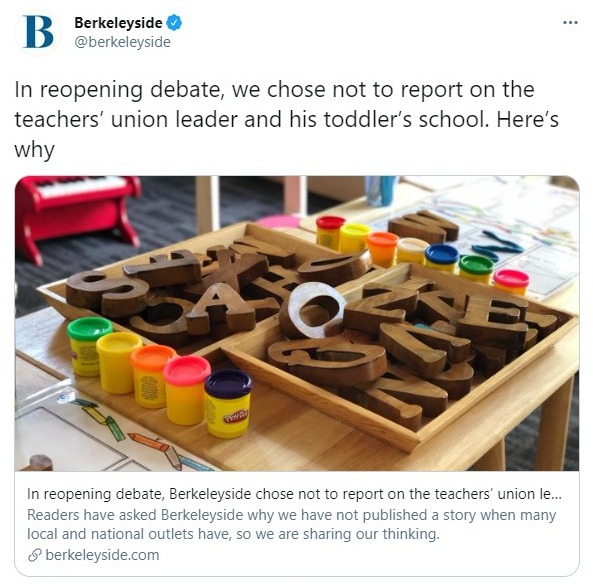
Above: Berkeleyside’s explanation for why there was no story.
After two days of silence, Berkeleyside posted an explanation in which it claims to have known about the situation for a month but refrained from writing about it because it wasn’t – and isn’t – a story.
Some of the reasons cited include family privacy concerns, the teacher’s status as a private individual (not elected to public office), and the lack of a direct parallel for the private preschool chosen by the teachers union leader for his child. (This last part is in some dispute, but I’m not going to go into that here.)
In its clearest declaration, Berkeleyside declares that it does not “see this situation as the union president seeking out special treatment for his child while denying education to other children. We did not see any hypocrisy here.”
Then Berkeleyside cites a district statement about the video claiming that it invades personal privacy and a statement from a parent reopening group criticizing the video.
The invasion of privacy arguments are easily dispensed with. Ditto for the notion that the union leader isn’t a public figure whose family decisions are fair game for media coverage. And the idea that there’s no hypocrisy being exercised in the video seems wafer thin, too. Most of all, by writing about the nonstory it claims to have known about all along, Berkeleyside seems to be trying to have it both ways. Either it’s a story or it isn’t. Berkeleyside undercuts its own decision while attempting to defend it.
By writing about the nonstory it claims to have known about all along, Berkeleyside seems to be trying to have it both ways. Either it’s a story or it isn’t.
Attack ads like this one are a challenge for any newsroom to deal with, and aren’t especially common for education reporters to encounter except in places like Los Angeles where ads and flyers are common.
However, neither news outlet’s actions wash with me. KQED wants to report the story but disavow or distance itself from the video that inspired the story — and to claim that it’s doing so because the video is distracting to readers. Berkeleyside wants to ignore the story but get credit for having done so.
But the larger point is that these muddled decisions are distracting to readers and take attention away from the underlying issue. We need clear, strong decisions from news outlets. That’s not what we’re getting here.
ABOUT THE AUTHOR

Alexander Russo
Alexander Russo is founder and editor of The Grade, an award-winning effort to help improve media coverage of education issues. He’s also a Spencer Education Journalism Fellowship winner and a book author. You can reach him at @alexanderrusso.
Visit their website at: https://the-grade.org/