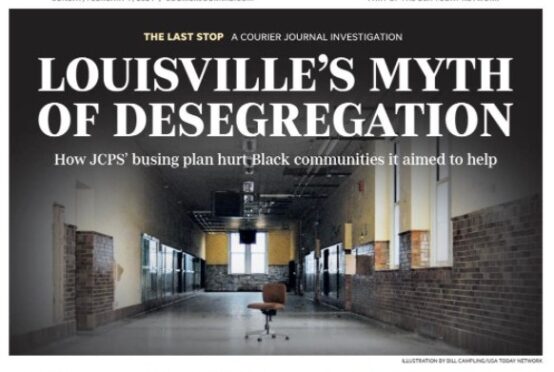
The nation’s most widely praised school integration effort goes under the microscope in an ambitious new series from the Courier Journal.
By Alexander Russo
What’s it like to report and write a series raising profound questions about one of the most highly touted school desegregation efforts in the nation – during a pandemic, in the wake of the Black Lives Matter protests, while school remains closed?
It’s not easy, that’s for sure. But that’s what the Louisville Courier Journal’s Mandy McLaren and Olivia Krauth pulled off last month, producing The Last Stop: Louisville’s flawed busing legacy may be near its end.
Like This American Life’s iconic “The Problem We All Live With” and last year’s “Nice White Parents,” this new four-part series will remind you that school integration efforts, no matter how well intended, face an uphill battle and often fail to produce the intended results.
“If a school district wants a quality, equitable education for all students and wants meaningfully integrated — not just diverse, but integrated — schools, it will require a sacrifice of white families,” said Krauth.
In the following interview – edited and condensed for clarity – McLaren and Krauth explain how they reported and wrote the story and what they learned.
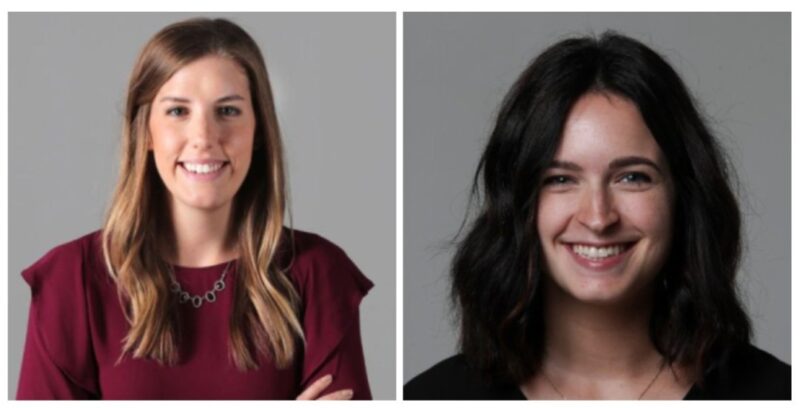
Above: Mandy McLaren (left) and Olivia Krauth (right)
What led you to embark on this ambitious series in the middle of the pandemic?
Mandy McLaren: This is a project that the newspaper has been wanting to do for years. And we had intended on launching into the reporting after last year’s legislative session ended — right around the time that the pandemic hit. So that obviously did not happen.
But one thing that’s important to understand is that yes, here in Louisville, we’ve been grappling just like everywhere else with what the pandemic means for schools, but we’ve also been under the spotlight due to the Breonna Taylor case, and all of the fallout that’s come with that. It’s not just about this woman who was killed; it’s about how the Black community, and, in particular, the West End, has been treated, from housing to education, jobs, health care — everything. The summer was a tipping point for where to put the resources.
What if any previous experience with school deseg efforts did you have, as a student or as a reporter?
Olivia Krauth: None as a student. I’m from northern Kentucky where an oversaturation of tiny independent school districts keeps schools relatively segregated along lines of class (northern Kentucky is relatively white). As a reporter, I covered busing and student assignment in Louisville at my job before moving to the Courier-Journal.
McLaren: After graduating from college in 2009, I moved to New Orleans, a city that is roughly one-third white. I saw firsthand, day after day, what resources and support my African American students received — or didn’t. I eventually chose to return to journalism and during grad school in D.C. was fortunate to work alongside then-education reporter Emma Brown, who had already done phenomenal reporting on school segregation at the Post. We didn’t get to pull off a big project, but I was able to report on segregation in DCPS, as well as pursue a story close to my heart — the role of charter schools in today’s school segregation debate.
We’ve been grappling just like everywhere else with what the pandemic means for schools, but we’ve also been under the spotlight due to the Breonna Taylor case, and all of the fallout that’s come with that. – Mandy McLaren
Lots has been written about segregation and integration, in Louisville and nationally. What did your series find that echoed or differed from what people have been writing before?
Krauth: I think so much of the coverage locally in the past has been, “Look at the diversity, look at the diversity. We’re so diverse, look at us go!” The reality of the situation for the students that have to be quote-unquote “bused” was largely missing from that conversation.
Why should readers care about the long commute that West End students face, if the end result is a quality education?
McLaren: West End students largely aren’t getting a “quality” education at the other end of their long bus rides, if academic and behavior data are the indicators we are using to judge that. But to the broader question here, I would say to people that this story is about dignity — who in this system is given the dignity of choice, and who is not.
Krauth: Readers should care because West End students, whether they stay in the underinvested schools in their community or leave for schools that may not make them feel welcome, are rarely getting the education they deserve.
Readers should care because West End students, whether they stay in the underinvested schools in their community or leave for schools that may not make them feel welcome, are rarely getting the education they deserve. – Olivia Krauth
How do you report a story like this in the middle of a pandemic when schools were closed?
McLaren: How do you report this project that is very emotional at its essence? It’s about your children and where you feel comfortable sending them to school. How do you evoke that in your reporting in the middle of a pandemic, when everybody’s at their houses? So that was sort of the thinking early on for identifying for story number one, the Shawnee football team over the season, because it felt like a very concrete example of how that school has been affected by the integration plan and how it’s really just stunted their enrollment.
What particular moment or detail from the series are you most proud of?
McLaren: One that stands out the most to me was, how they have this school from a white county refuse to come play them, because they thought it was too dangerous to play in the West End in the middle of the Breonna Taylor protests. But then Jackson County, which is a very white county in southern Kentucky, they came out and said, we’ll come play you and we’ll do this to show that color doesn’t matter. Color does matter very much, as our reporting showed. But why that moment stands out for me is literally just being able to see these kids be happy and to feel like valued members of a community. So often they are ignored or asked about everything that’s wrong in their lives. It was memorable, to me, to see them finally just being able to be teenage boys proud of their accomplishments.
Krauth: I did not go outside much for this project; I did a lot more data, so my response is probably going to be visual centered: the driving route map that everyone’s loving the GIF of. That’s something that’s near and dear to my heart. I did not make that, but I researched the data for it and fought very hard for it. In addition, a quote from the fourth story on whether or not JCPS is giving up on integration stayed in my mind for a while. Robert Gunn, the principal of the W.E.B. DuBois Academy, said a lot of people call his students, who are predominantly Black and from low-income households, “at-risk.” He prefers to call them “at-promise.”
Color does matter very much, as our reporting showed. But why that moment stands out for me is literally just being able to see these kids be happy and to feel like valued members of a community. – Mandy McLaren
What did you do to make sure that you were producing journalism that you felt was standout high quality and didn’t contain blind spots or misrepresentation?
McLaren: I can start with the diversity of sourcing for this project. A lot of the past coverage I saw was centered around white families or even centered around white national experts. And I really wanted these stories to be told by the people that are most significantly impacted. So I spent the whole month of August metaphorically knocking on doors specifically to find Black parents, Black alumni, Black educators. Not all of the people picked up the phone, but the ones that did, like one of them, Crystal White, is one of the main parents focused in the third story.
You have to be intentional to find folks who are most impacted. They’re marginalized for a reason, right? That term means something. And so as a reporter, the onus is on us to do the extra legwork, to not just talk to the easiest person but to talk to the people who actually have the experiences that are going to illuminate what the problems are, and what the solutions are.
Krauth: It was a little bit trickier for me because my stories need to include the experts. And, of course, all the people who are determining how great this plan is working are white. And so it was always in the back of my mind to make sure we’re balancing this out, remember you’re a white woman covering an issue that you were never really directly impacted by.
Looking back at the coverage, did you get any sense of the adequacy of the integration coverage by the Courier-Journal in the past?
McLaren: We did not report explicitly on that. However, I think it’s important to reflect on whose voices we centered in past stories specifically in the aftermath of the 2007 U.S. Supreme Court decision. Cumulatively, it did feel as though a lot of the voices that were in those stories were white parents and white parents on the East End of the county. The overarching narrative became “these bus rides are really long, and a waste.”
One thing that was really quite depressing to me was how many times the Courier Journal has written nearly an identical package to this — to no subsequent change. It was depressing to see, “Oh, we’ve actually been reporting these problems for a long time.” Maybe now is the moment that the community is willing to see the problems and want to make change. I don’t know. We’ll see what happens. But I really don’t want someone to look back at our project in 20 years and say, “I can’t believe nothing came of this.”
It was always in the back of my mind to make sure we’re balancing this out, remember you’re a white woman covering an issue that you were never really directly impacted by. – Olivia Krauth
To what extent did reporting this series shift your own understanding of the JCPS deseg program and the chances of success these kinds of programs have?
McLaren: Before I moved to Louisville in 2017, all of what I knew about Jefferson County’s assignment plan came from national deseg experts and/or media. Continually, Jefferson County received glowing reports about its continued efforts to keep schools integrated, especially after the 2007 PICS decision. What I learned once I got here was a completely different story, as we emphasized throughout this project. Too often, conversations about school diversity in this community have happened without all the facts actually being laid out on the table.
Krauth: I think this series caused an existential crisis for me, in a way. By the end of the project, it was apparent to me that if a school district wants a quality, equitable education for all students and wants meaningfully integrated — not just diverse, but integrated — schools, it will require a sacrifice of white families. It will mean sending their kids to the West End and not just to the magnet schools they’ve made exclusionary. It will mean more systemic change to systems that have privileged white families, like housing patterns and investments to support Black businesses and wealth. But history has shown that white families are not willing to make those sacrifices.
What do you wish you’d known at the beginning of this process, or think that other education reporters should know before embarking on this kind of project?
Krauth: I wish I had project management skills. Mandy has worked on larger projects before, but this was my first big deal investigation. Neither of us really knew how to navigate the process of bringing in designers or news dev type of people, or who to contact when on that front. I also struggled at times with organization — I did much of the data for the project, but I prefer to handwrite my notes, methodology, etc. At some point, I got buried in notebooks and spreadsheets, so having a system mapped out beforehand would have been helpful.
McLaren: I think one of the biggest takeaways I would want to share with other reporters embarking on similar work is to put in the legwork to know your community’s history. Spend time in news archives. Talk to community elders. As ed reporters, think about how much time we spend on reporting disparities, achievement gaps, etc. Yet, year after year, we see no change. I truly think it is our duty to lay out for readers in excruciating detail how we got to this point — how decisions over decades, largely made by white people, have perpetuated generational poverty in the Black community. By weaving together the historical thread, and showing how it directly contributed to the achievement outcomes we see now, I believe there’s a greater chance for today’s leaders to finally bring about actual, impactful and lasting change.
ABOUT THE AUTHOR
Alexander Russo
Alexander Russo is founder and editor of The Grade, an award-winning effort to help improve media coverage of education issues. He’s also a Spencer Education Journalism Fellowship winner and a book author. You can reach him at @alexanderrusso.
Visit their website at: https://the-grade.org/