One day, a few years ago, I went to buy a power cord at the local Best Buy, and I noticed they had put a virtual reality headset out on the counter for customers to try. At that point, I had read a bit about VR — enough to make me curious — so I went over and put on the headset. Instantly, I found myself in a cavernous theater, near the stage, as several Cirque du Soleil acrobats assembled themselves into an elaborate human pyramid, just 10 or 12 feet from where I stood. Oh my God, I thought (or did I say it out loud, standing there in Best Buy?), this changes everything! I had no idea the technology would immerse me so completely in its world.
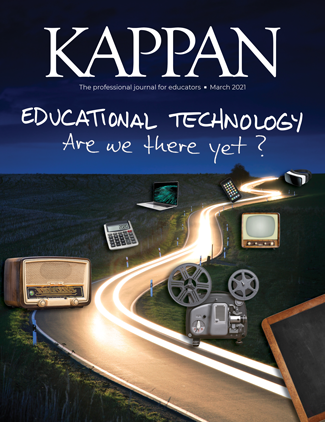
Later, at home, my mind raced with possible applications for K-12 education — students could take a virtual walking tour of ancient Rome, climb inside a human body and watch the circulatory system in action, practice their Spanish in a virtual meetup with students in Madrid or Mexico City. But I had to wonder, why was I getting so carried away? Usually, I’m a techno-skeptic. I follow Hack Education, the blog of “ed tech’s Cassandra,” Audrey Watters. I’ve read Larry Cuban’s books about the breathless predictions that accompanied every past invention, from the radio and the film projector to computers and interactive whiteboards, each of which was supposed to “transform” our public schools. And yet, after five minutes with a VR headset, I was ready to mortgage my house and invest in an ed tech start-up.
As Victoria Cain and Adam Laats explain in this month’s Kappan, American educators have been seduced by technology since as far back as the early 19th century, if not earlier. And, adds Justin Reich in his article on tech use during the pandemic, developers have always been happy to take advantage of them, pandering to the sense of wonder and possibility that new devices tend to arouse. Some inventions (like the VR headset at Best Buy) are just so cool, providing an experience that seems so different from anything we’ve known before, that it’s only natural to think of them as “gamechangers” — at least until we grow accustomed to them and come to realize, once again, that not much has changed about the everyday work of teaching and learning.
I don’t mean to suggest that ed tech has nothing to offer. But after 200 years of overhyped teaching tools and educational revolutions that never happened, perhaps it’s time we stop falling for what Reich calls the “charismatic salesmanship” of technology vendors and, instead, learn to appreciate the incremental changes technology can actually help us make. Virtual reality probably won’t transform K-12 education, but researchers think it might prove useful in helping students see the world from others’ perspectives. Personalized learning, notes Reich, hasn’t been the staggering success that its boosters have promised, but a few digital math programs do seem to help students master certain skills.
So let’s forego the wide-eyed claim that the latest technology will change everything, as well as the dismissive assertion that technology changes nothing at all. It’s not terribly exciting to stick to the middle ground — focusing on the very specific, if modest, ways in which ed tech can help us improve our schools — but at least it’s something.
ABOUT THE AUTHOR

Rafael Heller
Rafael Heller is the former editor-in-chief of Kappan magazine.