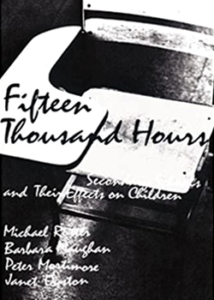
 Fifteen Thousand Hours: Secondary Schools and Their Effects on Children by Michael Rutter, Barbara Maughan, Peter Mortimore, & Janet Ouston, with Alan Smith (Harvard University Press, 1979).
I read this book in my 9th year teaching middle school, not imagining that I would leave the classroom. Much like the Effective Schools research pioneered by Ronald Edmonds, Fifteen Thousand Hours challenged earlier, discouraging research that suggested that family wealth, not schools, determines how kids will do in life. In fact, the book showed, some schools did have a profound impact on the lives of poor children. By comparing schools with similar populations, the researchers were able to identify specific factors that made some schools more effective. Intriguingly, the book focused on the “ethos” of those schools (the authors were ahead of their time in recognizing the importance of social-emotional learning ), echoed Edmonds’ research showing that the principals of effective schools were strong instructional leaders, and called for educators to provide a safe and humane climate, set high expectations for all children, and use student learning results to fine-tune instruction. The idea that schools can be “a force for the good” (the book’s concluding words) got me fired up about being a principal. Today, rereading my copy of Fifteen Thousand Hours, I see lots of my old underlining and marginal notes, illustrating how the book reoriented my thinking about leadership and education for social justice.
ABOUT THE AUTHOR

Kim Marshall
Kim Marshall, formerly a Boston teacher and administrator, now coaches principals, consults, and speaks on school leadership and evaluation, and publishes the weekly Marshall Memo. He is the author of Rethinking Teacher Supervision and Evaluation (3rd ed., Jossey-Bass, August 2024).
Visit their website at: www.marshallmemo.com