0
(0)
BEST OF THE WEEK
The week’s best education journalism, all in one place.

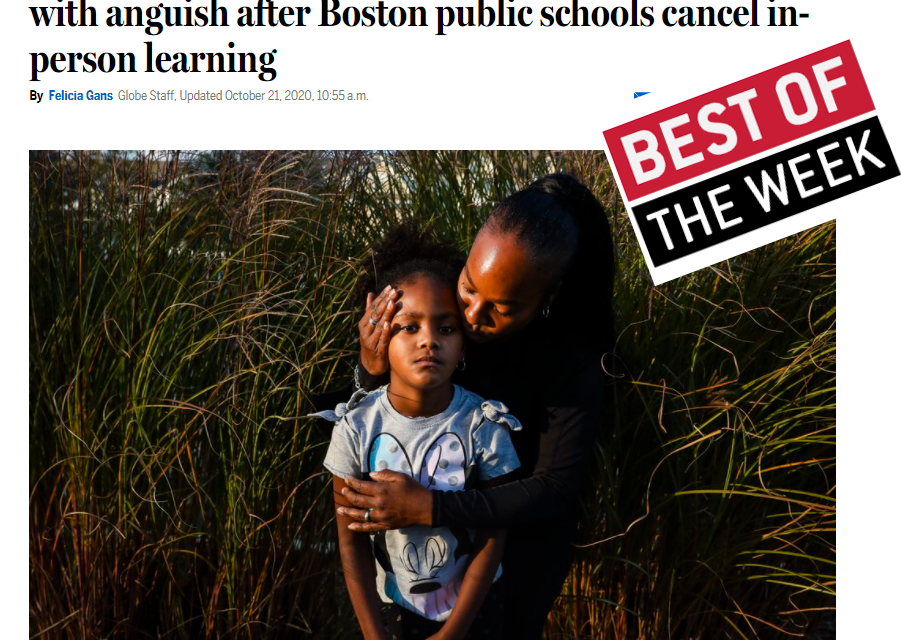
🏆 BEST: This week’s best story was ‘Missing a year affects us a lot’: Families respond with anguish after Boston public schools cancel in-person learning. This student-centered piece by Boston Globe reporter Felicia Gans explains what the most vulnerable students will be missing as Boston goes to all-remote learning: stability, academic progress, special education supports. It’s from last week, but it’s too good not to highlight here.

🏆 RUNNER-UP: The Washington Post’s Perry Stein nabs this week’s runner-up spot with a story on how teacher reluctance stymied a charter opening. “Despite a new building, a top-notch air-filtration system, a non-unionized teaching staff and families who want to return, LAMB could not start in-person classes.” Stein captures the frustration of all involved at a diverse school at which COVID fears and uncertainty stopped a reopening in its tracks.

🏆 BIG STORY OF THE WEEK: The big story of the week has been how teachers are responding to remote learning and the push to reopen schools. For example, The 74 has a good story about criticism over the quality of the work being assigned by teachers during remote learning (Survey Finds Most Teachers Assigned Busy Work in the Spring. Now, Experts Say, It’s Time to Give Students More Challenging Assignments — Remote or Not). Chalkbeat wrote a strong story about the possibility of a changed grading system (NYC schools will offer flexibility on grades. Are the changes here to stay?). And the Washington Post covered the challenges classroom teachers face during an intense political campaign (As the election draws near, civics and government teachers walk a fine line). Perhaps the most intense teacher-focused piece of the week was NBC News’ How one teacher’s Black Lives Matter lesson divided a small Wisconsin town. The CT Post took a good look at newly-minted teachers starting their careers under difficult circumstances: Here’s how student teachers are working during a pandemic.

MEET AMBER WALKER, OUR NEW COLUMNIST & EDITOR

The Grade’s new columnist and editor Amber C. Walker describes how she found her way to journalism, why she left the newsroom, and how she plans to approach her new role with The Grade. “I want The Grade to not only reach a greater share of our current audience of education reporters, but to bring the best of your journalism to the audience that matters most: the students and families you cover.”

And earlier this week, I published a column on what makes the New York Times’ COVID schools newsletter so good. The bottom line is that it helps readers understand what’s going on. It slows things down just a little bit — in a good way. It turns out I’m not its only admirer.

Thanks to the Times newsletter for mentioning us! Welcome, new readers!

MEDIA TIDBITS

Thought-provoking commentary on the latest coverage.

Above: It’s been enormously difficult to describe the different learning modes going on around the country in the absence of reliable national data. However, the NYT published some recent figures based on the Census Bureau’s Household Pulse Survey that may be useful. They show the percentage of parents who reported “classes canceled or moved to distance learning” last month. As you can see above, some places like DC and New Mexico are above 90 percent. Others like New York and Colorado are in the 70s. 

📰 THE CRITIQUE OF THE CRITIQUE: Rachel Cohen’s American Prospect piece Why Reopening Schools Has Become the Most Fraught Debate of the Pandemic was arguably the most-debated story of the week. It fits alongside Chalkbeat’s review of the reopening research from a few days before — but goes much further — as well as the recent Jacobin piece critiquing the critique of remote learning. It’s part of what I’d describe as a broader pushback on the notion that schools may be safer to reopen than was widely thought over the summer. Cohen’s piece makes some good points about the limits of the available infection data, and she warms my heart with her willingness to critique other journalists’ work. The piece has generated no shortage of admirers, including HuffPost’s Rebecca Klein, who described it as “a tour de force.” But it is also full of problems, large and small. For further reading, check out responses from some of those mentioned in the piece, including NYT education reporter Eliza Shapiro, MSNBC’s Chris Hayes, Brown researcher Emily Oster, and epidemiologist Whitney Robinson. “Are we waiting for the pandemic to essentially end before returning all kids to classrooms?” asked the Times’ Dana Goldstein, in response to Hayes’ commentary, “Or will we balance health risks against the academic and social risks of 1 year + without school for millions?”

📰 DIVERSE VOICES IN EDUCATION JOURNALISM: One promising way for newsrooms to move toward more diverse coverage is to improve the diversity of the voices it seeks out in its work. That’s what the Gastropod podcast did, with foundation help. “Improving the diversity of voices is not a quick fix, and requires a long-term investment of effort… in order to achieve results down the line,” states the report, Tracking and Increasing the Representation of Diverse Voices. “Another, similarly unsurprising, lesson is that tracking performance helps improve results.” I’ve heard of individual reporters and some outlets attempting to track source diversity, but has anyone on the education beat done so? I’d love to hear.

📰 REMOTE LEARNING, EMPLOYMENT, AND POVERTY: One of the best pieces I missed last week is High Country News’ In Las Vegas, the burdens of remote learning rest heavy on working parents, which describes the impact of remote learning on parents who can’t work from home. The NYT’s Upshot produced some related national reporting about the devastating impact of remote learning on working mothers’ employment:. “A 10 percent rise in the school closing rate in September was associated with summer labor force growth that was 1.5 percentage points lower for mothers… the equivalent of 1.6 million fewer mothers … All of this difference was because of home/family care.”

Missed some previous editions? You can see the archive of past newsletters here. 

PEOPLE, AWARDS 
Who’s going where & doing what?

đŸ”„ Check out the provocative new commentary in the NYT from freelance education writer Melinda D. Anderson (above). She writes that for some Black students “for whom virtual school is viable, the current disruption has opened up a new world: education without daily anxiety about racism.” For more on Black parents’ experience of remote learning, check out this thread from self-described public health geek Theresa Chapple.

đŸ”„ Moves: Alia Wong, much missed from The Atlantic, is joining USA Today as a national education reporter. She’ll focus on educational equity. Former Hechinger reporter Bracey Harris just started on the NBC News enterprise team. She got a warm welcome from NBC News Digital senior editor for enterprise Julie Shapiro.

đŸ”„ Congrats to Chalkbeat’s Gabrielle LaMarr LeMee, Amy Zimmer, and Christina Veiga for winning a 2020 Front Page Award from the Newswomen’s Club of New York in education reporting for their crucial work on school ventilation. Kenya Hunter was spotlighted by the Virginia Press Association. ”God blessed the day this fierce one slid into my DM,” tweeted the New York Times’ Erica Green.

Did someone forward you this newsletter? You can sign up here. 

EVENTS
What just happened & what’s coming next?

⏰ Wondering where Trump and Biden stand on education? EWA Radio can help. Listen to their podcast on the presidential candidates’ education plans, featuring Lauren Camera of U.S. News & World Report and Michael Stratford of Politico Pro.

⏰ Boston’s WGBH released the second video in their multimedia series “COVID and The Classroom.” The video follows freshman Bridget Donovan who is trying to find her community.

⏰ ICYMI: An episode of ABC’s “The Con” (hosted by Whoopi Goldberg) spotlighted education reporters Melissa Korn and Jennifer Levitz’s reporting on the college admissions scandal. Check out the trailer here or watch the full episode on Hulu.

⏰ On Tuesday, the Boston Globe politics team held an election Q&A with students.  On Thursday, freelance journalist Rachel Cohen, the Voice of San Diego’s Kayla Jimenez, and Chalkbeat Indiana’s Dylan Peers McCoy shared tips about investigative education reporting in a virtual forum with the Fund for Investigative Journalism.

THE KICKER

The CT Mirror’s Jacqueline Rabe Thomas gives us a glimpse into her experience of writing deep dives.

That’s all, folks. Thanks for reading!

ABOUT THE AUTHOR

Alexander Russo

Alexander Russo

Alexander Russo is founder and editor of The Grade, an award-winning effort to help improve media coverage of education issues. He’s also a Spencer Education Journalism Fellowship winner and a book author. You can reach him at @alexanderrusso.

Visit their website at: https://the-grade.org/

How useful was this post?

Click on a star to rate it!

Average rating 0 / 5. Vote count: 0

No votes so far! Be the first to rate this post.