By Alexander Russo
The Connecticut Mirror’s Jacqueline Rabe Thomas may be the best education journalist you’ve never heard of.
The nonprofit outlet she works for is relatively small, focused on one relatively small state, and her stories rarely seem to attract much attention outside Connecticut’s borders.
That’s too bad, because her work – both before and during the COVID crisis – has been consistently strong. But it doesn’t bother her or her outlet. Unlike some, Rabe Thomas is devoted to local news. And it doesn’t mean she’s flying entirely under the radar.
“Jacqui’s work stands out to me because she dots her i’s and crosses her t’s — but she does it in a concise and fluid way that’s not formulaic,” the Education Writers Association’s Emily Richmond said in a recent phone interview. “She’s got the quotes, she’s got the research, she’s got the impact. She’s got it all in there.”
Indeed, Rabe Thomas has managed to find new challenges within her existing newsroom, working with outside outlets, and broadening her beat to include housing and other issues. She’s a reporter who knows herself – and who has figured out how to get what she needs to make a long, successful career built around covering education.
Consistent quality
I first started following Rabe Thomas’ work a couple of years ago, and it wasn’t long before I noticed its quality. Like anyone, her stories sometimes missed elements I would have wanted to see, or she picked a story topic or angle that wouldn’t have been my first choice. But the quality of the reporting and writing is consistently strong.
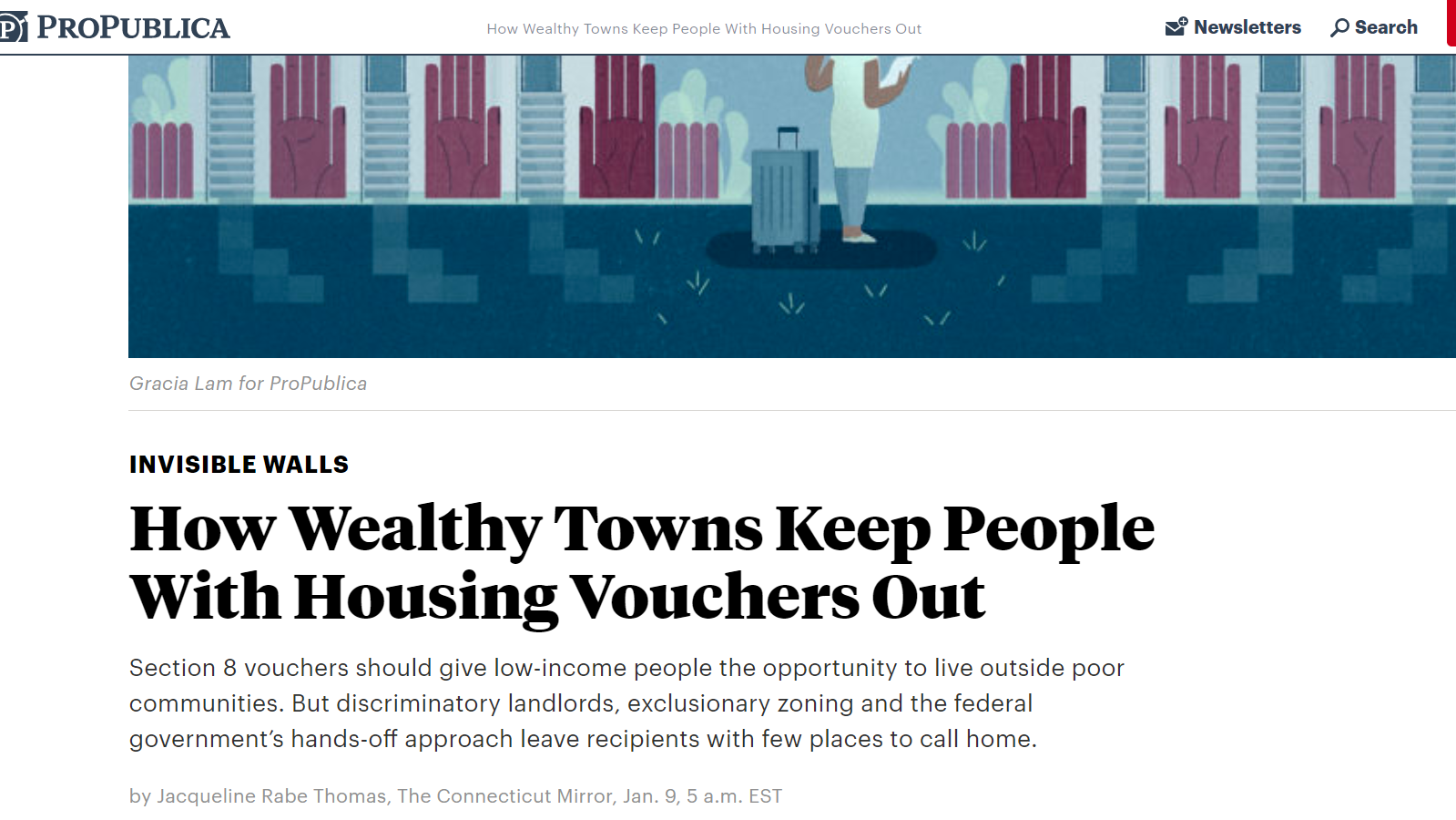
One of my all-time favorite pieces was a January 2020 story explaining how if poor people can’t rent homes in wealthier neighborhoods, then they can’t legally attend “better” schools in wealthier neighborhoods. One of the central characters risks eviction to keep her kids in a school that serves them well.
This was part of Invisible Walls, a nine-part series highlighting the ways in which Connecticut’s housing segregation illustrates a national problem. Her editor, Elizabeth Hamilton, describes the series as “some of the most important work that any journalist in Connecticut has done in the last year and a half.”
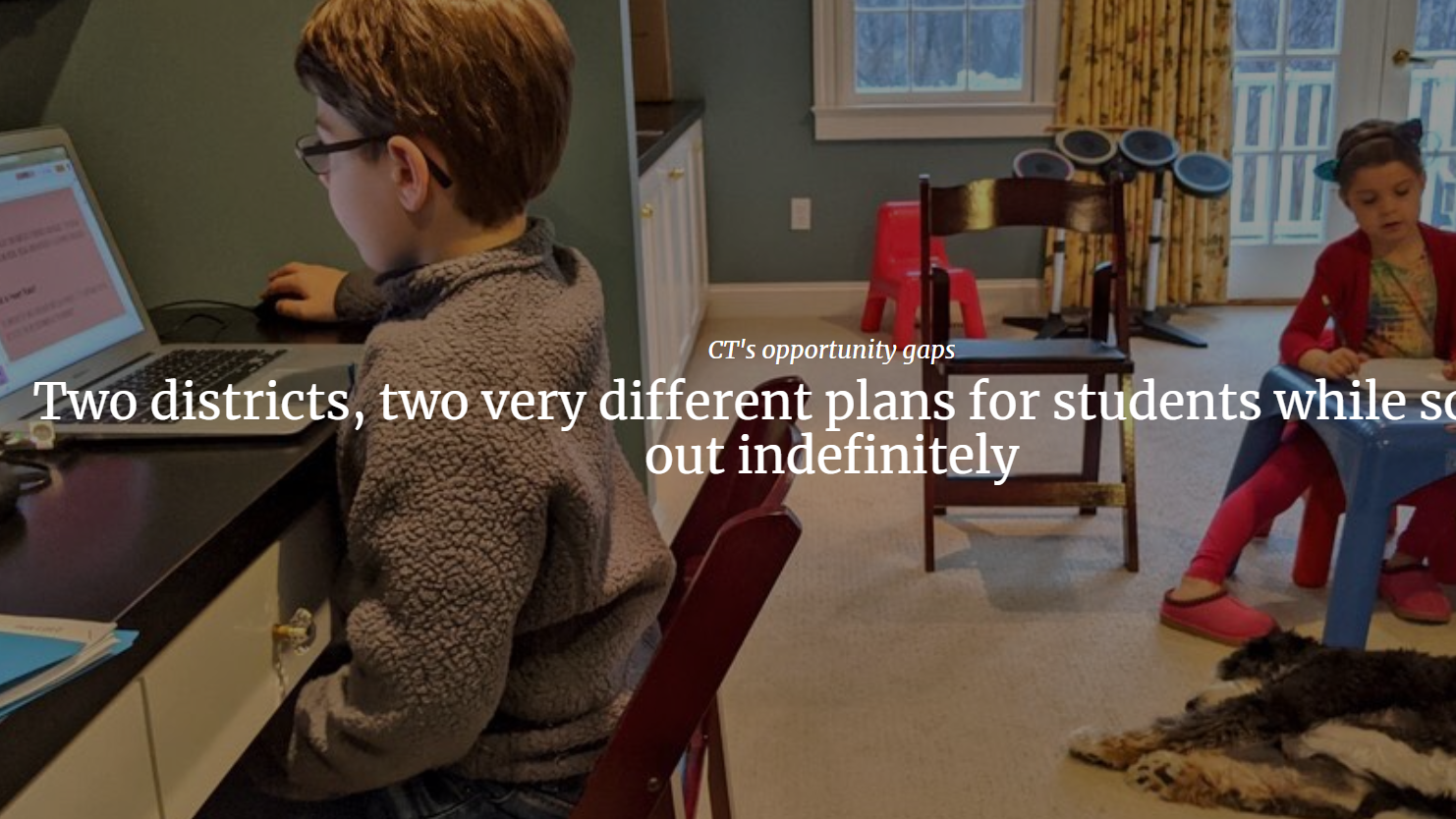
But her COVID coverage has also been especially strong. In March, she wrote about how differently districts were approaching the remote learning challenges: Two districts, two very different plans for students while school is out indefinitely helped readers (and educators) see the range of responses to the same basic situation. Over the summer, she wrote about the effort to re-engage students by moving to “live” remote instruction, highlighting the inadequacies of remote learning and obstacles to live video. Just last month, she wrote about the implications of the state’s decentralized reopening process, which further disadvantages vulnerable kids while their counterparts are back in class.
What makes Rabe Thomas’ work so good?
“She takes interesting angles to avoid writing an expected story about a topic that we’ve all heard about already,” says an education journalist who wanted to remain anonymous, citing the “added depth” in a story about a report that lists which schools call police on students the most. “The story shows how someone calls the police on a 4-year-old, a nice touch for a story that could have easily started: ‘Waterbury calls police repeatedly for children who are under 12.’ ”
Editor Hamilton cites a forthcoming story about remote learning that debunks the state’s claims of high student participation rates, noting the Rabe Thomas doesn’t just take official statements at face value.
It isn’t just her admirable ability to find and dig through documents, said ProPublica’s Mike Mishak, who edited Rabe Thomas and six others last year. It’s also her tenacious field reporting. In a recent phone interview, Mishak told me about her relentless pursuit of Gov. Ned Lamont, who repeatedly declined interview requests and dodged questions even when Rabe Thomas appeared at many of his events. She also went out numerous times to bus stops and other public places looking for people whose stories would resonate with average readers and pull them in. Mishak called her efforts in this regard a “testament to her diligence, to getting all the ingredients that you need for a great investigative series.”
The backstory
Fifteen years ago, when Rabe Thomas started out, she was a web site editor and education reporter for Southern Maryland Newspapers. She worked for Congressional Quarterly for a very short while before discovering that “covering Congress wasn’t my thing.”
Shortly after, she joined the Mirror as part of its inaugural staff (it launched in January 2010), part of a wave of nonprofit news sites both national and local. “I’ve always been an education reporter through and through,” she says.
Covering Connecticut education issues for a brand-new news outlet wasn’t easy at the start. The Mirror launched in 2010, when nonprofits were less common than they are now. And Rabe Thomas didn’t grow up in Connecticut.
Initially, she says, it was harder to get sources to open up to a reporter they didn’t know from an outlet they’d never heard of. The Mirror functions as a bit of a wire service for other outlets that publish its content, so sometimes sources had read her stories but didn’t know they were from the Mirror or by her. “A lot of people don’t pay attention to bylines,” she says.
A decade later, lack of recognition in Connecticut is no longer a problem. In 2017, she was named one of Connecticut’s 40 under 40 by Connecticut Magazine for her education coverage. Last year, she won first place for investigative/enterprise reporting in the New England Better Newspaper Competition for her series on housing segregation.
Parents, educators, and policy makers rely on her reporting, as you can see in David DesRoche’s 2019 story for The Grade: In Connecticut, fewer reporters, more missed stories.
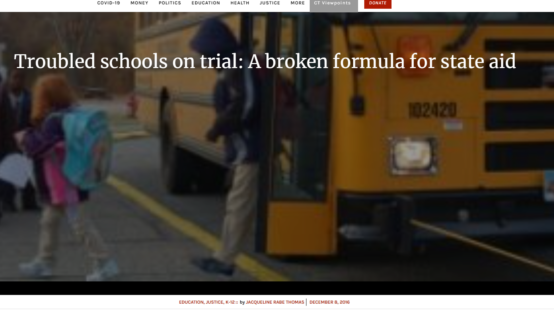
Rabe Thomas isn’t entirely unknown outside the state, either. In 2012, she won a national EWA award for beat reporting for her education coverage at the Mirror. She also won best investigative reporting that year for a series she co-bylined on higher education improprieties within the state board of regents. Her 2016 series, Troubled Schools on Trial, was a finalist for an EWA award for best single-topic news or feature.
“Jacqui is an example of what institutional memory looks like,” says EWA’s Richmond. Her coverage is authoritative, as she’s able to bring her past experience and knowledge to current-day stories. “Hers is work that I point out to other people as an example,” says Richmond.
Richmond compares Rabe Thomas to the Baltimore Sun’s Liz Bowie, who’s shown the benefits of a strong background on the beat in stories like Unsettled Journeys, about immigrant students, and Lori Higgins, who moved from the Detroit Free Press to Chalkbeat Detroit not long ago.

Local first
Being little-known outside the state doesn’t really matter to her, says Rabe Thomas, because she’s always wanted to be a local reporter.
“Whether people know who I am outside of the state, I don’t necessarily care all that much,” she told me in a recent phone interview.
“I like writing local stories. I think that’s what matters.” She also knows what kinds of stories matter most to her.
“I naturally gravitate to reading stories about underserved students and systemic issues,” says Rabe Thomas, citing Bethany Barnes’ Oregonian story, A family’s quest to stop the next school shooter in Oregon; Chana Joffe-Walt’s New York Times podcast, Nice White Parents; Meghan Irons and Malcolm Gay’s The Valedictorians Project for the Boston Globe, and Alvin Chang’s Vox stories about school attendance zones and district boundaries.
“These stories all provided a deep dive on issues that aren’t well covered but are so important.”
Exploring and growing
Now that she’s an accomplished veteran, her challenge is to find novel ways to tell the story.
“It kinds of gets a little repetitive year after year, covering the same budget fiasco,” Rabe Thomas notes. She can do it, but it doesn’t challenge her as much as it once did. Luckily, she’s got an editor who believes in growing her reporters and letting them focus on things that they’re most interested in.
“They’re not going to make me cover tuition increases,” says Rabe Thomas.
Rather than burning out or bailing on the beat, Rabe Thomas’ solution seems to be learning new things and exploring new angles.
In 2019, Rabe Thomas was a part of the ProPublica Local Reporting Network, a yearlong partnership in which she focused on how housing policies impacted education, health, and other things.
“I was thrilled, learning a whole new beat,” Rabe Thomas recalled. “It was an opportunity to expand my portfolio.”
“It was super rewarding,” according to editor Hamilton. “Jacqui learned a lot about managing a big project, where it’s sometimes easy to go down a rabbit hole.”
Making matters easier, the Mirror was able to hire veteran education reporter Kathy Megan to fill in on the beat during that time.
Here and there, Rabe Thomas also has been able to stretch herself by working with the Solutions Journalism Network to report on not just the problems, but also the solutions to pervasive challenges.
“I struggle sometimes with being too negative in my reporting,” she says. Working with the Solutions Journalism Network has pushed her to “go a little bit further.”
These stories take more time. They’re not entirely natural to her. But she says those stories are the ones that make her proudest.
“It’s easy to document problems; it’s not hard. But that’s not what readers always want to read.”
Next challenges
Before the pandemic, Rabe Thomas worked mostly out the history-laden state Capitol press room, complete with empty desks and stained-glass windows. The Mirror has offices at the local NPR station, where she is now able to work three days a week, thanks to her two kids being back to in-person school and day care.
She’s a member of the 10th cohort of EWA Fellows and is working on a close look at the impact of the COVID shutdown on kids and schools in the state.
She’s also moved over to cover inequality in all its many forms, including education. The new beat assignment, dubbed “disparities,” was developed during the pandemic in part in response to Rabe Thomas’ success covering housing through the ProPublica partnership.
“I did see that she was kind of naturally veering to housing stories,” says Hamilton about the expanded beat. “It was clear to me she’d outgrown the confines of the education beat in some respects and needed to broaden her horizons.”
The change is eased somewhat because the Mirror recently hired Report for America fellow Adria Watson to cover education, and Watson is already turning out strong work. Just last month, she wrote about the implications of the state’s decentralized reopening process, which further disadvantages vulnerable kids while their counterparts are back in class.
Like anyone, Rabe Thomas says she’s still working on becoming a better journalist. “I’m really good at researching and reporting,” she said. However, “I have this habit of wanting to know everything about everything. I tend to go down a lot of rabbit holes.” Turning the reporting into a story is not so easy for her. “I’ll do all this research, but then when it’s time to synthesize it down to two or three thousand words, that’s really challenging for me.”
This is just the latest evolution of an education reporter whose career has combined hard work, sharply honed research skills, and a commitment to learning new topics and skills.
Related coverage:
In Connecticut, fewer reporters, more missed stories
Education reporters share their own back to school decisions
Coverage challenges in the coronavirus era
Report for America goes to school
ABOUT THE AUTHOR

Alexander Russo
Alexander Russo is founder and editor of The Grade, an award-winning effort to help improve media coverage of education issues. He’s also a Spencer Education Journalism Fellowship winner and a book author. You can reach him at @alexanderrusso.
Visit their website at: https://the-grade.org/