How the much-expanded fellowship program could bolster education coverage.
By Colleen Connolly
Launched less than three years ago, Report for America (RFA) now has hundreds of reporters around the country, roughly 20 of whom cover education as most or part of their job.
While these journalists are providing much-needed education coverage in places that might not otherwise have the resources to dedicate to the beat, the contribution isn’t big enough to make up for the enormous need for schools coverage or to counterbalance the industry downsizing that’s been going on – not yet, at least.
If the foundation-funded journalism program continues to grow – its aim is to reach 1,000 reporters by 2024 – it could become a substantial player in recruiting and placing reporters on the beat. At that size, roughly 80 more reporters could be covering schools as part of their core duties.
Based on the last three years, however, it’s unclear whether RFA and participating newsrooms are going to prioritize education over other beats.
Disclosure: I applied to be a Report for America corps member earlier this year.
Background
Report for America launched in January 2018, placing about a dozen reporters in newsrooms across the country in an effort to bolster local journalism. Most of the corps members are early in their careers, but have worked as journalists before and have stellar resumes.
This year, the program ballooned to 226 reporters, and the newest corps members started their jobs in June. Initially a two-year program, RFA recently added the option for corps members to stay for a third year to deepen their roots in the community and to add depth to the beat. RFA contributes 50% of its reporters’ salaries for the first year, with the newsroom covering the rest through grants or other means.
To understand the program’s impact, I reached out to 17 current and former corps members who reported on education in some capacity and interviewed five. Of the reporters I talked to, only two had previous experience as education beat reporters. But all five had some experience in reporting on education, and they were able to hit the ground running. And though none of them was working in a place they had lived before, many of them came from the region.
The current/latest crop
Roughly 10% of RFA’s current 226 corps members are doing at least a little education coverage. About half of those are focused solely on the beat. The rest are covering beats that have an education component, such the impact of the pandemic on marginalized people.
These corps members work at local news outlets, including newspapers and nonprofits, covering everything from the intersection of education and childhood trauma in northern California (Nada Samir Atieh) to the education crisis in Puerto Rico (José Encarnación).
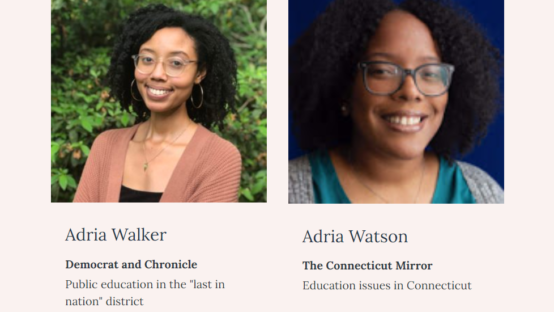
In Saint Paul, Minnesota, Becky Dernbach is covering education among Hmong, Somali, Latino, and other immigrant students for the Sahan Journal. And in Rochester, New York, Adria Walker is covering public education in the “last in the nation” school district for the Democrat and Chronicle.
The Associated Press has also placed several reporters in capital cities covering state legislatures, many with a focus on education funding.

Contributions
In their first few months on the job, many RFA education reporters have produced stories that likely wouldn’t have been covered otherwise.
At the Belleville News-Democrat in southern Illinois, K-12 reporter Megan Valley is regularly checking in with 35-45 school districts and covering their frequently changing reopening plans. The newspaper has an investigative reporter who often writes larger education accountability stories, but there was no one dedicated to the beat to keep up with the important granular stories.
At the Concord Monitor in New Hampshire, RFA reporter Eileen O’Grady published a three–part series about the racial inequities in school discipline just one month into the job. Editor Steve Leone said that story “100% would not have happened” without O’Grady, who replaced a general assignment reporter.
In a year when education is being upended by the pandemic and scrutinized for systemic racism, Leone added that having a reporter solely dedicated to the beat was not just helpful, but necessary. “It’s not like we wouldn’t cover education (before)…,” Leone said by phone. “But we would only cover it at the expense of something else when it rose above a certain threshold.”
Some RFA corps members have already published education stories that led to change in the community, too. Isabelle Taft, who is covering the Vietnamese and African-American communities in Biloxi, Mississippi, for the Sun-Herald reported a story about a family at risk of developing complications from COVID who was unable to request remote learning for their child because they didn’t have internet. After Taft spoke with the superintendent, the district changed its policy and said it would work with families to provide them with internet access.
Not a strength — yet
Given the importance of schools and the challenges of the pandemic, there’s a good case to be made that education should be a priority for RFA in recruiting and placing its members in newsrooms.
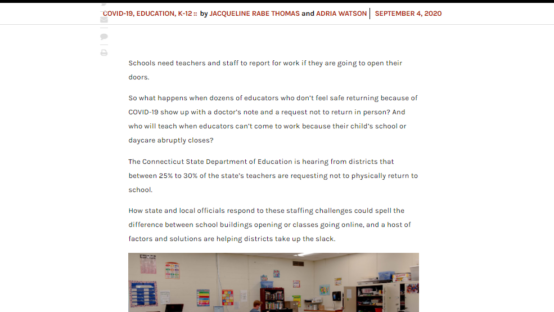
RFA education reporters are filling a need. And some newsrooms are providing significant mentorship and investing in the corps members’ future work, too. The Connecticut Mirror recently hired Adria Watson (not to be confused with Adria Walker at the Democrat and Chronicle) through RFA to cover education after veteran education reporter Jacqueline Rabe Thomas moved over to a new beat on social inequality. Executive editor Elizabeth Hamilton said by phone that it was the perfect opportunity to bring in a young reporter to be mentored by Rabe Thomas. And they are already working together on stories.
Yet it can’t be said that education is a strong suit for RFA — so far, at least. In its first year, there weren’t any RFA members who focused on education. Last year, there was only one education beat reporter in RFA — Devna Bose, who worked at Chalkbeat Newark. Chalkbeat Newark did not renew its participation in RFA this year, and none of the other Chalkbeat bureaus applied, according to Brittany Bernardi, Chalkbeat’s talent and recruiting coordinator. Bose is now a corps member at the Charlotte Observer covering poor and minority communities. She declined to talk to us for this piece.
In fact, education outlets are curiously missing from RFA newsrooms. Bernardi said in an email that the organization didn’t see a good fit for the program at any of their bureaus this year, but both she and Kim Kleman, national director of RFA, said they may partner again in the future.
EdSource, which covers California education news, was initially listed as a participating RFA newsroom this year, but it did not hire a corps member. Kleman said there wasn’t a good fit within the applicant pool. EdSource went ahead and posted the job — immigration and education reporter — in the usual manner, and reporter Zaidee Stavely is covering the beat.
Kleman said she expects the number of RFA education reporters to grow next year as newsrooms scramble to cover virtual, hybrid, and in-person learning during the pandemic. She told me news outlets applying for the program are increasingly interested in hiring education reporters, acknowledging it’s one of the most fundamental beats but also one that is frequently cut as newsrooms shrink.
If RFA focused on education coverage, it would almost certainly benefit the beat in a number of areas. For one, according to the program’s statistics, 40 percent are journalists of color.
Future prospects
Filling in coverage gaps in news deserts they’ve never lived in before is a tall order for RFA members. None of the reporters I spoke to had visions of “saving education journalism.” Instead, they were quick to point out that there were other reporters in the area who wrote about education, if not enough of them.
The current crop of reporters has a month or so to decide whether they want to stay at their RFA posts next year, but many have already decided their work is far from over.
“I’d love to stay in education and I’d also love to stay at the VC Star,” Shivani Patel, who covers inequities in education for the Ventura County Star in California, told me. “I think a year is great to get to know a community, but I don’t think it’s enough.”
Previously:
How a Teach For America-inspired journalism program aims to bolster local news coverage
ABOUT THE AUTHOR

Colleen Connolly
Colleen Connolly is a freelance journalist who covers New England for The Grade. Her work has also appeared in the Columbia Journalism Review, The Guardian, The New Republic, Smithsonian magazine, and the Chicago Tribune. You can follow her on Twitter @colleenmconn or find out more on her website: https://colleenmaryconnolly.com/.