0
(0)
BEST OF THE WEEK
The week’s best education journalism, all in one place.

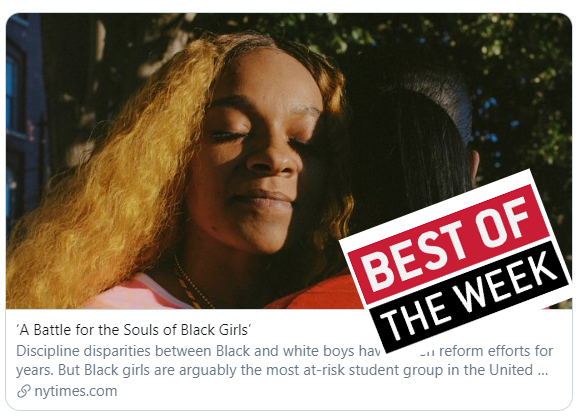
🏆 BEST: The best education journalism of the week goes to Friday’s front-page New York Times story ‘A Battle for the Souls of Black Girls’, which sheds much-needed light on the disparate treatment and discipline rates of Black girls. Erica Green, Mark Walker, and Eliza Shapiro’s nationwide look at an underreported problem has no shortage of statistics and examples of the problem. Importantly, the story features the voices of girls and their parents. As a result, the story feels like it is as much by them as it is about them.

🏆 RUNNER-UP: Monday’s New Yorker/ProPublica story, The Students Left Behind by Remote Learning, features a blistering narrative and a powerful analysis of how the nation came to overestimate the dangers of reopening schools while underestimating the effects of a prolonged school shutdown on vulnerable kids.

🏆 BIG: The big story of the week is the patchwork return to in-person learning and the debate about whether to continue to do so. Some of the stories and outlets that covered the story: Florida schools reopened en masse; feared COVID surge hasn’t followed (USA Today); Elementary Schools Reopen in Person, in Milestone for N.Y.C. (NYT); Some CT towns begin shift to five days a week in the classroom (Hartford Courant); Mayor Lori Lightfoot: ‘We’re not there yet’ on in-person CPS learning (Chicago Tribune); Some students will be able to return to D.C. public school buildings this week (Washington Post); Affluent campuses fill with kids, poorer schools remain mostly online (Palm Beach Post); A little more than half of DISD families say they’ll return to campus (Dallas Morning News); Students Return to School Buildings, but Teachers Work Remotely (Wall Street Journal); and Arkansas teachers refuse to teach in-person classes (NPR).

HOW VULNERABLE KIDS BECAME INVISIBLE THREATS

On the surface, the recent New Yorker/ProPublica article by Alec MacGillis focuses much-needed attention on the plight of vulnerable kids who have been so poorly served in recent months.

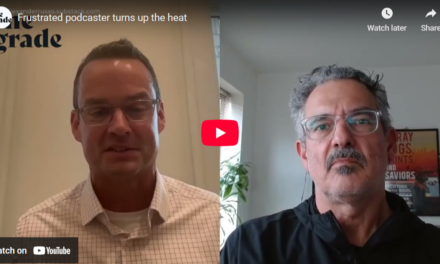
But in this week’s most recent column, I explain how the piece also functions as a powerful critique of media coverage, an examination of how journalism seems to have unwittingly contributed to the neglect of kids like Shemar rather than having been a persistent voice calling for society to come to their aid.

Earlier in the week, I also wrote seven ideas to guide your reporting on the difficult topic of COVID and schools. Journalism has all too often failed Black and Latino communities in the past. Let’s make sure that’s not happening again this fall.

MEDIA TIDBITS

Thought-provoking commentary on the latest coverage.

Above: Last week’s roundup featured bright spots in education journalism. Here’s another one: The Atlantic just published a new series called The Firsts (above), which is about the first children to desegregate schools. Kudos to Adam Harris and everyone else involved!

📰 A TURNING POINT ON IN-PERSON EDUCATION? With stories in the New Yorker, Washington Post, USA Today, and Politico, we’re getting closer to the point at which reopening schools in person — safely — takes center stage in national news outlets. Increasingly frustrated with the lack of in-person education being offered, even where the infection rates are low and safety equipment is available, parents and others in places like Oregon and North Carolina are pushing districts to expand in-person options for parents who want it. Who’s next?

📰 MORE COVERAGE, JUST A LITTLE BIT CALMER, PLEASE: I welcome more national coverage of the reopening debate, and I commend the Politico folks for focusing attention on an issue that often feels like it’s being covered piecemeal (see above). However, the Politico story is another example of coverage that seems intended to amplify fears. The ‘acceptable carnage’ headline seems unnecessarily inflammatory. The description of the risk seems overstated and misleading. The inclusion of inflammatory quotes without giving questioning or contextualizing them is irresponsible. Politico has some great education reporters, but this is not their best work.

📰 ‘SAVVY’ JOURNALISM AND NYC SCHOOLS COVERAGE: For years now, NYU’s Jay Rosen has been trying to persuade journalists to reconsider the “savvy” approach to journalism, in which reporters focus on inside baseball and which political interests are winning or losing. (This 2011 Atlantic article, What If Journalists Stopped Trying to Be Political Insiders?, explains the argument.) But the “savvy” approach is often what I see when it comes to NYC schools coverage right now: a focus on the fighting among educators, city hall, the governor, and the Department of Education — and a relentless leaping ahead to find the next point of conflict or drama at the expense of reporting what’s actually happening across the massive school district.

Missed some previous editions? You can see the archive of past newsletters here. 

PEOPLE, AWARDS, JOBS
Who’s going where & doing what?

đŸ”„ Jobs: The Des Moines Register is hiring an education reporter. Teach For America is hiring an editor to help shape how TFA reports on national issues in education, particularly in the communities they work in. Also, Tom Huang tweeted that the Dallas Morning News Education Lab, which just launched this week, is hiring a reporting intern. Still no word on who’s going to get the Washington Post editor job.

đŸ”„ Oh, no! Bill Hangley Jr. is leaving Chalkbeat Philadelphia. “They’ve got their new system up and running, and my eyes keep rising to the horizon, so it’s a good time for us to part ways,” he begins the long thread explaining why.

đŸ”„ “I don’t think any single topic has been misreported, misunderstood and sensationalized to the point of misinformation more than the topic of children, schools and this pandemic,” tweeted UNC professor Zeynep Tufekci, Ouch!

đŸ”„ Chalkbeat’s Cara Fitzpatrick tweeted last week that she pulled her kids out of school and decided to homeschool them. The tweet elicited a long thread of commiseration and wishes for luck. We asked education reporters, including Cara, about how they were handling their kids’ schooling this fall, and got some fascinating responses. Other reporter/parents who have weighed in on the subject include the New York Times’ Nikole Hannah-Jones, who tweeted about sending her 5th grader to in-person school for the first time since March and CNN’s S. Mitra Kalita, who shared mixed feelings about seeing her 4th grader off to school.

Did someone forward you this newsletter? You can sign up here. 

EVENTS

Above: On Slate to talk about his New Yorker story, Alec MacGillis noted that “a Black child is now more likely to be going to school in Florida or Texas than in Maryland or Massachusetts or California.”

⏰ Education journalists like USA Today’s Erin Richards were all set to fact-check the presidential debate, but — thankfully, given the quality of the discussion — education didn’t come up.

⏰ On a recent WNPR segment, John Henry Smith tweeted that the CT Mirror’s Jacqueline Rabe Thomas told him that she “can count the number of families who have actually gotten some of that state rental assistance money on one hand.”

⏰ On Wednesday, journalist and education consultant Carla Murphy discussed the results of a Leavers survey she conducted of 101 former journalists of color to understand when and why they left the industry. The event wasn’t recorded but you can read the notes here.

⏰ Learn how to sell your education book! EWA is hosting a webinar Oct. 6, featuring Wall Street Journal’s Melissa Korn (“Unacceptable: Privilege, Deceit & the Making”), freelancer Danielle Dreilinger (“The Secret History of Home Economics”), freelancer Jeff Selingo (“Who Gets In & Why: A Year Inside College Admissions”), and Gail Ross, president of the Ross Yoon Agency. The Atlantic’s Adam Harris will moderate. You can register here.

THE KICKER

“First day of in-person school in Brooklyn since March,” tweeted the New York Times’ Nikole Hannah-Jones. “Baby girl and mom were both excited and nervous. Shout out to all the amazing educators in the building today, including my daughter’s 5th-grade teacher Ms. Jackson.”

That’s all, folks. Thanks for reading!

Reply to this email to send us questions, comments or tips. Know someone else who should be reading Best of the Week? Send them this link to sign up.

Using Feedly or FlipBoard or any other kind of news reader? You can subscribe to The Grade’s “feed” by plugging in this web address: http://www.kappanonline.org/category/the-grade/feed/.

Read more about The Grade here. You can read all the back issues of The Grade’s newsletter, Best of the Week, here.

ABOUT THE AUTHOR

Alexander Russo

Alexander Russo

Alexander Russo is founder and editor of The Grade, an award-winning effort to help improve media coverage of education issues. He’s also a Spencer Education Journalism Fellowship winner and a book author. You can reach him at @alexanderrusso.

Visit their website at: https://the-grade.org/

How useful was this post?

Click on a star to rate it!

Average rating 0 / 5. Vote count: 0

No votes so far! Be the first to rate this post.