How media coverage of school safety has clouded the school police debate
By Alexander Russo
Last week, in the midst of the police brutality protests and growing calls to defund policy departments, a handful of school districts including Minneapolis began to reconsider the value of having police in schools. More appear ready to do so.
The issue of school police is an important one. Even as school police officers have become a common part of American education, studies suggest their presence has negative effects on students of color.
And yet, efforts to remove police from schools in previous years have not prevailed. “Few, if any, school districts have ever taken such a dramatic step over the issue” in the past, noted BuzzFeed.
Journalism’s unintended contribution to promoting the spread of police in schools should not be overlooked.
Early on, in the 1990s and 2000s, media coverage of school police often failed to question the idea carefully enough.
In recent years, depictions of school violence have perpetuated the mistaken notion that schools are dangerous places for kids that require law enforcement on campus.
As long as media depictions of school violence remain exaggerated, it will be extremely difficult for districts to make informed decisions about whether to remove police from schools.
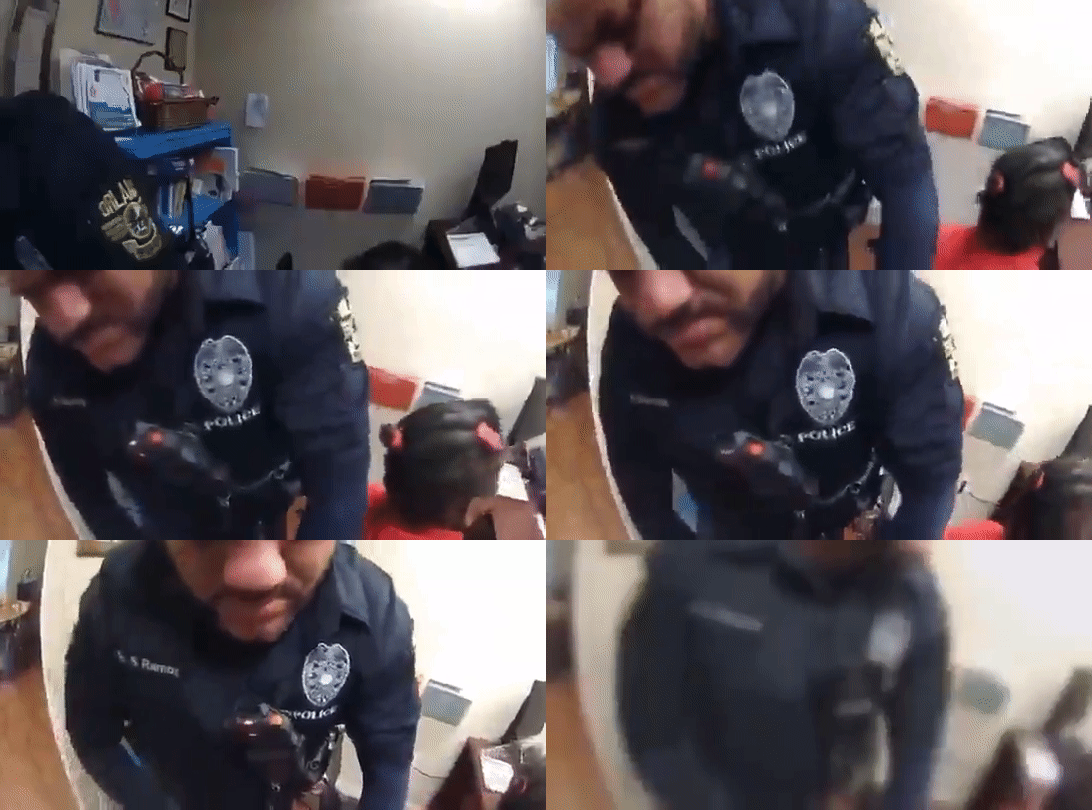
Above: A young girl is handcuffed by a school police officer.
When school police programs began to proliferate in the 1990s and 2000s, based on concerns about gangs, guns, and bullying, mainstream coverage was generally neutral, if not positive.
A 1997 New York Times article is a typical example: Evolving Role for Police Officers in Schools, focused on Stamford, Connecticut, schools: “In recent years uniformed and armed police officers have begun to supplement security guards who have been there for years. Moreover, more and more security guards are being hired not only for middle schools but for some elementary schools, too.”
This 2011 NPR segment is another good example: In Texas, Keeping Kids In School And Out Of Court. Or check out this 2013 MSNBC segment: The Obama administration funds police officers in schools.
However, as long as there have been school police, there have been questions about whether mixing kids and law enforcement on campus is a good idea. And, in the middle part of the last decade, coverage of school police began to trend sharply critical — first in progressive outlets and then in more mainstream ones.
“Over the past five years at least 28 students have been seriously injured, and in one case shot to death, by so-called school resource officers,” reported Jaeah Lee in Mother Jones in 2015: Chokeholds, Brain Injuries, Beatings: When School Cops Go Bad.
Schools with officers “had five times as many arrests for ‘disorderly conduct’ as schools without them,” reported Vox’s Libby Nelson and Dara Lind in a 2015 piece headlined The school-to-prison pipeline, explained.
In 2017, KNTV’s Bigad Shaban, Michael Bott and Mark Villareal won accolades for their series Arrested At School, about misuse of police officers in Bay Area schools.
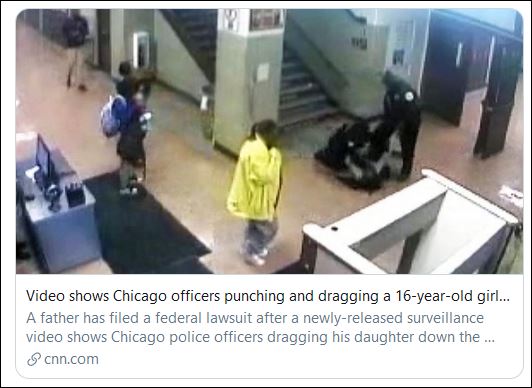
Above: Another incident showing school police hurting students.
So why haven’t schools done more to limit police presence in recent years?
There are several factors at play, including the little-reported issue of teachers union support for school police and the reality that some school communities very much like their school resource officer.
But one obvious obstacle is the perceived threat of mass school shootings such as Sandy Hook and Parkland among the public.
And in this area in particular, the media contribution to an informed discussion is a particularly bad one.
For quite a long time, the general message conveyed to the public by the media has been that schools are dangerous places, full of bullying, theft, predatory behavior of all kinds, and — most of all — the possibility of gun violence by disaffected community members or disturbed outsiders.
The 2018 Washington Post feature Scarred by school shootings illustrates how, by emphasizing the ubiquity of school shootings, media coverage can unintentionally make schools seem unsafe.
Other common problems include: overestimating the number of school shootings and covering district responses without addressing effectiveness questions and unintended consequences.
Without better context reminding readers that schools are among the safest places for kids, school violence coverage contributes to the mistaken notion that danger lurks outside every classroom — and makes school police seem necessary.
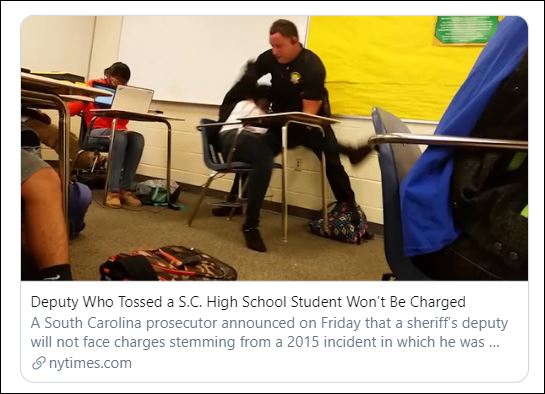
Above: A school police officer who body-slammed a high school student in South Carolina.
School shooting coverage has been improving recently, notes Northeastern University’s James Alan Fox, citing recent stories questioning the number of school shootings, the value of shooter drills, and the purchase of bulletproof doors.
However, school violence coverage is going to have to get much more contextualized and rigorous for there to be a clear, well-informed discussion of school police.
And coverage of the current school police debate is going to have to continue to deepen and evolve, as the political rhetoric bumps up against real-world questions about how to replace school police with a robust alternative.
Minneapolis isn’t the first place to reconsider school police. And it won’t be the last.
Related commentary:
Roundup: School shooting coverage
ABOUT THE AUTHOR

Alexander Russo
Alexander Russo is founder and editor of The Grade, an award-winning effort to help improve media coverage of education issues. He’s also a Spencer Education Journalism Fellowship winner and a book author. You can reach him at @alexanderrusso.
Visit their website at: https://the-grade.org/