#CoveringCOVID19, a daily update from The Grade to help education journalists cover the COVID-19 crisis.
THE TOP FIVE
Five great education stories about how schools are responding to the COVID-19 crisis:
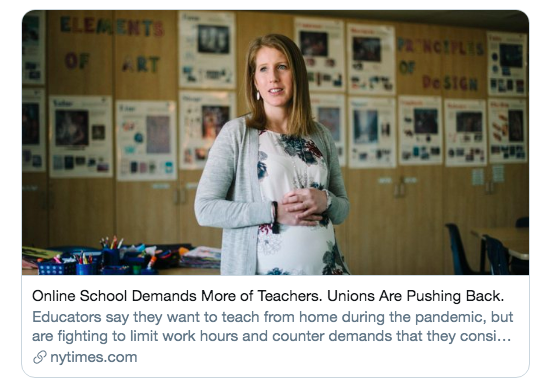
 Online School Demands More of Teachers. Unions Are Pushing Back – New York Times (above)
Cincinnati Public to broadcast lessons on TV, but district can’t reach thousands of students – Cincinnati Enquirer
Students, families are in ‘desperate need’ of computers amid coronavirus distance learning – Chicago Sun-Times
For NYC students learning English, remote learning can come with steep barriers – Chalkbeat and WNYC
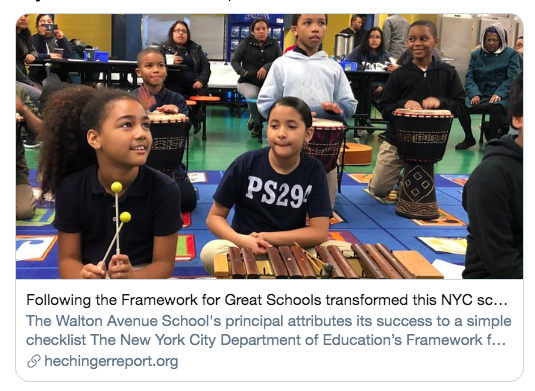
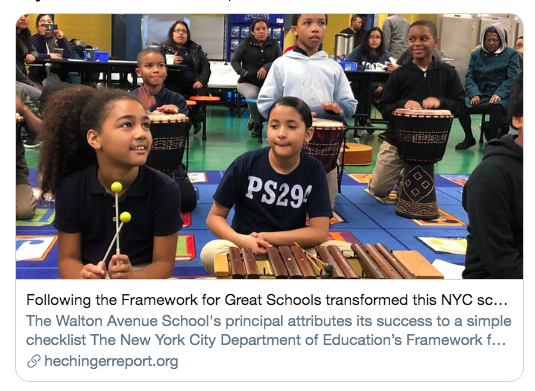
‘Everything they need’: A school transformed from one of New York City’s worst to one of its best; then coronavirus shut its doors – Hechinger Report (below)
KEEPING VULNERABLE KIDS FRONT AND CENTER
I’ve seen so many teacher- and parent-focused stories in the past few days that I think I’m starting to develop a rash.
Here’s an example from the Washington Post. Here’s another from EdWeek, which opens with a white private school teacher in Seattle.
But the issue isn’t any individual article, it’s the cumulative message of so many articles piled on top of each other.
Sympathetic as I am to the new burdens on teachers and parents — and knowing that adults are much easier to find and get talking — I’d love to see at least as many stories focused on the experiences of kids. Especially kids who are particularly vulnerable.
If you have to do a story about an adult, please try to bring us stories about adults who aren’t predominantly white middle- or upper-middle class professionals, whose eloquent lamentations already fill our Facebook newsfeeds and Twitter timelines.
Yes, everybody’s struggling, and the full range of experiences and perspectives are important to note. But some people are struggling far more than others. Let’s center our attention on the people who are the most vulnerable, including teachers and parents but — mostly! — kids.
TIDBITS
 Only in America. There’s a TIME magazine cover featuring school lunch workers. At the same time, EdWeek notes that districts are starting to furlough them.
Our Monday story, Four hours a day; how teacher contracts are shaping remote learning, goes well with today’s new Eliza Shapiro/Dana Goldstein report: During Coronavirus, Unions Resist New Demands on Teachers. In related news, the Boston Globe reports that the Boston remote learning agreement doesn’t require any “live” instruction.
Programming is spotty. Participation is low. Technical glitches are widespread. Can we just talk about how poorly district remote instruction programs seem to be going out there? Some recent examples: Fairfax Schools online learning sputters again (Washington Post), Why Seattle kids were among the last in the region to start receiving laptops after coronavirus closed schools (The Seattle Times). Or is it unfair and inappropriate to hold districts accountable for serving kids as well or better than the handful of places doing it reasonably well?
Our latest piece from Bekah McNeel examines what re-opening schools is going to look like, based on early reports from other countries by the WSJ, NYT, AP, and others, plus insights from reporters and researchers who have studied how American schools tend to do things when reopening schools after a shutdown.
That’s it! See you back here tomorrow. Sign up for the weekly email, Best of the Week, which comes out Fridays around noon Eastern.
ABOUT THE AUTHOR

Alexander Russo
Alexander Russo is founder and editor of The Grade, an award-winning effort to help improve media coverage of education issues. He’s also a Spencer Education Journalism Fellowship winner and a book author. You can reach him at @alexanderrusso.
Visit their website at: https://the-grade.org/