Millions of English language learners have been affected by the school shutdown, and there are lots of good ways to highlight their experiences. Here are a few tips and examples.
By Barbara Gottschalk
Chicago middle school teacher Nancy Serrano was worried. She feared her newcomers, the most vulnerable English learners (ELs), would be overlooked in plans for schooling during the coronavirus pandemic, reported Chalkbeat’s Kalyn Belsha in a March 26 article. “They’re always thought of last,” Serrano said in the story.
Education Week’s Corey Mitchell reported similar concerns in his March 17 article, including how closings would affect English learners who speak less common home languages.”[English learners] who don’t speak one of the major languages have much less support,” Judie Haynes, an author and English learner educator consultant, wrote in an email to Education Week.
These stories on the challenges facing English learners are rare finds among coverage of the effect of the coronavirus on the nation’s schools. That’s too bad.
ELs make up nearly 10 percent of the total U.S. school population and make up an even bigger proportion in many school districts, including several of the nation’s larger school systems.
And, as a recent Associated Press story notes, “the shift to distance learning has created unique challenges for English language learners and their parents, who are tasked with keeping them on track despite their own struggles and lack of familiarity with the educational system.”

Above: A Chalkbeat article focusing on the experiences of English learners during the COVID-19 crisis.
Based on the coverage I’ve seen in recent weeks, most education reporters covering the COVID-19 story have been giving short shrift to the particular concerns of ELs.
When students learning English as an additional language are mentioned, their instruction is more likely to be framed as just one more problem to overcome or as an excuse for not providing any instruction at all.
An On Point episode from Boston’s NPR news station early in the crisis is typical of the majority of the coverage. All three school leaders interviewed for the story head districts where 7% to 8% of the students are ELs. But these students were not mentioned even though other at-risk groups were.
The same thing happened in an update to a previous Here’s the Thing episode on WNYC. In a 12-minute telephone interview, a New York Times education reporter mentioned just about every vulnerable population — homeless students, special education students, poor students — except English learners. This, in spite of the fact 14 percent of the students in New York City’s schools are ELs.
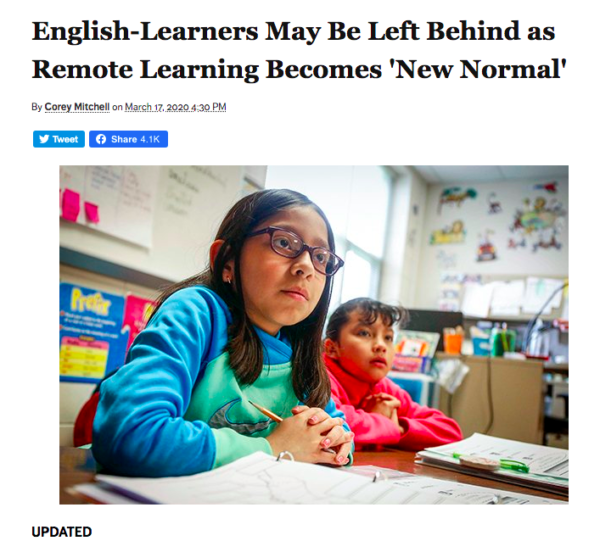
Above: An Education Week article exploring the impact of remote learning on English learners
As a veteran teacher of ELs, I can easily see issues education reporters are missing and need to write more about. Earlier this year, I wrote this piece for The Grade, How to write smarter stories about English learners.
During the coronavirus pandemic, school districts and governments are issuing daily directives noting many that are “open to interpretation.”
Those directives are often in fuzzy English, a challenge for anyone, but particularly daunting for English learners and their family members who may need an additional interpretation from English to their home language.
Are school districts addressing these needs? There’s no way to know unless journalists are holding them accountable for how they are responding to their population of English learners.
Stories on the challenges facing English learners are rare finds among coverage of the effect of the coronavirus on the nation’s schools. That’s too bad.
Above: This article from a local newspaper in Pennsylvania shows how appropriate data about ELs and other student groups can give context to a story.
It’s easy for reporters to overlook these students. They are unevenly distributed and are heavily concentrated in schools with high percentages of other ELs. Seventy-five percent of U.S. schools, according to the U.S. Department of Education, either have low percentages of ELs or none at all.
In addition, language differences also make it difficult to contact the students and their families; in some cases, family members’ immigration status may encourage them to stay under the radar.
Though there have been some improvements in recent years, the vast majority of education reporters identify as white, as revealed in The Grade’s 2019 snapshot of newsroom diversity. Relatively few are multilingual.
Still, even with access, the stories of ELs don’t necessarily get told. This USA Today article about a school district in New Jersey with a 29% EL population included quotes from two different Spanish-speaking parents, but nothing specific about EL students’ particular struggles. The article focused on parents waiting in line to get information packets, meals, and Chromebooks. It was a missed opportunity to explore the particular challenges for ELs.
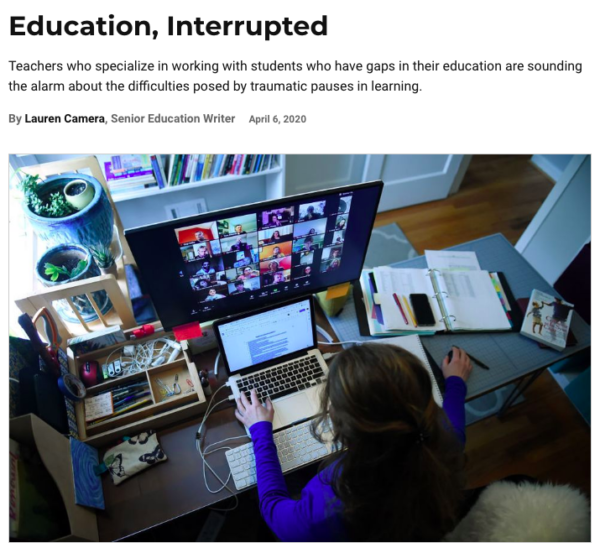
Above: This recent USNews article features English learners in a broader context
How can more education journalists include English learners and their families as part of coverage during the pandemic? Here are some suggestions:
- Ask what districts are doing for their ELs. The Center on Reinventing Public Education (CRPE) is building an online database with links to 101 (and counting) school districts’ detailed plans for responding to the COVID 19 crisis. Only 51% of the districts listed, however, say they are providing resources for special populations, which includes ELs. Use the database as a starting point for questions.
- Talk more to teachers, less to school superintendents. Teachers of ELs know their students better than administrators anyway. They are also more likely to give you insights into challenges their students’ families are facing.
- Report on the areas where the students are. This U.S. Department of Education report lists school districts in the U.S. with the highest numbers and percentages of ELs. Another good place to find schools with high percentages of ELs is each state’s department of education data website. This article from a local newspaper in Pennsylvania shows how appropriate data about ELs and other student groups can give context to a story.
- Cover aspects unique to English language learners, including lack of information in the home language and worries about extended family members in the home country. This article for The 74 focused on additional concerns EL families may have because of immigration status. In this U.S. News and World Report story, Lauren Camera wrote about ELs with limited formal education, students with gaps in their education even before this shutdown.
- Seek out data on how well EL students are being reached and served by district remote learning programs. Colleen Wright’s story in the Miami Herald reported how one group of ELs had been overlooked in Miami-Dade County Public Schools’ online plans. Are EL remote learning participation rates better or worse than district averages? What about EL engagement rates?
Related posts:
How to write smarter stories about English learners
ABOUT THE AUTHOR

Barbara Gottschalk
Barbara Gottschalk is an ESL teacher & author of “Dispelling Misconceptions About ELLs” & “Get Money for Your Classroom.” You can reach her on Twitter at @barbgottschalk1.