Despite a fast-moving story and limitations on in-person reporting, education journalists are still getting the job done.
By Alexander Russo
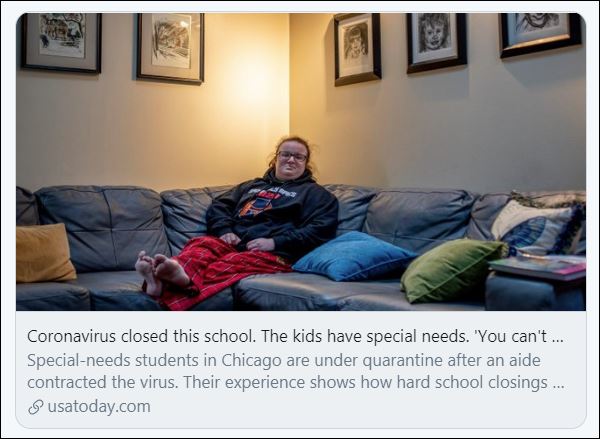
For her March 15 story about kids with special needs attending a school that had already moved to online learning, USA Today’s K-12 education reporter Erin Richards drove to Chicago and stood in doorways to do in-person interviews.
Her story reflects the details that only firsthand reporting can generate. But that was before social distancing guidelines went into effect, and what Richards did last week is going to be even harder if limits on social interactions intensify.
Thus far in the new era, news outlets and education teams are operating at an extremely high level, producing an abundance of generally high-quality stories.
They have been making do as best they can, relying on remote and online options. And they’re going and seeing things firsthand when they can – and when they think it’s important enough.
How much longer they can continue to report effectively under these conditions is an open question, especially if restrictions on social interactions grow more stringent and the potential recession affects reporter jobs.
In nearly any scenario, covering the coronavirus story is going to be an enormous challenge.
It’s all hands on deck, notes USA Today’s national education editor, Chrissie Thompson. “Right now, I don’t know of an education reporter anywhere in Gannett who is not 100 percent on coronavirus coverage.”
“When you shut down an entire school system, the ripple effects are huge and affect everyone,” the Seattle Times’ Dahlia Bazzaz wrote in an email. “Trying to bottle the scale of that disruption into a few hundred words is the hardest thing I’ve ever had to do as a journalist.”
Update: In an interview published Friday, New York Times education reporter Eliza Shapiro said that her doctor said she had likely gotten COVID-19. However, she was never tested. Now recovered, she also reported a new story.
Sign up here for our free newsletter featuring the week’s best education news & newsroom comings and goings.
When it comes to its effects on schools, the coronavirus story is a fast-moving and uncertain one.
Most schools are closed. Some are making a go of it online or offering packets of work and broadcast options. There’s been a ton of confusion around the federal guidelines for the length of school closings and the requirements for providing special education.
However, an unsettled, fast-moving story is just one of the challenges involved.
With so many schools closed, there’s no central place to talk to kids, parents, and educators. School and district phone calls are going unanswered, often without forwarding information.
Many newsrooms are shuttered, too, forcing reporters and editors to try and get their work done on laptop computers sitting at kitchen tables.
Some reporters have their own health issues to consider, including asthma or family with medical conditions that make them vulnerable.
For reporters who are parents — which includes LOTS of education reporters — the challenges are tripled: No school. No newsroom. Everyone’s trying to do everything in a space that’s probably not used to that kind of intense use.
Then there are the still-new social distancing guidelines, which vary by region and newsroom but generally call on reporters to talk to potential sources and interview people from a distance, or perhaps even to avoid in-person reporting as much as possible.
Needless to say, carefully planned stories scheduled for the spring have been mothballed or reconsidered.
Creative use of callouts and remote reporting
There’s lots that can be done online these days, which has been a great aid to reporters working remotely.
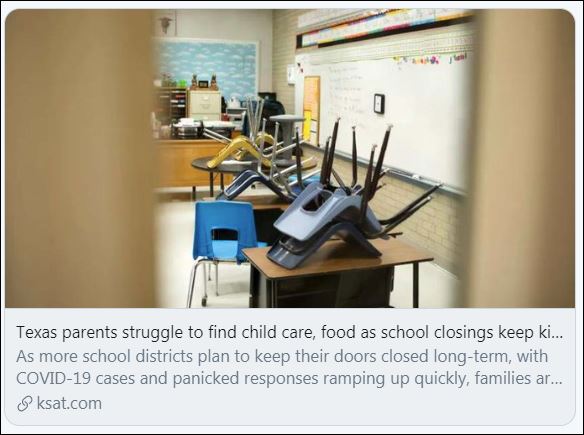
The Texas Tribune has been circulating a callout at the bottom of each of its coronavirus stories, generating almost 6,000 responses so far across a variety of topics. “I have been sitting at home calling parents, teachers, and students who have responded, and vetting them, for use in my stories,” said the Tribune’s Aliyya Swaby via Twitter. She wrote about parents’ struggles to find childcare and food earlier this week.
Austin public radio’s Claire McInerny reported this story about kids being home from school totally remotely. “Our station has been ‘work from home’ and not trying to meet up with people,” McInerny says. “We decided great audio quality is not the priority here.”
WNYC’s Jessica Gould writes that when it comes to field reporting, she’s “not doing that very much this week.” However, she’s finding a lot of engagement online and on the radio, and focusing on getting information out to her audience. “I’m not as concerned as I usually am with crafting the most beautiful package of storytelling and sound.”
See her most recent piece here.
Being selective about in-person reporting
There are still situations in which reporters have been going out into the field and reporting on what they see firsthand.
Bethesda Beat’s Caitlynn Peetz reported her story about grab-and-go meal programs in her district and told me via Twitter that she and her fellow reporters are being careful but “if there’s an event or something going on out in the community, we’ll still go.”
The Seattle Times’ Bazzaz visited one of the Seattle schools offering free lunch, calling it “one of the only gestures of normalcy and hope schools” can offer to families right now.
“I try to do most of my reporting remotely unless the story demands that I be there in person to witness what’s happening,” Bazzaz writes. “I carry my hand sanitizer with me, and try to stay at least a few feet away from my interview subjects when possible.”
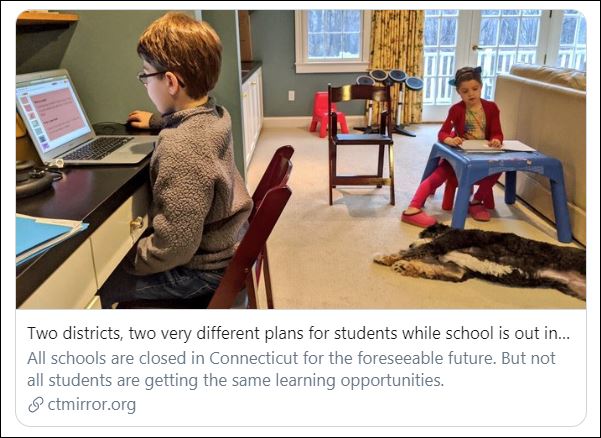
The main drawback of working remotely has been not getting spontaneous answers to questions from the governor during his daily appearances, says the CT Mirror’s Jacqueline Rabe, whose latest story is here. Even with phone interviews, “you lose out a lot,” she told me (in a phone interview). “You just don’t necessarily know what you’ve lost.”
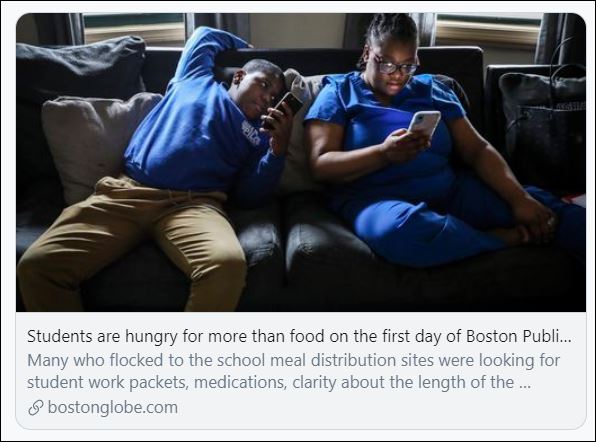
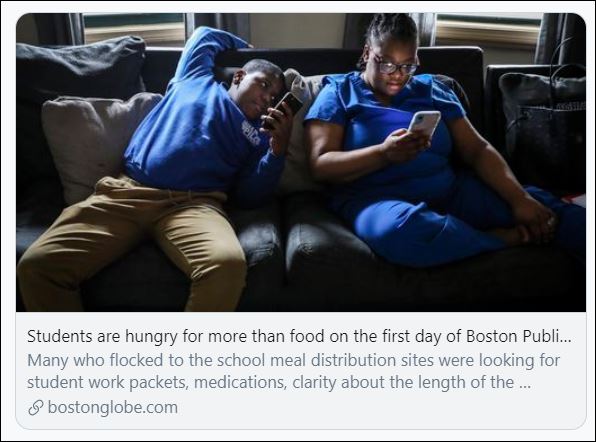
Above: “Malaki donned his school uniform, a cobalt blue polo shirt embroidered with his school’s name,” opens a recent Boston Globe story. “He headed out alone into lightly falling snow for the short walk to the nearest open school… in search of food for his family.”
Recognizing the limits of remote reporting
Most of the education journalists I talked with this week are reporting each situation as best they can, making decisions on how to report the story on a case by case basis.
“It’s a mix,” wrote WHYY Philadelphia public radio’s Avi Wolfman-Arent, who like many reporters is working from home and doing as much as possible online. “As far as going out, it’s mostly just been to talk with families…man-on-the-street kind of stuff.”
In some cases, reporters are thinking twice about field reporting.
“I thought about going out to see how the school meals were being distributed to students at school sites, but I chickened out at the last minute,” said the Tribune’s Swaby. “I didn’t want to risk anyone else’s health, especially people just waiting to get their free food.”
WBUR’s Kathleen McNerney told me that she and her reporters have been having explicit conversations about the necessity of field reporting stories. “For every story, I’m asking ‘Do you feel comfortable doing this?’ and ‘What precautions are you taking?’,” the senior producer and editor told me in a phone interview. For this Monday piece about Boston’s last day of school for the foreseeable future, reporter Carrie Jung did some onsite reporting.
Editors are also having to rethink all their plans.
“We’re certainly replacing pre-planned stories that were framed around the assumption of a fully open and operational school system,” says the Seattle Times’ Joy Resmovits, describing planned pieces that “might make no sense or feel inappropriate in the context of a protracted school closure.”
The one silver lining may be that everyone’s working on the same story at the same time.
“Yesterday’s piece on whether we’ll need more summer school was a collaboration between Lily Altavena in Phoenix, Max Londberg in Cincinnati, Justin Murphy in Rochester, New York, and Jim Little in Pensacola, Florida,” notes Thompson in an email. “Erin’s piece this morning on the legal/equity concerns of online learning had contributions from John Wisely in Detroit, Olivia Krauth in Louisville and Max Londberg in Cincinnati.”
To learn more about how the media covers education, follow The Grade on Twitter and Facebook.
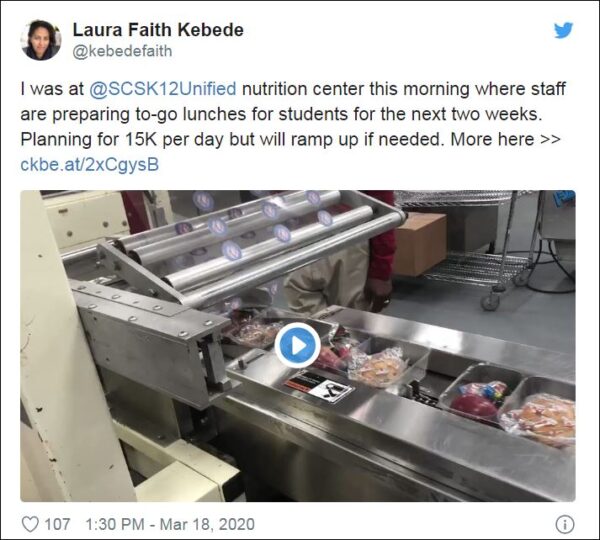
Above: “I was at @SCSK12Unified nutrition center this morning where staff are preparing to-go lunches for students for the next two weeks,” tweeted Chalkbeat TN’s Laura Faith Kebede. You can read more here.
A new way of doing things?
USA Today’s Richards weighed whether to make the drive to Chicago and talked with her editor about how to report the story safely. “There’s so much more that you can report when you’re on the scene,” she told me in a telephone interview, describing “all those rich details you get when you’re looking people in the eye.”
But in this new era of reporting, “we have to engage with our sources in different and more distant ways,” Richards says.
To be sure, the demand for firsthand reporting may increase when schools come back into session or roll out their education plans.
“I’ve been [working] remotely since last Wednesday,” the El Paso Times’ Molly Smith told me. “But that may change next week once schools are no longer on spring break and will begin distributing meals/homework packets.”
The basics of beat reporting remain the same, even when the situation is extraordinarily unusual.
“Figure out what your priorities are, pivot briefly for breaking news, and then re-center,” says Bazzaz. “Think about what this means not just for people for whom it is an inconvenience, but a threat to their livelihoods and health.”
Related pieces from The Grade
ABOUT THE AUTHOR
Alexander Russo
Alexander Russo is founder and editor of The Grade, an award-winning effort to help improve media coverage of education issues. He’s also a Spencer Education Journalism Fellowship winner and a book author. You can reach him at @alexanderrusso.
Visit their website at: https://the-grade.org/