Previously characterized by a focus on affluent communities, the new wave of gifted education coverage addresses systemic inequalities. Here’s how it’s being done.
By Holly Korbey
Not too long ago, former Seattle Times education reporter Claudia Rowe cringed when she heard some parents she knew compare getting into the city’s gifted program to getting into a private school.
Were the city public schools’ gifted programs — free, publicly funded programs ostensibly available to everyone — only attainable for white, affluent parents who were in the know?
Rowe decided to find out.
Over the course of 10 months in 2017 and 2018, she produced a series of stories on Washington’s gifted education program that revealed stark inequities in how students were identified and served.
Her reporting revealed that Seattle’s gifted program was made up of nearly 70 percent white students, yet they made up less than half the entire school population. Meanwhile, just 1.6 percent of black students and 3.7 percent of Latino students participated.
“The idea of so-called gifted education has become a flashpoint for these issues around race and class and access,” said Rowe, now a freelance writer and author. “But I didn’t even know how intensely it would crystallize these issues.”
After Rowe’s series ran, the state and the district launched initiatives aimed at increasing equity in their gifted programs, which soon turned into a battle over whether Seattle Public Schools should keep the program at all.
Coverage has deepened and improved in recent years, and journalists I talked to identified a handful of key strategies for covering gifted education with a fresh eye.
Done well, gifted education is a timely and powerful lens to examine inequality in schools. It’s not just another selective schools story focused on affluent, anxious parents. It deserves more coverage than it gets.
Done well, gifted education is a timely and powerful lens to examine inequality in schools. It’s not just another selective schools story focused on affluent, anxious parents. — Holly Korbey
Gifted education affects a relatively small number of students — only about 6 percent of public school students are enrolled in gifted programs nationally — but it speaks to larger issues.
Many gifted programs are disproportionately made up of white and Asian higher-income students — and their voices have historically driven coverage of gifted education, especially in large urban districts. This has long been a failing in education coverage.
“Why are we getting [so many] stories about anxious upper-class parents? Because that’s New York City parents. I think there’s that bias,” said University of Arkansas gifted and education policy researcher Jonathan Wai, referring to stories like this 2018 Wall Street Journal piece about privileged parents paying expensive tutors to coach 4-year-olds into gaining admission to New York City’s gifted and talented program.
New York’s gifted coverage sets the tone for the rest of the country, Wai said, even though it’s not representative of the research base or even what people are doing elsewhere. “I find that to be a huge blind spot.”
To learn more about how the media covers education, follow The Grade on Twitter and Facebook.
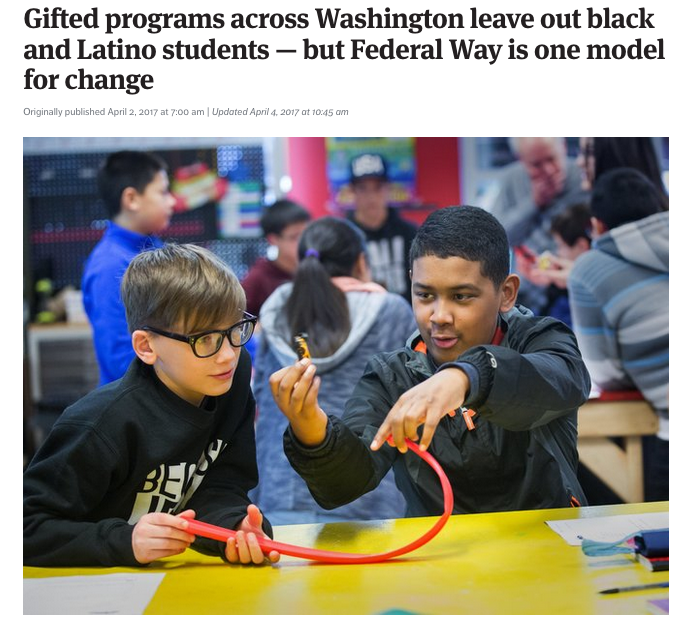
Above: One of Claudia Rowe’s 2017-2018 Seattle Times series on inequalities in gifted education.
Rowe’s reporting was one of the first in a recent wave of education coverage looking at gifted education as a failure of educational equity.
During the last couple of years, education reporters at USA Today, the New York Times, Chalkbeat Tennessee, and a handful of other publications have also produced stories on the controversial issue of who gets to be “gifted” and whether the promise of reaching a student’s potential gets fulfilled.
Education Week reporter Christina Samuels, who covers the equity in education beat, wrote in an email that she sees a few unfortunate reasons for the lack of media attention in the past, including a sense that gifted kids will succeed “no matter what,” as well as a lack of federal attention and a tiny bit of funding always on the chopping block.*
Samuels, though, is encouraged by recent stories from her Education Week colleagues on gifted equity. Sarah Sparks’ series on gifted and disadvantaged students from 2016, Unmet Promises: High-Achieving, Low-Income Students, has been followed more recently by EdWeek stories focusing on gifted students who also have disabilities.
“All of those conversations are helpful in expanding the conversation around giftedness,” Samuels said.
Both Wai and education reporters interviewed for this piece see equity of access as the most controversial and complex issue surrounding gifted education and believe there’s ample opportunity for more investigation across the nation.
Sign up here for our free newsletter featuring the week’s best education news & newsroom comings and goings.

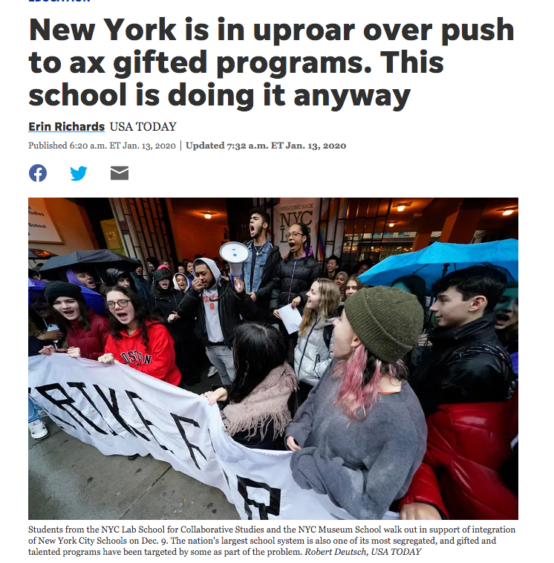
Above: Erin Richards’ recent USA Today report on proposals to eliminate gifted and talented programs in New York City.
If you’re interested in tackling the topic or exploring it from a different perspective, here are some great ways to report and write your own stories:
Seek out all sides of the story
In reporting for her January 2020 story, New York is in uproar over push to ax gifted programs. This school is doing it anyway, USA Today’s Erin Richards worked hard to include parents of different races and ethnicities in her coverage of New York City’s proposal to eliminate its gifted program in an effort to integrate the city’s public schools.
Through interviews with white, black and Latino parents, she quickly learned there wasn’t agreement on what to do about the gifted program at one Brooklyn school considering elimination of the program.
“Radically overhauling gifted and talented programs has long been a political third rail, largely because the programs are popular with affluent parents whose children are enrolled,” Richards wrote. “Then there’s the troubling fact that the move to eliminate gifted programs is opposed by some black and Latino parents, whose kids it’s supposed to help.”
“It’s not just about how smart you are,” Richards said in a phone interview. “It’s about opportunity and resources, the haves and have-nots.”
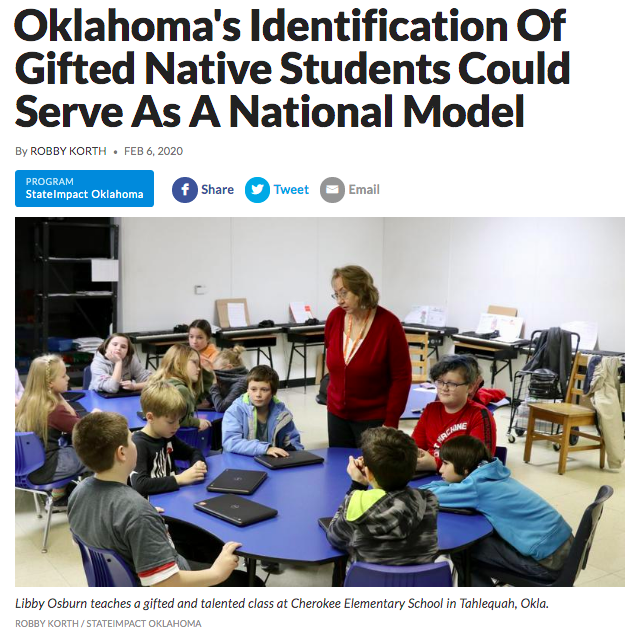
Above: Robby Korth’s 2019 StateImpact Oklahoma story about inclusion of Native American students in gifted programs.
Look for bright spots
In 2019, Oklahoma NPR education reporter Robby Korth stumbled across a Purdue University state-by-state analysis of gifted education programs and found that his state was doing particularly well identifying and educating gifted Native American students — an unexpected development in a state where students of color often receive uneven and inequitable opportunities.
Funded through StateImpact Oklahoma, Korth’s February 2020 radio story for station KOSU, Oklahoma’s Identification Of Gifted Native Students Could Serve As A National Model, detailed how a foundation grant is helping Oklahoma boost gifted identification of Native Americans, even as the numbers of gifted black and Latino children still lag behind.
To get the details, Korth went to Tahlequah, capital of the Cherokee Nation. He found that schools there were relying on more than one method to identify gifted learners; while nearly every 2nd grader was being screened, teachers were also recommending students who might fall through the cracks.
Korth’s story does a great job highlighting the impact on unidentified gifted students (mostly low-income students and students of color) who don’t receive the proper interventions.
In a state where deep budget cuts and a massive teacher shortage dominate coverage, Korth uncovered a complex and important story about a bright spot in Oklahoma schools that had been rarely covered.
“Listeners are into gifted education,” Korth said. “Because I think that we all want to see the most out of our kids.”
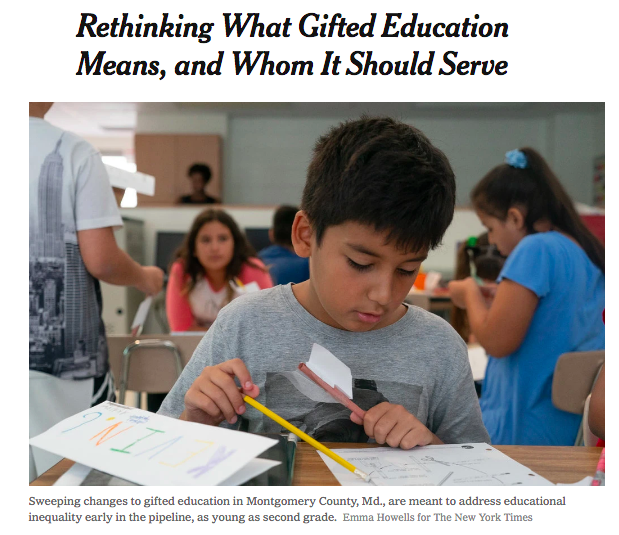
Above: Dana Goldstein’s 2018 New York Times story about efforts to improve identification of students in Montgomery County, Maryland.
Focus on how students get identified
How students get identified for gifted programs can be a gold mine for education reporters.
Other reporters’ stories on gifted screening have helped to demystify the underlying racial and economic disparities in gifted and selective programs.
Dana Goldstein’s 2018 New York Times story, Rethinking What Gifted Education Means, and Whom It Should Serve, detailed how Montgomery County, Maryland, overhauled its screening process to be more equitable.
And Eliza Shapiro’s 2019 story, Should a Single Test Decide a 4-Year-Old’s Educational Future?, shows how New York City’s only gifted screening, administered when children are 4 years old, benefits parents in the know and ones who can pay for tutors.
Research has shown that testing and identification vary wildly from state to state. Some states approve dozens of acceptable gifted tests, and in others, students can be recommended to a program by a teacher or a parent.
In Oklahoma, grant money was supporting a mix of screening and recommendations to help identify gifted Native students.
You have to lay it all out for the reader, so they recognize why this has much wider ramifications than, ‘Am I happy or mad that this kid passed the gifted test?’— Former Seattle Times education reporter Claudia Rowe.
The stories highlighted here just brush the surface of an issue that can illuminate larger inequities in society at large.
There’s room for more stories about gifted programs in the vast country between New York City and Seattle, and for “solutions”-type stories on existing equitable programs, like a Montessori school in Dallas, Texas, that my own child attended, a test-in academic magnet that’s also racially and economically balanced.
“You have to lay it all out for the reader, so they recognize why this has much wider ramifications than, ‘Am I happy or mad that this kid passed the gifted test?’ ” Rowe said in a phone interview. “It’s much bigger than that.”
*This story has been updated to correct the stories recommended by Education Week’s Christina Samuels.
Related stories from The Grade
Cracking the code on reading instruction stories
Writing better stories about students with disabilities
How to write smarter stories about English language learners
The media blind spot hiding a big problem in American classrooms
Teacher strike coverage illustrates need to amplify parent, student voices
ABOUT THE AUTHOR

Holly Korbey
Holly Korbey is a journalist and the author of Building Better Citizens. She’s a regular contributor on education for Edutopia and KQED’s MindShift, and her work has also appeared in The New York Times, The Washington Post, The Atlantic, The Boston Globe, and others. She lives in Nashville with her family. Follow her on Twitter: @HKorbey.