To support the claim that teachers are professionals, licensure must emphasize the knowledge and skills most directly tied to the work of teaching.
Whatever the occupation, professionalism involves two claims to competence: (1) Professionals have the specialized knowledge and skills needed to carry out their work successfully, and (2) they have met their profession’s high standards of practice (Abbott, 1988; Larson, 1977).
To ensure that they meet these criteria, professionals undergo rigorous and extensive training, often culminating in a licensure exam. Such exams cannot assess all the knowledge and skill the profession requires, but they can at least certify the aspiring practitioner’s command of the field’s most essential competencies. Further, through the process of creating such tests, the profession pushes itself to define those key competencies, which, in turn, lets preparation programs know what content and skills they need to teach. And through administering and scoring those tests, the profession protects the public from aspirants who haven’t met those standards. In short, licensure exams function — and have functioned for many decades — as a means of supporting claims to distinct expertise and capability, which leads to public trust and recognition of professional status.
In medicine, for example, licensure exams have long been used to assess specialized knowledge in areas such as anatomy, biochemistry, pathology, and pharmacology. And in recent years, they have evolved also to assess professional practice. For instance, the United States Medical Licensing Examination includes clinical simulations that require test takers to diagnose patient illness and communicate the results. After all, professionals are defined not just by their knowledge but also by how they put that knowledge to use (Glazer, 2008).
Arguably, licensure exams in every field should assess both professional knowledge and essential practices. That might mean, for example, demonstrating the ability to land a commercial jet, provide sound legal advice, diagnose a mental illness, insert an IV, or — in the case of new teachers — model for students how to decode words or approach challenging mathematics problems.
Licensure tests and teaching
Teaching is one of the largest licensed professions in the United States, and nearly all teachers are required to pass a licensure exam before entering the classroom (U.S. Department of Education, 2016). However, questions abound as to those exams’ quality, design, and purpose: To what extent do they actually assess important professional competencies? And how might they better attend to both the core knowledge and practices that beginning teachers should be expected to master?
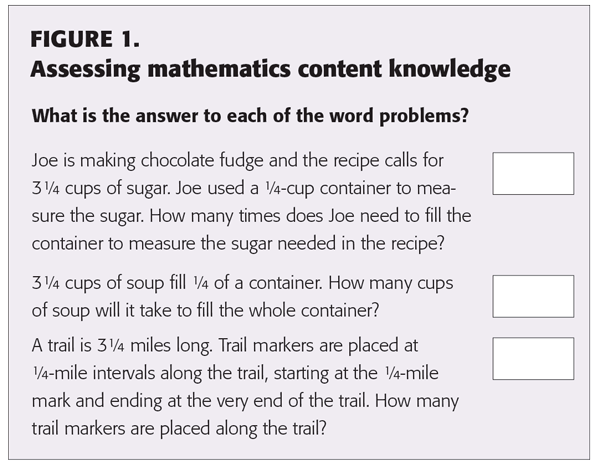
At present, the majority of teacher licensure exams focus primarily or exclusively on new teachers’ knowledge of the content they are expected to teach (Gitomer & Zisk, 2015; Mitchell et al., 2001). Indeed, they often feature questions about content that are remarkably similar to those commonly found on student achievement tests (as illustrated in Figure 1).
Of course, new teachers should be able to demonstrate that they understand the content they’ll be teaching. However, knowledge of this sort isn’t necessarily a form of professional knowledge (that is, knowledge that sets the professional apart from other well-educated people). Licensure exams that focus primarily or solely on the content that should have been mastered in K-12 education serve to undermine the argument that teaching requires its own specialized knowledge base and should be considered a profession.
Testing for professional knowledge
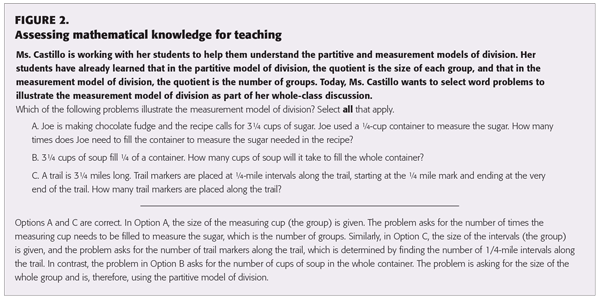
A new generation of assessment tasks (often referred to as content knowledge for teaching, or CKT) is designed to assess a fuller range of the content knowledge used in teaching school subjects (see for example, Gitomer et al., 2014; Hill, Schilling, & Ball, 2004; Kersting, 2008; Krauss, Baumert & Blum, 2008; Phelps, 2009; Phelps, Gitomer, et al., in press). CKT assessment tasks are designed to provide evidence of the knowledge teachers use in many of their daily tasks — such as evaluating student work, representing content to support particular learning goals, eliciting student thinking, explaining and modeling concepts, and many others (Gitomer, Phelps, et al., 2014; Phelps, Gitomer, et al., in press). Figure 2 shows an example of this type of task.
At first glance, the items shown in Figure 1 and Figure 2 might look similar. However, closer inspection reveals that Figure 2 calls for a different and arguably deeper understanding of mathematics. To answer the question in Figure 2, test takers must examine each word problem to identify the model of division that is represented. These different models of division are important to students’ learning of mathematics because they provide insight into how division is related, for example, to the commutative property of multiplication. Teachers use this mathematical knowledge as they select appropriate word problems to illustrate the different models of division for students. Rather than simply assessing whether a teacher can solve a word problem involving division (which most educated adults can do), practice-based items like this assess specialized knowledge about division used in teaching (see, for example, Ball, Thames & Phelps, 2008; Hill & Ball, 2009).
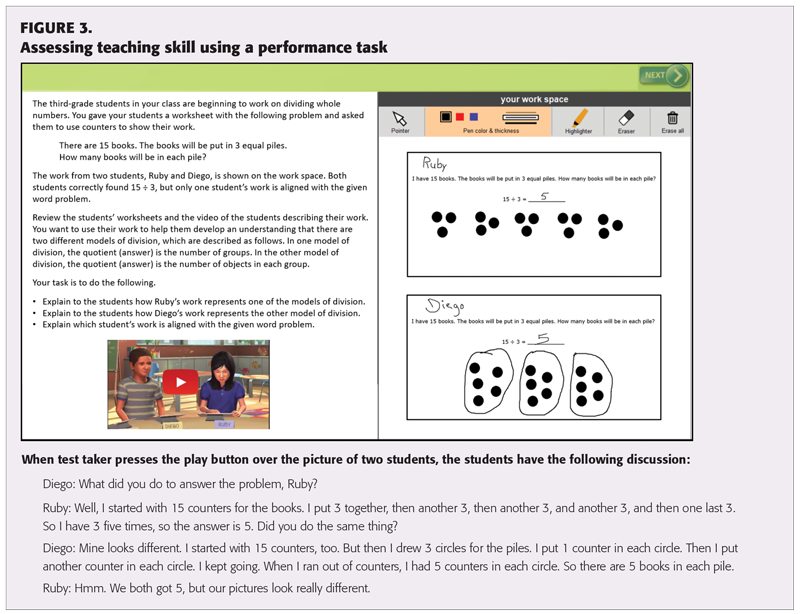
By assessing knowledge specific to the work of teaching, the CKT assessment approach represents a significant step forward for licensure exams. Again, though, it is important to assess not only what new teachers know but also what they can do in the classroom. The performance task shown in Figure 3 requires test takers not only to demonstrate that they can differentiate among the models of division but also to show that they can explain these differences. After considering the instructional situation and reviewing the short video of two students discussing their mathematical work, the test taker delivers a short explanation as if speaking to students. A virtual whiteboard is available for the test takers to present visual representations as part of their performance.
A good explanation will help students understand the two models of division, the underlying mathematical structure of each model, and why each student’s approach will give the same numerical answer. To successfully complete this performance task, teachers must have not only a deep understanding of the given mathematical concept, but also the skills needed to represent and explain the content in ways that will support student learning.
A call for more practice-based testing
Taken together, Figures 1-3 provide a vivid illustration of differing approaches to assessing teacher competence. Historically, teacher licensure has focused on general types of proficiency and knowledge of the content that students are learning. This approach has done little to support the claim that teaching is a profession requiring its own distinct professional knowledge and skills. Perhaps general content knowledge should be a requirement for entering a teacher preparation program, but it should not be the emphasis of licensure tests designed to assess the professional knowledge that aspiring teachers acquire during professional training.
In stark contrast to knowledge-based testing, recent practice-based approaches seek to assess teachers’ facility with the professional competencies they gain during teacher preparation — that is, how they will use their professional knowledge to help students learn a subject. Licensure tests that assess the types of content knowledge and teaching practices illustrated in Figures 2 and 3 would focus directly on the professional work of teaching.
There are, of course, challenges that would need to be addressed to develop such a practice-based licensure program. Decisions would need to be made about the teaching practices that are most critical to assess and then tests would need to be developed for all major subjects and grade levels. Including performance tasks would complicate administration, and the human scoring would increase costs compared to traditional multiple-choice tasks. Such costs would need to be balanced against the benefits of providing evidence of teaching competencies that focus directly on the work of teaching. However, preliminary research suggests that practice-based knowledge and performance tasks can be developed, scored, and administered in ways that are cost effective and that provide valid and reliable evidence of teaching competence (see for example, Mikeska et al., 2018; Phelps, Bridgeman, et al., 2020; Phelps, Steinberg et al., in press).
The sorts of assessment tasks presented in this article illustrate just one promising approach to improving teacher licensure exams by focusing on professional knowledge and practice. For example, other emerging models (such as edTPA and the Praxis Performance Assessment for Teachers) feature portfolio assessments, assessing competencies such as planning a lesson to meet particular instructional goals and student needs, engaging students in learning the lesson material, and reflecting on and adjusting instruction.
There is more than one potential avenue for assessing aspiring teachers’ specific professional competencies. What’s important is that we actually do it. Today, most teacher licensure tests provide incomplete evidence of the critical competencies that make up the core work of teaching. In professions such as medicine, licensure tests undergo frequent revision to ensure that they provide evidence of the most important professional competencies required to enter the profession. The same should be true of teaching. Improving licensure exams can help strengthen teaching’s status as a profession by emphasizing the specialized knowledge and skills that are distinctive to teaching.
References
Abbott, A. (1988). The system of the professions: An essay on the division of expert labor. Chicago, IL: University of Chicago Press.
Ball, D.L., Thames, M.H., & Phelps, G. (2008). Content knowledge for teaching: What makes it special? Journal of Teacher Education, 59 (5), 389-407.
Gitomer, D.H. & Zisk, R.C. (2015). Knowing what teachers know. Review of Research in Education, 39 (1), 1-53.
Gitomer, D., Phelps, G., Weren, B., Howell, H., & Croft, A. (2014). Evidence on the validity of content knowledge for teaching assessments. In T. Kane, K. Kerr, & R. Pianta (Eds.), Designing teacher evaluation systems: New guidance from the Measures of Effective Teaching project (pp. 493-528). San Francisco: Jossey-Bass.
Glazer, J.L. (2008). Educational professionalism: An inside-out view. American Journal of Education, 114, 169-189.
Hill, H. & Ball, D.L. (2009). The curious — and crucial — case of mathematical knowledge for teaching. Phi Delta Kappan, 91 (2), 68-71.
Hill, H.C., Schilling, S.G., & Ball, D.L. (2004). Developing measures of teachers’ mathematics knowledge for teaching. The Elementary School Journal, 105 (1), 11-30.
Kersting, N. (2008). Using video clips of mathematics classroom instruction as item prompts to measure teachers’ knowledge of teaching mathematics. Educational and Psychological Measurement, 68 (5), 845-861.
Krauss, S., Baumert, J. & Blum, W. (2008). Secondary mathematics teachers’ pedagogical content knowledge and content knowledge: Validation of the COACTIV constructs. ZDM Mathematics Education, 40 (50), 873-892.
Larson, M.S. (1977). The rise of professionalism. Los Angeles, CA: University of California Press.
Mikeska, J.N., Kurzum, C., Steinberg, J.H., & Xu, J. (2018). Assessing elementary teachers’ content knowledge for teaching science for the ETS Educator Series: Pilot results (ETS Research Report No. RR-18-20). Princeton, NJ: Educational Testing Service.
Mitchell, K.J., Robinson, D.Z., Plake, B.S., & Knowles, K.T. (Eds.). (2001). Testing teacher candidates: The role of licensure tests in improving teacher quality. Washington, DC: National Academy Press.
Phelps, G. (2009). Just knowing how to read isn’t enough! What teachers know about the content of reading. Educational Assessment, Evaluation, and Accountability, 21 (2), 137-154.
Phelps, G., Bridgeman, B., Yan, F. & Steinberg, J. (2020). Using situated performance tasks to assess teaching skills. Manuscript in preparation.
Phelps, G., Gitomer, D.H., Iaconangelo, C.J., Etkina, E., Seeley, L., & Vokos, S. (in press). Developing assessments of content knowledge for teaching using evidence centered design. Educational Assessment.
Phelps, G., Steinberg, J., Leusner, D., Minsky, J., Castellano, K., & McCulla. L. (in press). Praxis Content Knowledge for Teaching: Initial reliability and validity results for elementary reading language arts and mathematics. Princeton, NJ: Educational Testing Service.
U.S. Department of Education. (2016, August). Preparing and credentialing the nation’s teachers: The secretary’s 10th report on teaching quality. Washington, DC: Author.
ABOUT THE AUTHORS

Geoffrey Phelps
GEOFFREY PHELPS is a senior research scientist at the Educational Testing Service, Princeton, NJ.
Gary Sykes
GARY SYKES is a principal research scientist at the Educational Testing Service, Princeton, NJ.