While coverage is dwindling in many other places, the Boston region is experiencing a resurgence in education journalism. But that doesn’t mean there aren’t concerns and complaints.
A year ago this month, the Boston Globe’s renowned Spotlight team produced the Valedictorians Project, a series in which a pair of reporters attempted to find out the academic and professional outcomes for Boston Public Schools valedictorians, ostensibly the city’s best and brightest students.
Instead of thriving in college and beyond, as one might have assumed, many of them struggled, and few reached the professional aspirations they’d hoped to achieve.
It was a standout piece of work — by some accounts, one of 2019’s best examples of education journalism — and a harbinger of things to come. A few months later, the Globe would announce that the Spotlight team was going to create a new education desk to do more of the high-quality work on display in the Valedictorians Project.
While journalism jobs are on the decline nationwide, and other regions are struggling with dwindling education coverage, the Boston area is heading the other way. Thanks in large part to philanthropic funding, the region boasts not only the Globe’s expanded education coverage but also the work of two public radio education teams, WBUR and WGBH.
But that doesn’t mean the coverage is as robust as it was back when education teams were much larger, or that there aren’t concerns and complaints about the coverage being provided — including from observers and some of Boston’s own education journalists.
“We have the nation’s top-performing state, K-12 education system, we are a higher education mecca, a hub of innovation in the entrepreneurial and nonprofit sectors and host to the nation’s first public school system,” said Paul Reville, a former secretary of education for Massachusetts and current professor at Harvard. The region should also be a national leader in education reporting, says Reville, “but unfortunately, that is not usually the case.”
Why the Globe is making progress
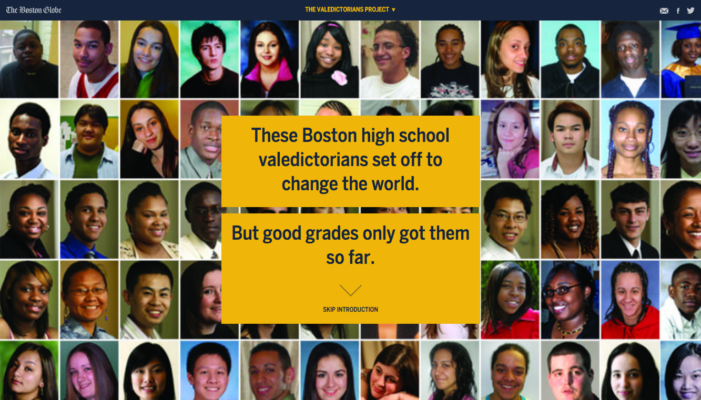
Above: Last year’s Valedictorians Project was a harbinger of renewed education coverage from the Boston Globe.
“The Globe has always taken education reporting seriously — it’s a core part of our mission,” says Felice Belman, deputy managing editor for local news, in an email to The Grade.
But there’s another reason why Boston is making progress on education reporting — a surge in foundation funding.
With financial support from the Barr Foundation, a locally based charitable fund run by the Hostetter family, the Globe launched its expanded education effort, dubbed The Great Divide, in June. The project now employs four full-time reporters and has its own designated editor, Sarah Carr. That’s in addition to the paper’s daily K-12 reporter, James Vaznis, and their separate higher education coverage.
This is a level of investment few regional newspapers put behind their education coverage in the current era — if they have a designated education team at all.
Not surprisingly, multiple Boston media sources point to The Great Divide as a top contributor to the city’s education beat.
Belman says that the new team members “rightly focus a lot of our attention on the city’s troubled public schools.”
The Great Divide already features an impressive scope of stories on that front, including a recent look at the atrocious condition of many Boston public school bathrooms. It’s a good example of how solid education journalism can bring attention to overlooked, practical problems.
Lawmakers, community members, and even many parents are probably not attuned to the indignities of ramshackle public school restrooms. But it’s an unpleasant — and inescapable — daily reality for thousands of Boston students.
One major drawback is that the paper implements a strict paywall that extends to its education coverage. A Globe subscription runs nearly $7 a week. That means at least some of the Boston students and parents most closely tied to and impacted by the paper’s spotlight on educational inequities will lack access to those very stories.
*The original version of this story misidentified Felice Belman as a deputy editor of the Boston Globe’s news department. Her correct title is deputy managing editor for local news.
Education teams at WBUR and WGBH
Above: WBUR’s education project launched the summer of 2016.
The Globe is not the only Boston outlet with an education team.
Radio station WBUR, a local NPR affiliate out of Boston University, kicked off Edify in 2016 with its own three-person education team.
Tracy Novick, a Worcester School committee member and education activist, credits Edify for bringing “thoughtful and careful coverage of education issues that take real time” to Boston-area residents.
Recent Edify stories include coverage of the parental anxieties that school choice can evoke, the declining rate of college enrollment, and an interactive infographic highlighting district performance on state tests.
That kind of user-friendly access to local school data is a huge public service — and one that can often disappear when newsrooms downsize or eliminate designated education coverage.
Financial backing for Edify comes in part from Bob Hildreth, founder of Inversant, and a former member of the WBUR Board of Overseers.
WGBH has also produced some strong education coverage, though its next steps remain unclear. Some of its strongest coverage was being produced by star reporter Bianca Vázquez Toness, on topics including Boston’s controversial process for determining entrance to selective high schools and flaws in the state system for identifying needy students .
“In general, I would say that her framing of stories is different in ways that are useful,” says Novick.
But Toness recently moved over to the Globe’s new education team, and her WGBH position has not been filled. We’ve been told that WGBH plans on replacing her. The job opening is posted here.
Expert views on what’s still being missed or not covered well
Even with Boston’s relatively robust investment in education journalism, many see room for improvement.
Journalist Max Larkin, a founding member of WBUR’s Edify team, says that outlying areas are often overshadowed by a persistent focus on central Boston, which represents just a small part of the region. “We need to get outside the local Boston bubble,” Larkin says, and make a greater effort to engage with communities in surrounding Worcester and Brockton.
Novick cites the same problem. “Boston’s shadow is long, which means we have LOTS of places that just don’t get covered,” she says via email.
For the Globe’s Belman, too, there are plenty of opportunities for different education stories that often aren’t covered. “If we had more reporters, I’d have them write more about innovation in the suburbs. We’d spend more time on charter schools. We’d do some reporting on the colleges and universities that operate in the shadows of Greater Boston’s many powerhouse institutions,” she says.
And though Novick says education coverage is “getting better” over all, she sees a pronounced lack of reporting on state policy. These are “real people are making decisions that have a real impact on public education. What are those decisions? What difference will they make?” She credits reporter Katie Lannan with the State House News Service for being an often-lone voice focused on education policy at the state level.
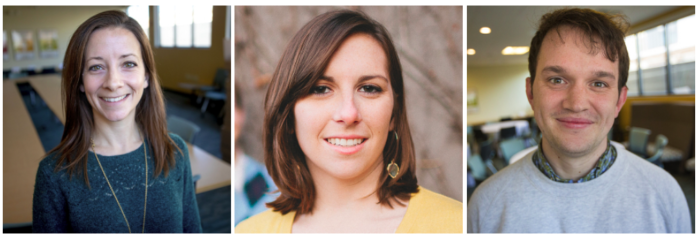
Above: Three members of WBUR’s education news team (left to right: Carrie Jung, Kathleen McNerney, and Max Larkin)
However, the most commented-on shortcoming in the current education landscape is the lack of what Novick calls “doing school” coverage — stories that foreground the perspective of students.
“What is it like to be at the bus stop at 6 a.m.? Or have four hours of homework? Or eat all your meals at school? Or feel as though your whole life depends on getting an A rather than a B+?”
That lack of ground-level perspective extends to parents, too. WBUR’s Larkin says that education reporters can be wrong in their assumptions about what matters most to parents (read: test scores). “Sometimes I think we give too much attention to winners and losers, and we don’t give enough attention to what really makes parents like a school,” he says, citing a handful of recent conversations with parents who relayed what they were looking for in a school.
Their answers included time for outdoor play, attention to their children’s social and emotional needs, and being in a place where their child felt loved and looked after. Notably, none of them listed test scores as a top priority.
George Mastoras, communications manager for the Nellie Mae Education Foundation, makes a similar point about the need for more student and parent input. “I keep hoping to see more community voice, particularly from students and parents,” Mastoras says. “I’m hopeful that reporters pay just as much attention to what’s happening in the city’s classrooms and neighborhoods, and how it affects young people and their families.”
He also says a shift to more “solutions journalism” would be a boon to the education beat in Boston.
This is a perspective Novick shares, wishing the Globe’s recent restrooms piece would have taken the “extra step” to explore what local and state agencies could do to fix the problem. “While they seem to be tackling policy issues, they aren’t taking them in a policy direction, even if that’s what (it at least seems to me) is called for,” Novick says.
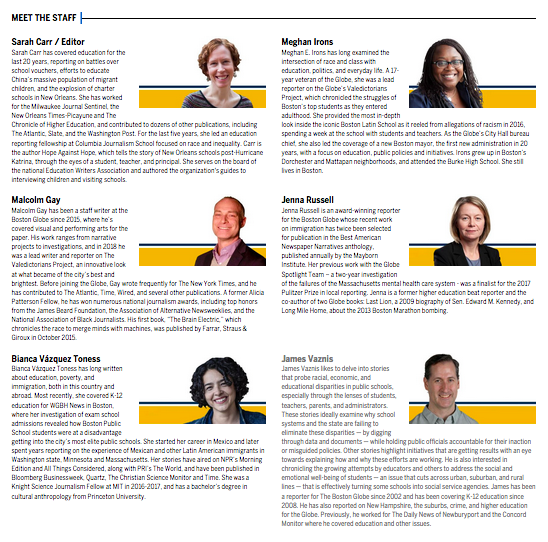
Above: The Boston Globe’s massive-for-2020 education team, including Meghan Irons, Bianca Vázquez Toness, Jamie Vaznis, Malcolm Gay, Jenna Russell, and editor Sarah Carr.
Some observers want more hard-hitting, accountability coverage from the region’s education teams.
“Even Boston, which has generally received disproportionate attention relative to the rest of the state, has seen a drop in attention,” according to longtime educator Reville. He notes that Boston has had a new superintendent since last spring, but her work “has received disappointingly little attention.”
And Keri Rodrigues, founding president of the advocacy group Massachusetts Parents United, says that while the Globe’s new education team is an “encouraging” sign, the region needs a more aggressive approach. “We have to hold elected officials accountable,” she tells The Grade, urging reporters to push those in power to answer for their role in the “sad and sorry state of BPS [Boston Public Schools].”
She was disappointed that local outlets didn’t report earlier on Boston public schools sharing student information with ICE (Immigration and Customs Enforcement), noting that her organization has spent two years asking Boston city council to hold meetings on ICE’s involvement with public schools.
And she questions why the Globe’s Valedictorians Project wasn’t followed by an equally thorough investigation into why so many Boston schools had poorly prepared their best and brightest for success after high school.
“If you only have 13 out of 33 high schools that are accredited, well what do you think is going to happen?” Rodrigues says.
Related stories from The Grade:
In Connecticut, fewer reporters, more missed stories
2 education reporters … for a metro region of nearly 8 million people
Globe launches expanded education effort (2015)
Profiling valedictorians to highlight school inequality
The 7 most memorable pieces of education journalism for 2019
Praise & criticism for coverage of MA’s $41M charter school ballot debate
ABOUT THE AUTHOR

Jessicah Lahitou
Jessicah Lahitou is a a former teacher who writes on education for The Good Men Project. She has previously worked as a newswriter for Bustle, and enjoys penning occasional pop culture essays as well. You can follow her at @jesslahitou.