Hailed as ‘essential listening,’ the new Chicago Public Radio documentary calls for a followup report
By Tara García Mathewson
For several years now, school reform has focused on massive change. Close a school. Keep one open but fire more than half of its staff. Open entirely new schools. Pour millions of dollars into one building on a temporary basis in hopes of transforming teaching and learning.
These are the solutions for turning around schools deemed failing.
But at what, exactly, are these schools failing?
To get at this question, Chicago education reporter Linda Lutton’s latest documentary for WBEZ Chicago Public Radio takes listeners into a single 4th-grade classroom in Chicago’s West Side, located across the street from an apartment Martin Luther King, Jr. lived in 50 years ago in order to draw attention to the slum conditions in the neighborhood.
Hailed as “essential listening” by many who have heard it, The View From Room 205 offers a masterful critique of the widely held belief that public education can be the great equalizer, ensuring every student has access to the American Dream. Its driving question: what if that belief is wrong?
Serving as something of a character in her own story, Lutton comes to the role as a particularly credible expert. She is grounded by more than a decade covering schools in Chicago and armed with tape from 80 visits to Penn Elementary and the homes of its students during the 2014-15 school year, when she also studied the intersection of poverty and education as a Spencer Fellow at Columbia University.
Lutton’s piece opens with a scene from the first day of school during the 2014-15 academic year. Then-Chicago Public Schools chief Barbara Byrd-Bennett tells Penn students there’s no dream they can’t achieve if they stay focused and persistent.
“And with that,” Lutton says, Byrd-Bennett “makes clear it’s up to the 4th graders – and every kid in the room – to work hard and succeed. It’s up to them and William Penn Elementary.”
“Poor kids hear that message all the time,” Lutton said in a recent phone interview. “It’s like repeating it will make it real.”
The truth is, though, most high poverty schools are doing exactly as one might expect.
The students in Room 205 have had so little exposure to fresh fruit, they don’t know the term “ripe,” when school’s out some of them don’t get breakfast or lunch, and neighborhood violence means guns can take down multiple members of a single family.
Penn students overwhelmingly fall below mastery on reading and math skills. Too few of them graduate. Even fewer go on to college. More so than in decades past, family income is incredibly predictive of academic success.
Yet still, Lutton points out policymakers blame schools for poor outcomes, focusing on aggressive education reform rather than interventions that might address the root problems.
“And that’s happening at precisely the moment when school is more important than ever for life success, for getting out of poverty,” Lutton said by phone.
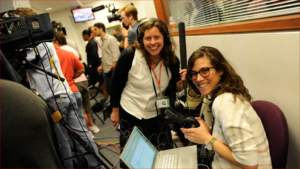
Lutton (left) at what looks like a Chicago Board of Education meeting. via WTTW.
Perhaps the most powerful takeaway from the documentary is its push to move education reform beyond the school building. Lutton reminds listeners that today’s education reformers see their work as a civil rights fight, yet they have largely ignored King’s calls for a basic income or significantly higher minimum wage – efforts that would address poverty head-on. It is this call for recalibrating the reform movement that most stuck with me.
And, of course, there are the children.
Cate Cahan, WBEZ’s senior metro desk editor, said Lutton deserves credit for keeping these students multidimensional in a story about their disadvantage.
“If you’re talking about a school in a poor neighborhood and a school that is trying but struggling, you just expect all these sad stories … and here these children just burst out of her microphone,” Cahan said.
Still, one can’t ignore the truly sad story she is presenting. The child who is the classroom IT guy relies on a cracked-screen smartphone for lack of a traditional computer at home. The relentlessly positive kid who always wants to give a shout out to his mom is in a foster home, and Penn is his third school in three years.
WTTW Chicago Public Television education correspondent Brandis Friedman found herself wanting to hear more than just the sadness and desperation that poverty brings to the educational context. She said Lutton is almost universally considered the city’s best education reporter, but journalists generally get pushback for going into a community and telling a single story of poverty.
“Maybe there was nothing joyful for her to present,” Friedman said. “And I get that, too.”
Journalists spend a lot of time profiling reform efforts that seem to help students overcome the odds – even though, if the odds remain the same, most students will continue to perform exactly as statistics predict. With this piece, Lutton forces education writers to think twice about that.
“It can be hard to look at schools like Penn … hard to look at places like Lawndale,” says Lutton in the piece, referring to the impoverished neighborhood surrounding the school. “I think that’s why we mostly look away.”

Education journalists and documentary-makers have heaped praise on Lutton for her latest work.
Alex Kotlowitz, a decorated journalist and chronicler of the effects of poverty (as well as a collaborator of Lutton’s on This American Life’s 2013 “Harper High” series), said Lutton’s piece reveals how much power there is in the “small story.”
“She goes into this school and goes into this one classroom,” Kotlowitz said in a recent interview. “In that one classroom, she’s able to ask these really large, ambitious questions. That’s the mark of really good nonfiction storytelling and its power.”
Emily Hanford, senior education correspondent/producer for APM Reports, said the piece doesn’t necessarily raise questions other journalists haven’t asked, but it asks them well. She said Lutton did a “marvelous job” connecting observations and the experiences of the people at Penn with pressing larger questions and themes.
“As someone who does this kind of work, I have a very significant impression of how difficult that is,” Hanford said.
Other educators in Chicago and beyond seemed to recognize their challenges in Lutton’s story and listeners have roundly praised the piece as required listening.
It does feel like Room 205 is the first part of a series, though. Lutton brings compelling evidence to the argument that schools can’t overcome the barriers presented by poverty. So what comes next – wraparound services like those of the Harlem Children’s Zone, job training for parents and community members who are underemployed, or something more systemic? Schools do not exist in a vacuum. Education reporting shouldn’t either.
Unfortunately, Lutton said she doesn’t have any major follow-up planned at this point. That means it’s up to other reporters to pick up where she left off. And it’s up to activists and policymakers to heed her call to address poverty head-on.
Tara García Mathewson is a Boston-based freelance education writer whose work has appeared in The Huffington Post, The Christian Science Monitor, The Hechinger Report, National Catholic Reporter and Education Dive, among others. You can find her at www.taragm.com and @TaraGarciaM on Twitter.
Previous columns: Education Journalism’s Diversity Challenge, Do The Work, and Careful About That Dual Language Coverage!
ABOUT THE AUTHOR

Alexander Russo
Alexander Russo is founder and editor of The Grade, an award-winning effort to help improve media coverage of education issues. He’s also a Spencer Education Journalism Fellowship winner and a book author. You can reach him at @alexanderrusso.
Visit their website at: https://the-grade.org/