When a teacher educator is called on to teach a blind student, she learns how to become a better teacher.
As a public school mathematics educator and administrator for more than 25 years, I’ve made many accommodations for special education students. The accommodations have been pretty typical: extra time, an alternate site for testing, or, for a deaf student, written or typed notes — nothing so exceptional that it would keep me up at night.
What did keep me up — at first
I recently accepted a full-time assistant professorship at Rhode Island College. Three months before the semester began, the school notified me that a blind student had enrolled in my elementary mathematics class for preservice elementary teachers. Several staff members assisted with the planning before the semester started. For example, the Office of Diverse Populations ordered a Braille version of our textbook. That office also enlisted someone to assist with quiz and exam translations.
Nonetheless, I felt ill-prepared to teach a blind student — one who had been blind from birth. I had taught students with sight impairments before by using enlarged print materials or writing with a darker marker on a white board. These are easy accommodations. But taking instructional responsibility for a blind student was altogether different. Initially, it was downright frightening. I wanted to make sure the student had the opportunity to participate fully in class, but I wasn’t sure how.
My curriculum and lesson planning included an interactive notebook, hands-on activities such as manipulatives, foldables (three-dimensional graphic organizers), a Frayer model (a strategy that uses a graphic organizer for vocabulary building), and group work. I didn’t know how the blind student would be able to accomplish the work and in a reasonable amount of time. I didn’t understand how she would be able to get to class without assistance. I had so many questions: How could she complete assignments, work on a team with manipulatives, or do a video project? My questions remained unanswered as the semester rolled around.
There were 31 students on my roster so all the seats would be filled. The first day, I arrived early to make sure everything was ready. I kept the front seat available for the blind student so she wouldn’t trip over book bags and other paraphernalia. I set up the document camera and interactive white board and opened the syllabus file. Students started to file in and take what would be their seats for the next 14 weeks.
Then the moment came when the student — whom I’ll call Abbie — arrived at the door. I exhaled audibly. KC, her seeing-eye dog, had guided her mistress to class. My immediate impression was one of relief. I’m not sure why. Was it because I knew Abbie wasn’t alone? No, that wasn’t it. Perhaps it reassured me that this student was serious about her education, that she didn’t expect special treatment. Who knows? It just made me relax and feel as though we could get through this.
So many insights
In our first one-on-one meeting in my office — we would meet many times — Abbie told me she wanted to be a teacher of blind students. But to do so, she had to obtain regular teaching certification. She also told me that to have a seeing-eye dog, one must demonstrate the ability to lead the dog rather than having the dog lead you. In fact, she had traveled with the dog from New York City to Providence.
We would often talk about Abbie’s desire to receive the same education experience as everyone else. KC helped her do just that. One weekend, they took the train to Boston for a conference. She also would take KC on walks in unfamiliar neighborhoods to keep her alert and out of her comfort zone. I never was quite sure whether the “her” referred to the dog — or to Abbie. I’ve since realized that the handler actually directs his or her canine companion where to go.
As Abbie’s teacher, I learned several things.
Don’t overestimate what the student can do.
Teachers believe that students should be able to complete assignments independently. They often feel that if they scaffold too many supports, they’ll lose the integrity of the assignment — that they’ll dumb down the standards (Schmoker, 2010). Therefore, teachers are often hesitant to change the model or type of assessment to better meet all their students’ needs.
What I learned is that some students need alternative methods for demonstrating what they know. Don’t assume they’ll be able to show their learning in the same way as other students. Don’t overestimate them in this sense. However, this doesn’t mean that the student is demonstrating less rigor than his or her peers.
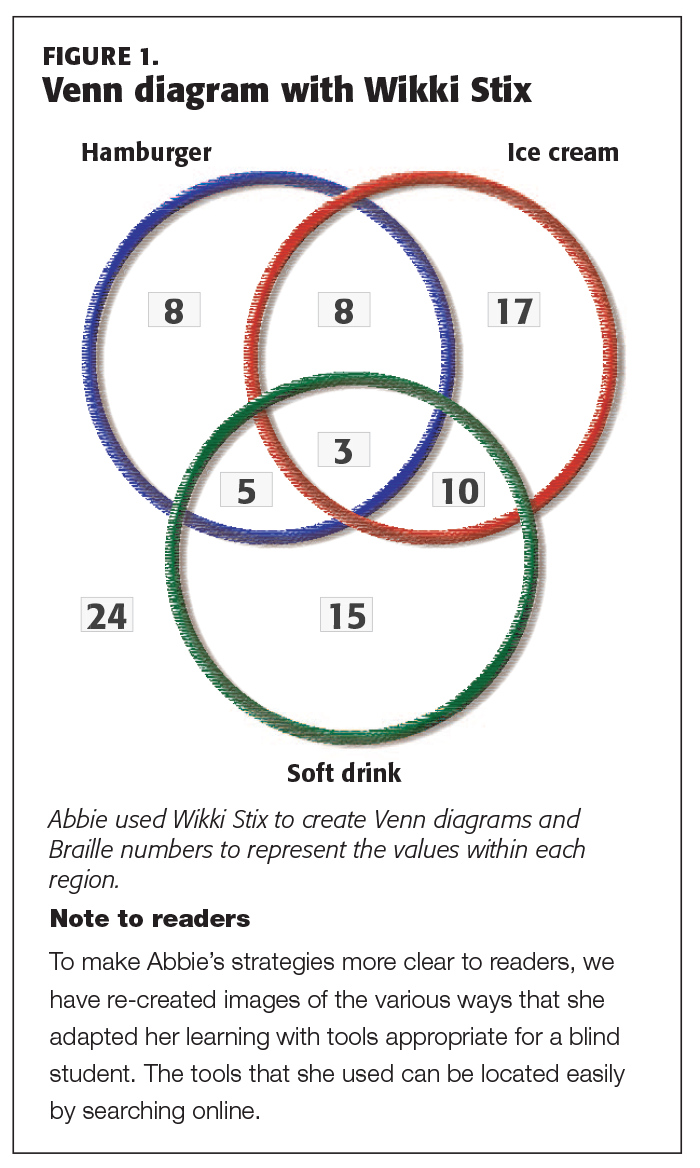
For example, when solving problems using Venn diagrams, Abbie couldn’t visualize the model in her head. Because she’s always been sightless, color has no meaning for her. However, because her senses of hearing and touch are strong, she used Wikki Stix (pieces of yarn that stick to a surface) to create Venn diagrams and Braille numbers to represent the values within each region. Using texture, size, and shape was important because that enabled Abbie to feel each region and use Braille numbers to label each (see Fig. 1). The problem stated that 90 students were at an amusement park, 24 chose a hamburger, 38 chose ice cream, 33 chose a soft drink, 11 chose a hamburger and ice cream, 8 chose a hamburger and a soft drink, 13 chose ice cream and a soft drink, and 3 chose all three. How many students did not choose any of these items? The answer was 24.
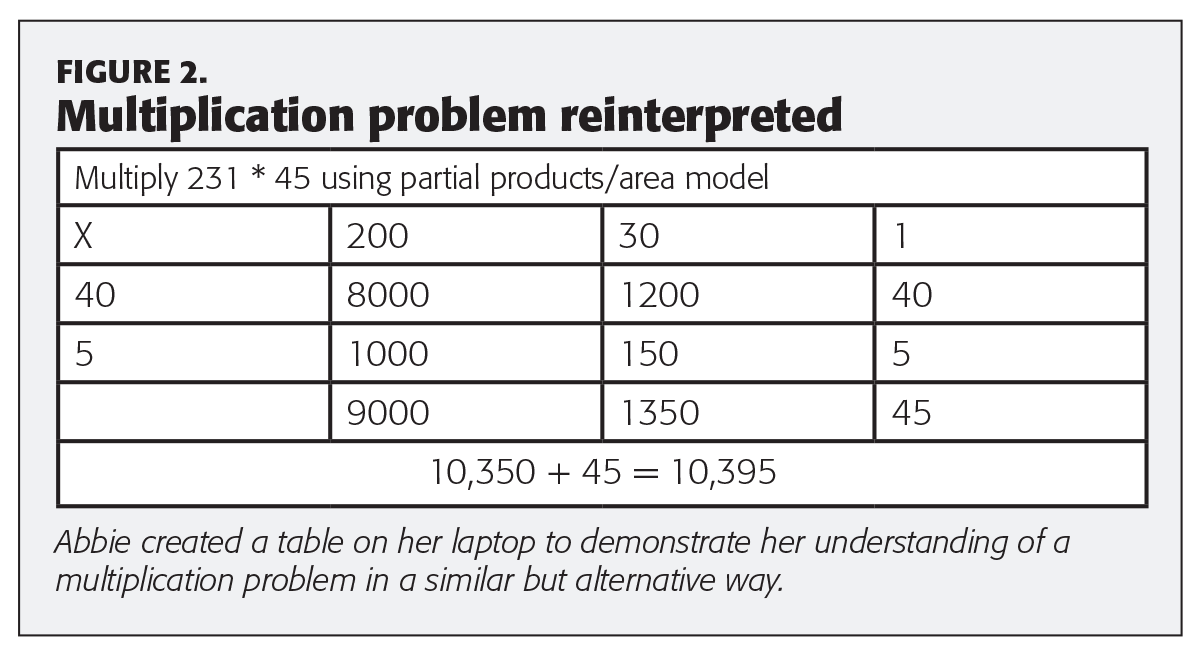
When computing multiplication problems using the partial products or the area model, Abbie could create a table on her laptop and demonstrate understanding in a similar but alternate way (see Fig. 2). Blind students often have a screen reader that will verbally tell them what’s on the page. They can then respond in word-processed form. Voice recognition software can sometimes be used. However, in this example, Abbie created a table and filled in the data. Abbie rarely responded in Braille. The screen reader tool was her preferred mode of obtaining information. (One day I listened to her voice recognition translations, and I couldn’t understand one word. The person spoke so quickly that it was incomprehensible to me.)
When it was time for Abbie to take quizzes or tests, I found that some problems were best examined through discourse and questioning rather than asking her to write her responses down. For example, I often ask students to explain in writing a misconception that students might have in math. With Abbie, I found it easier to have her explain her thoughts out loud. Teachers need to exhibit flexibility to foster student success, especially for students with a range of learning needs.
I also found that I had to speak in a more specific way during instruction. I couldn’t say “this” or “that” as I pointed to the board because Abbie didn’t know what I was pointing to. I had to say everything out loud. For example, when adding 482 and 658, I had to be clear about where to place each value saying 4 hundreds 8 tens and 2 ones are being added to 6 hundreds 5 tens and 8 ones. Unless you prepare and present notes to blind students ahead of time, this is particularly difficult. Sometimes teachers need to make up examples on the spot. When a blind student is in the class, the teacher will need to read out the new problem at least twice. This practice can also be helpful for students with special needs or English language learners. Being precise in one’s speech is just good practice for everyone (O’Connell & SanGiovanni, 2013).
Don’t underestimate what the student can do.
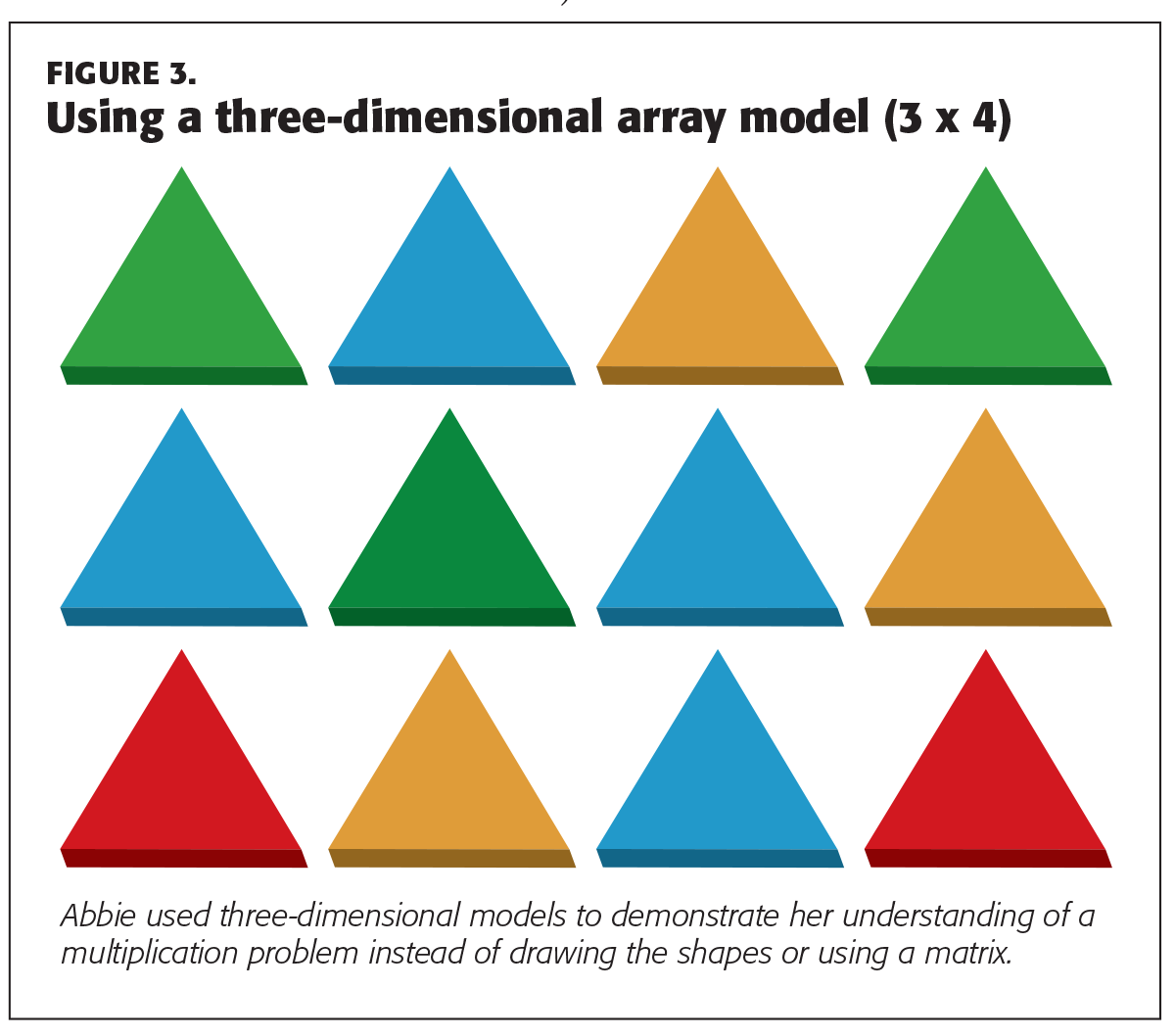
As the semester progressed, I also learned that I shouldn’t underestimate what Abbie could accomplish. We had an assignment to create a foldable on the problem-solving steps: understand, plan, answer, and check. The assignment required an example, use of color, and a manipulative format. Abbie was unable to complete the assignment with accommodation because she writes in Braille, and I can’t read Braille. So she found a solution: She completed the assignment for blind students in Braille, but she narrated each step verbally and wrote in numerical form for sighted observers or participants . Also, part of the project called for students to work on area models of multiplication. Abbie used three-dimensional shapes to represent 3 x 4 instead of drawing the shapes or matrix (see Fig. 3).
Trust the student.
Trusting students is important because they know themselves best. It’s possible that a student could try to take advantage of the situation, but that’s not what I discovered here. In fact, Abbie pushed herself because she wanted to have the same experience as other students in the class. Students need to be responsible for their own learning, and Abbie exhibited such responsibility.
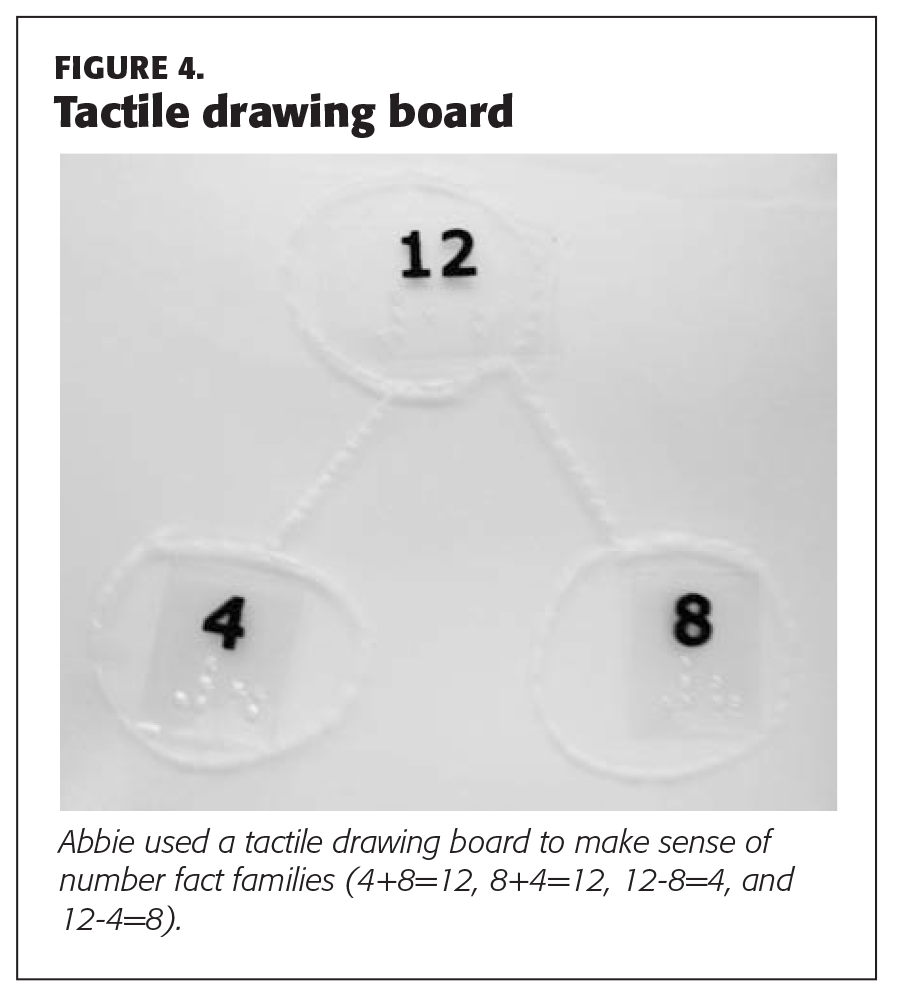
When we were developing a sense of fact families (4+8=12, 8+4=12, 12-8=4, and 12-4=8), Abbie was able to draw a number bond on a tactile drawing board (see Fig. 4). The board holds a clear sheet of paper with a diagonal texture; you can make raised drawings using a writing tool, much like a pen but which creates a raised edge on the paper secured on the board. Abbie could feel the edges so she could solve the math problem. The board became my new friend. Using the board, I could create templates for Abbie so she could complete the same assignment as the other students.
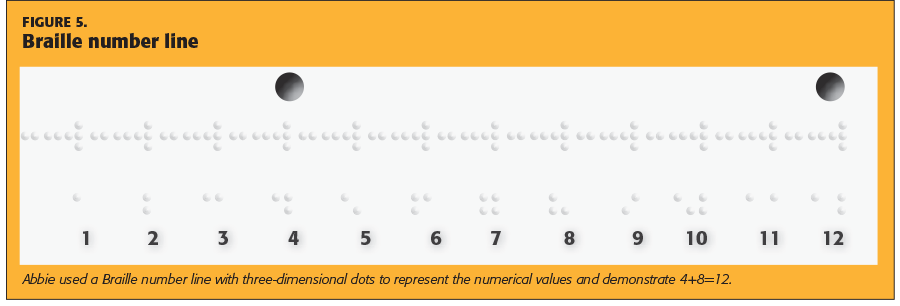
When we covered addition on a number line, I became concerned that Abbie wouldn’t be able to complete this topic proficiently. However, she ended up using a Braille number line with three-dimensional dots to represent the numerical values and demonstrate 4+8=12 (see Fig. 5).
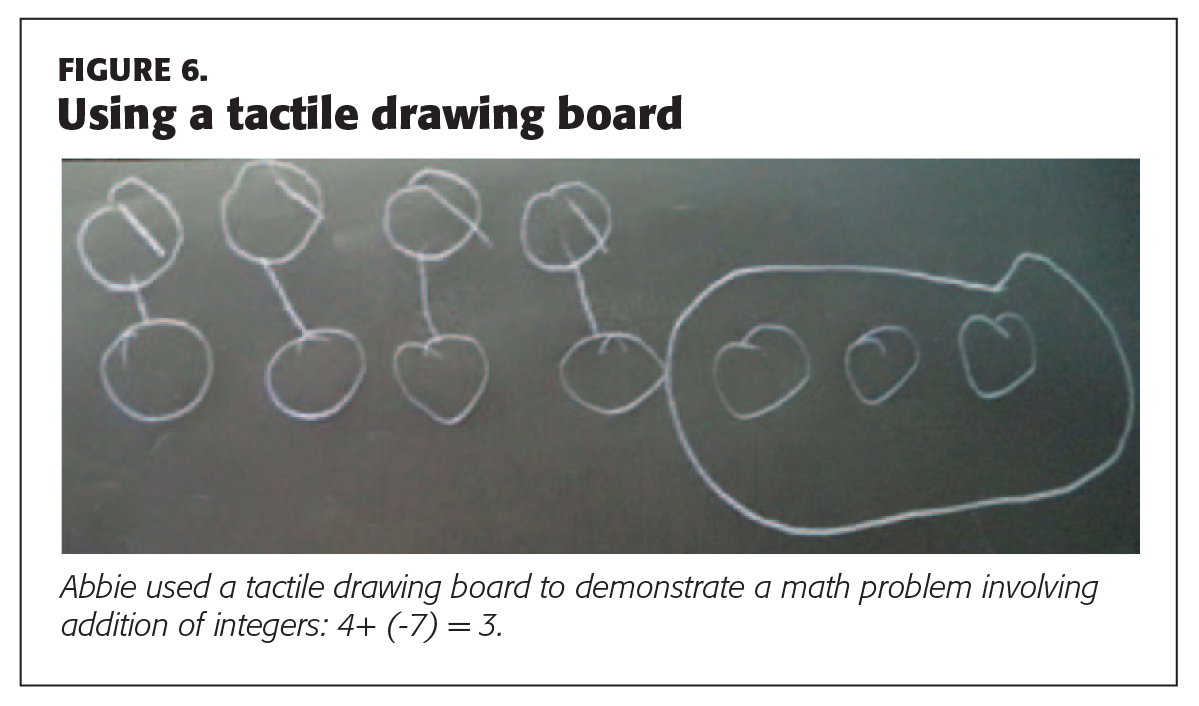
During the unit on integers, Abbie used the tactile drawing board to demonstrate 4+(–7)=–3 (see Fig. 6). The four circles with the diagonal lines through them on top signify positive numbers; the seven other circles are negative numbers. Abbie matched the four positive and four negative circles, connecting them with a line, and she ended up with three remaining negative circles, shown grouped and circled on the right. In this way, Abbie demonstrated mastery of the property of additive inverses.
As a final caveat, I should mention that Abbie and I did receive support from the Special Populations personnel, who provided the tactile drawing board. When I needed assistance, I had a contact person who was invaluable. So don’t forget to ask for help when you need it.
All of us learning
When the semester came to a close, I reflected on the experience. It was hard work but worth every minute of it. I learned so much about being more explicit, more adaptable, more creative, and more flexible in allowing student choice. KC and Abbie made me a better teacher.
After the semester was over, I noticed some differences in the final grades for the two classes I taught. Abbie’s class had 31 students, and the other section had 26 students. They were both morning classes. After completing a t-test (which assesses whether the means of two groups are statistically different from each other), I saw there were no significant differences between the groups. Students in both classes improved at a similar rate. Perhaps the strategies I learned to integrate in one class were carried over to students in the other class. Regardless, this experience will shape my instructional and assessment practices for all students in the future.
References
O’Connell S. & SanGiovanni, J. (2013). Putting practices into action: Implementing the Common Core Standards for mathematical practice, K-8. Portsmouth, NH: Heinemann.
Schmoker, M. (2010, September 27). When pedagogic fads trump priorities. Education Week, 30 (5), 22-23. www.edweek.org/ew/articles/2010/09/29/05schmoker.h30.html
Citation: Caswell, C. (2016). What a blind student taught me to see. Phi Delta Kappan, 98 (3), 68-71.
ABOUT THE AUTHOR

Caroline Caswell
CAROLINE CASWELL is an assistant professor in mathematics and computer science in the Henry Barnard School, Rhode Island College, Providence, R.I.