Even the best teachers can become resistant to new learning. Deep reflection that reveals visible and invisible commitments to the status quo can yield progress.
About a year ago, we were consulting with the International School of Eastern Europe (not its real name), and its director asked us to join him for a private and confidential meeting. The school had a fine reputation and took great pride in placing its graduates in some of the most prestigious universities worldwide. And yet, the director was worried and upset. He had just done an anonymous survey of the teaching staff in order to assess the status of differentiated instruction at the school. He was profoundly concerned by some of the comments on the teachers’ surveys.
He thrust the survey results across the table at us and said, “What do you do with comments like these?”
- “Why doesn’t the administration leave us alone so that we can get on with what we are trained to do — teach!”
- “I am in favor of differentiation in theory, but where will the time come from?”
- “Differentiation is just another educational fad. I’m sick and tired of the flavor of the month!”
- “I’ve taught for 25 years, and I’ve had excellent AP and IB examination results without any of this differentiation stuff. Why change now?”
The director was at wit’s end. The frustration was clear in his voice as he described the professional learning opportunities he had organized for the teachers. The school had brought in consultants to present differentiation workshops. The leadership team had ordered books and organized book study groups. The school had offered small innovative differentiated teaching grants to encourage experimentation and professional risk taking. He had even set up a differentiation blog on which teachers could pose questions and gain support from the experience and expertise of colleagues.
“Some of the teachers get it,” he said. “But some of them just refuse to come on board. Can you help me understand what’s going on? For the most part, these are truly dedicated teachers. They want students to do well. They care deeply about students and their learning, but they are incredibly resistant to change.”
The director was facing a remarkably common situation in schools, in which a number of very hard-working and committed teachers will seemingly move heaven and earth to preserve the status quo.
What’s going on here? We suspect that such resistance to change and innovative practice may have to do with the type of challenge represented by the professional learning.
Technical and adaptive challenges
Generally speaking, adults face two types of challenges in their professional learning: technical and adaptive (Powell & Kusuma-Powell, 2013). Technical challenges simply require informational learning. In other words, we can address the challenge (solve the problem) with information. An example of a technical challenge might be a new software package that a teacher doesn’t yet know how to use. Teachers can address this technical challenge in a number of ways: Read the instruction manual, take an online tutorial, or seek the advice and counsel of a knowledgeable colleague. The problem of the new software package is a technical challenge and requires informational learning. In other words, the learning will directly affect the teacher’s behavior and capabilities. Technical challenges are generally relatively easy to address and don’t require a large investment of time or energy. Whenever we identify a technical challenge, we should address it with informational learning.
When we articulate our assumptions, we can examine and evaluate their implications and decide if they’re aligned with our deeply held beliefs about teaching and learning.
However, schools don’t only face technical challenges. Schools also face adaptive challenges, which call for transformational learning or learning that requires us to rethink our deeply held values, beliefs, assumptions, and even our professional identity. Adaptive challenges are complex, and addressing them requires patience and time.
As we reviewed the teacher comments on the anonymous differentiation survey, our hunch was that for at least some of the teachers, differentiation was an adaptive challenge, not a technical one. The leadership team had provided a wealth of opportunities for informational learning: workshops, book studies, incentive grants, and even an online blog. They assumed that if teachers understood the mechanics of differentiation — if they had a few more differentiation strategies — they would become skillful practitioners of personalized learning. After all this time, the leadership team knew informational learning in some cases was insufficient.
One of the most common mistakes that schools or governments can make is trying to address an adaptive challenge with a technical solution. When we have a mismatch between the type of challenge and the type of learning, we can generate enormous resistance. Psychologist Robert Kegan (2009) calls this “immunity to change.” Kegan suggests that all of us have immunity to change systems that are essentially self-protective. We strive to protect our self-esteem, our reputation with colleagues, our perception of past success, and even our feelings of professional fulfillment from the onslaught of externally driven change.
Nested learning
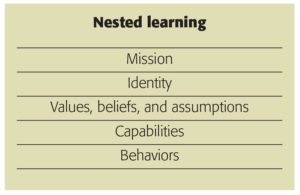 Robert Dilts (1994) suggests that adults have a hierarchy of learning targets that include behaviors, capabilities, values, beliefs, identity, and mission. The levels of adult learning are “nested.” In other words, the level above includes the outcomes of the level below it. Significantly, Dilts suggests that when we strive to change one level of the hierarchy, we need to facilitate learning at least one level above it.
When we try to modify behaviors and capabilities in an organization — capabilities being clusters of behaviors focused on a common outcome — we’re generally teaching at the level of informational learning. We’re answering the questions “what” and “how.” At these levels, we have identified a technical challenge, and we’re providing information. An example of this might include a workshop for teachers on differentiation strategies. Pedagogical strategies are essentially behaviors and capabilities that we employ in the classroom. For some teachers, this is all that’s required to become more skillful at personalizing learning.
However, this isn’t true for all teachers. In fact, the most hard-working, dedicated, and experienced teachers also may be the most resistant. They may require learning facilitated in the top three levels (mission, identity, and values, beliefs, and assumptions) because the learning challenge they face is adaptive. “I’ve had great AP/IB exam results for the last 10 years without having to differentiate instruction. How will all this new stuff ensure the same good results I already have?”
The top three categories of Dilts’ Nested Learning are the realm of adaptive challenge and require transformational learning. Instructional strategies simply aren’t enough.
Transformational learning
It was our hunch that some of the teachers at the International School who were resistant to differentiation faced adaptive challenges that required transformational learning in mission, identity, and values, beliefs, and assumptions. Transformational learning involves a three-stage process:
- A rigorous re-examination of reality, analyzing deeply held assumptions and tracking their implications;
- Cognitive reframing (ongoing coaching); and
- Modeling and coteaching (moving from the abstract to the concrete and practical).
We devised a plan with the leadership team to work with a small group of “resistant” teachers and to give them opportunities for transformational learning. We started the process with an activity called card stack and shuffle, which provided an opportunity for assumption analysis.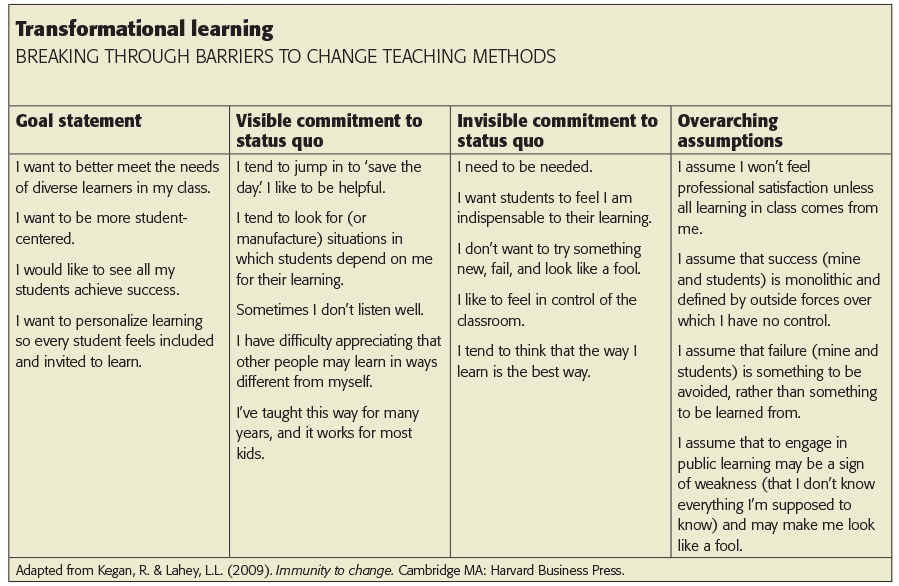
Ruthless re-examination
We explained to the teachers that each of us holds a variety of assumptions about teaching and learning that exert a powerful influence over each teacher’s instructional behavior and decision making. However, many of these assumptions are held at subconscious levels and haven’t been explicitly examined. The card stack and shuffle activity affords us an opportunity to bring some of our assumptions to the surface in order to analyze them and identify some of their implications.
In small groups, participants were given three index cards, upon which they completed three sentence stems. The sentence stems can be on any subject worthy of reflective inquiry. The ones we used were:
- I know I have taught a successful lesson . . .
- When a student is struggling in my class . . .
- Student success . . .
We wanted sentence stems that would allow for deep structured reflection. A group member then collected the cards and shuffled them. The cards were passed to another table so no table group was analyzing its own assumptions. The table groups spent about an hour analyzing the sentences, the assumptions that lay beneath them, and their implications. Afterward, we engaged the large group in a debrief that focused on the interesting patterns that emerged from the analysis.
One pattern that emerged was that student success was far more complex than simply academic learning and examination preparation. There was a lively discussion of attitudes and dispositions and the influence teachers can have over their development.
Schools often face adaptive challenges, which require us to rethink our deeply held values, beliefs, assumptions, and even our professional identity.
We subsequently coached three of these teachers for six months, during which time we supported them in mapping their resistance to change. We adapted this work from Kegan’s Immunity to Change (2009). This included having each individual identify a big goal that he or she was currently struggling with — an adaptive challenge that required transformational learning. In the case of the teachers from the International School, we asked that the goal have to do with differentiation. We then explored with teachers what Kegan refers to as “the visible commitment to the status quo.” These included the observable behaviors that were an obstacle to goal achievement. An example of a teacher is provided below. Then, over a series of coaching sessions, we invited teachers to explore the invisible commitments to the status quo. This step was more difficult and required deep analysis, reflective introspection, and a trusting relationship with the coach. Finally, we explored with these teachers what invisible assumptions might be driving their resistance to change. During this time, we also modeled differentiated instruction with these teachers in their own classrooms and engaged in coplanning, coteaching, and coreflecting.
When we articulate our assumptions, we can examine and evaluate their implications and, most important, decide whether they’re aligned with our deeply held beliefs about teaching and learning.
The process was long and labor intensive, but two unplanned and unforeseen consequences occurred. The first was that the previously resistant teachers became vocal and influential advocates for personalized learning. They were energized and excited by the process and were keen to share their new learning and insights. The new alignment between their values and beliefs and their instructional behavior resulted in them becoming effective and influential change agents among their colleagues.
The second unforeseen consequence was that the process of “uncoverage” became to some degree contagious and self-perpetuating. We observed that the kind of coaching we had provided — specifically, the professional inquiry and reflective questions — was finding its way into department and team meetings. The conversations at the school were becoming more deliberately structured and thoughtful. It will be interesting to see whether this is maintained over time and how this emphasis on reflective practice may influence the fabric of school culture.
We know that when teachers invest time in examining the work of a specific student, the process often reveals ideas, insights and connections that are applicable and beneficial to other students and other groups of students. We believe the same principle may apply to adult learning. When we invest time and energy supporting the transformational learning of a few individual teachers, we may well set in place the conditions under which many other teachers will embrace professional learning.
References
Dilts, R. (1994). Effective presentation skills. Capitola, CA: Meta Publications.
Kegan, R. & Lahey, L.L. (2009). Immunity to change. Cambridge MA: Harvard Business Press.
Powell, W. & Kusuma-Powell, O. (2013) The OIQ factor: Raising your school’s organizational intelligence. Woodbridge, UK: John Catt Educational.
CITATION: Powell, W. & Kusuma-Powell, O. (2015). Overcoming resistance to new ideas. Phi Delta Kappan, 96 (8), 66-69.
ABOUT THE AUTHORS

Ochan Kusuma-Powell
OCHAN KUSUMA-POWELL was an international school educator for over 30 years in the U.S., Saudi Arabia, Tanzania, Indonesia, and Malaysia. She is coauthor of NFI: An Inclusive Toolkit and The OIQ factor: Raising your school’s organizational intelligence . She resides in Kuala Lumpur, Malaysia.
William Powell
WILLIAM POWELL was an international school educator for over 30 years in the U.S., Saudi Arabia, Tanzania, Indonesia, and Malaysia. He is a coauthor of NFI: An Inclusive Toolkit and The OIQ factor: Raising your school’s organizational intelligence . He resides in Kuala Lumpur, Malaysia.