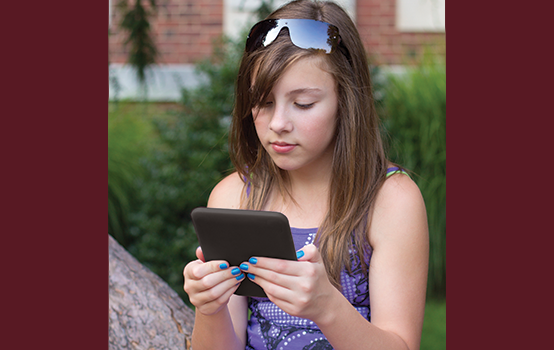
Giving students Kindles reinvigorates young readers and improves their reading achievement.
If you ask a typical 9th grader about reading, you’ll get a range of responses, but two trends will likely emerge: resignation and regret. If the student feels resigned, you’ll hear, “No way, I don’t read much,” or “I haven’t finished a book in years.” Reading will be characterized as “boring,” particularly in comparison to phones and video games, Instagram, and Snapchat. The student will sometimes tell stories of fake reading or of getting by in classroom discussions by mimicking peers.
If you keep listening, feelings of resignation will turn into regret. You’ll hear, “I wish I read more,” or “It’s too hard for me.” The student may smile when sharing her favorite book as a child but then quickly look away. After some silence, she may remember that she used to be a reader and wonder why that changed. Then, the “shoulds” will take over: “I know I should read more,” and “I should find more time to read.”
A few years ago, after more than a decade teaching English, I began asking students about their reading lives. After doing more than 100 informal interviews, I made a big decision. Instead of cajoling my 9th graders unsuccessfully to read great books like Night and Things Fall Apart, I launched an independent reading program as part of my curriculum. Influenced by reading gurus Nancie Atwell, Donalyn Miller, and Kelly Gallagher, and invigorated by an article in The New York Times, I built a fledgling classroom library of 500 titles and encouraged students to read books they liked, in addition to the books I required them to read.
For the most part, the experiment worked. My students read more than ever, improved their reading skills, and said they liked to read. But not all students felt that way. To some, reading was boring, no matter what. Reading wasn’t worth their time. Many said they hadn’t read a book since 4th grade. I needed to reach these students, too.
One November during reading workshop I noticed a boy with his head down and eyes closed. This was not the first time he had chosen sleeping over reading. He’d been consistently clear about his hatred for reading. His book, though, was still propped open — an advanced move by an advanced fake reader. By this time, I was exasperated by his reluctance to read, and I didn’t know what to do next. Instead of my normal intervention — approach the student, rouse him with a hand on his shoulder, and ask him if anything is wrong — I decided to do something different. I let him borrow my Kindle.
The boy, after a quizzical look, immediately sat up and quickly switched books — from Khaled Hosseini’s The Kite Runner (my choice) to Tupac Shakur’s The Rose that Grew from Concrete (his choice). He played around with the buttons and made the font bigger. Then, for the first time in nearly four months, the 9th grader read without interruption. This was not fake reading. At the end of class, he smiled and said, “This is so much better!” I asked him whether he wanted to take the Kindle home for the weekend. “Really?” Sure. By the next Monday, he’d finished The Rose, his first book of the year.
Since that day, I’ve collected Kindles and loaned them to reluctant readers to motivate them to read. My Kindle Classroom Project now serves 139 9th graders and has a library of 449 high-interest titles. Last year, the Kindlers read more books on average than their physical book-reading peers, and their reading scores climbed 1.9 grade levels, much more than the non-Kindlers’ 0.9. To be sure, my experiment was by no means a scientific study. But one thing remained clear: The 9th graders who read on Kindles told me they liked to read. Their resignation and regret gone, these students had reclaimed their love of reading.
It’s time to read
What made this reading resurgence happen? My gut says the Kindle helps students build a new relationship with reading. Many of my students wouldn’t risk being caught reading a physical book — not in class, and certainly not on the bus home. It’s much cooler, and maybe even safer, to break out an iPhone than a book. Though the Kindle is no longer a cutting-edge device, it still gives my students enough tech-cred to appease leery onlookers. The e-Ink version offers them the perfect mix of digital and analog: digital enough to maintain status among their friends, while analog enough to prevent a theft by their enemies.
Students say the Kindle’s clunky interface keeps them focused on reading. One student told me, “There’s no distractions. It’s just me and the words.” Her sentiment is absolutely true. Once a student chooses a font, nothing gets in the way of the reading experience. Even the touchscreen Kindles barely go on the Internet, and by no means are students trying to post Facebook or Twitter updates. When it’s time to read, it’s time to read. Several students said they leave their phones in another room when they’re reading at home so that texts won’t compete for their attention.
Over time, my students come to call the Kindle theirs. When I loan one out, the student hears, “Here’s something valuable to show that I care about you and that I want you to read.” As a result, much more than with physical books, students take care of their Kindles. One June, I was walking down the hallway and spotted a copy of Jay Asher’s Thirteen Reasons Why (a great book!) in the garbage can, likely the victim of a year-end locker-clearing celebration. That doesn’t happen with the Kindles. Students keep them in cases and don’t cram them into backpacks. In fact, in the three years my students have used them, only three devices have stopped working, perhaps because of negligence, but more likely due to old age.
Not losing Kindles also means not losing the e-books they contain. Because the books are safe in the Amazon cloud, they’re impossible for students to misplace or leave indefinitely at their cousin’s house. Their covers also don’t get tattered; there’s never need for contact paper. Many teachers spend countless hours at the end of the year pleading with their students to return paperbacks. “If a book doesn’t come back, at least I know someone’s reading it,” goes the common refrain. Yet the teacher still has to spot the $15 to replace the title. In contrast, with Kindles I’m freed up to listen to students, take book requests, and raise money for new titles to expand our e-library.
Another important benefit of this approach: Students can read the same title at the same time. Because most Amazon e-books can be shared among six devices simultaneously on the same account, there is no wait for popular books. When five girls all of a sudden wanted to read Simone Elkeles’ Perfect Chemistry two years ago, I didn’t have to rush to Barnes & Noble to order multiple copies of the book. The same thing happened with the boys and My Bloody Life: The Making of a Latin King, by Reymundo Sanchez. After several months, when the popularity of those titles waned, the books did not end up on remainder tables. Moreover, friends can form informal book clubs and talk about the books they’re reading. Students tell me that reading is much more enjoyable when it’s social. While they prefer to read silently and on their own, students like discussing the characters and major themes. A healthy “how-far-are-you-in-the-book competition” spurs students to keep up the reading pace outside of class. Stories, because they’re shared with friends at a critical stage of adolescence, carry deep meaning and create lasting memories.
Struggling readers
Above all, I believe the Kindle Classroom Project has been successful because it directly meets the needs of struggling readers. A Kindle cuts through the stigma that students have felt for many years and gives them another chance to identify as readers. Specifically, since all the Kindles look similar, kids need not disclose what they are reading. They can enjoy a book at the 3rd-grade level without fearing the taunts and condescension of peers and teachers. One of my students — a hulking, burly young man — got turned on to E.B. White’s Charlotte’s Web last year. No way would he have read that book, with Wilbur and Charlotte prominently displayed on its cover, in class or on the city bus.
The Kindle Classroom Project has been successful because it directly meets the needs of struggling readers.
In addition to being able to choose whatever titles they want, struggling readers invariably crank up the font size on the Kindle, sometimes to the largest setting. It’s easier for them to focus on a screen with larger text and fewer words per page. Readability is crucial. No longer do students drown in an ocean of tiny text, and rarely do they repeat lines, a common occurrence when text is small. With fewer words per page, struggling readers can feel the joy of finishing pages and wondering what will happen next. And because the Kindle maintains its thickness, never giving away the heft of a big book, a long story does not overwhelm the student in the same way a physical book would.
In short, for too long 9th-grade students — particularly those who have struggled with reading — have been told that reading is not for them, that they can’t read, that they’re dumb, that they should fake read instead of trying honestly, or maybe that they should give up reading altogether. Collecting Kindles and loaning them out to students changed this script and offered them a chance to reclaim their love of reading.
Start a Kindle project
The best part of the Kindle Classroom Project is that it is easily replicable. In fact, many teachers across the country — like Denise Fullerton in Berkeley and Meg Griswold in Nashville — have also experienced success using Kindles with students. With education budgets tight and less money to fund school libraries, many teachers fill the gap themselves in order to get good books in students’ hands. With the same amount of effort it takes to build a rich, physical classroom library, teachers can begin a Kindle project of their own. Here are a few suggestions:
- Start small. Let a student borrow your Kindle for a few days and see what happens. Most likely she will read more, but, in addition, her friends and family will notice. Within days, students will approach you with jealous complaints and hopeful requests that you loan them the Kindle next.
- Get the word out that you’re looking for used Kindles. With tablets and phones now the preferred way to read on a screen, many people in your community have old Kindles lying around their homes, ready to be read. I made my project public on my blog, but that’s not necessary. Most teachers ask their family and friends or make announcements in the school or community newsletter. Others have found success using DonorsChoose or by creating an Amazon wish list. The donations may begin slowly, but once word-of-mouth gains momentum, the Kindles will flow in faster.
- Create a separate Amazon account. This is crucial. You don’t want to share your personal Amazon account and its link to your credit card. Best to set up a new account without a credit card number for your Kindle classroom. Unfortunately, it’s not easy to transfer books from your personal account to this professional one, so if your personal library contains a book your 9th graders would like to read, you may need to buy an additional copy. But this way you don’t have to worry that students will go on an Amazon shopping spree.
- Invest in excellent books. Many people think the best library is the biggest one. On the Kindle, it’s more important to have high-interest books that pop. Students dislike combing through swaths of mediocre titles searching for a book they like. If you already have an independent reading program, it’s best to start with the popular books that are never out of circulation.
- After buying e-versions of those titles, listen to students. What are their favorite books? Which books have changed their lives? Depending on your budget and your fund-raising, make frugal decisions when building your e-library. Remember that each title can be shared on six Kindles simultaneously, so your $10 investment becomes $60, at least virtually.
- Catalog your Kindles and load up your books. Go to the Manage Your Devices page on your Amazon account and rename your Kindles so they’re easy to track. I also put a sticker on the back of each Kindle for easy identification. Next, register the Kindle under the classroom library’s email address. Once that is completed, check the Kindle web site to ensure that the device is listed and that everything got saved properly. The last step is to download books onto the devices, easily the most labor-intensive step. Despite Amazon’s policy to allow sharing titles to up to six devices, you must send each book to each device, one by one. If your e-library contains many titles, you may want to round up some help and speed up this step using multiple computers simultaneously.
- Charge up your Kindles and release them to students. Depending on its model, a Kindle keeps its charge for as little as a week and as much as a month. Either way, once you charge the devices, you won’t need to give out Amazon cables, especially if students keep Wi-Fi turned off. In the case of an around-the-clock avid reader, you can leave chargers in the classroom, but any Android phone charger will work.
- Maybe the hardest step in starting a Kindle program is the last one: determining which students should get the e-readers first. Because my intent is to serve the most reluctant readers first, struggling readers get priority. Also, some may be hesitant over worries they’ll break or lose the Kindle, or concerns that by accepting the device they must don a reader identity. In my experience, this process takes no more than a few moments, and, once the Kindle is in their hands, students are off and reading.
Once that happens, once students are reading again — not fake reading — the power of the story takes over. With the help of a Kindle, students begin inhabiting a new world filled with fantasy and possibility. Meanwhile, there is also a return to childhood, when reading was bright and joyful. As students read on their Kindles, they build their futures as they revise their pasts. All of a sudden, they’re readers again.
— Mark Isero
Citation: Isero, M. (2014). Rekindle the love of reading. Phi Delta Kappan, 95 (7), 61-64.
ABOUT THE AUTHOR

Mark Isero
MARK ISERO taught English and social studies for 15 years before becoming a literacy coach for Envision Education, a charter school network based in Oakland, Calif. Now in its fourth year, his Kindle Classroom Project serves students in California communities in San Francisco, Oakland, and Hayward.