
To ensure the best and most useful classroom discussions, teach the building blocks of listening, articulating, exchanging ideas, and synthesizing new knowledge.
At a wooden table in the corner of her classroom, Aja Settles is leading a comprehension conversation with 2nd graders Julius, John, Alejandra, and Kurtis. They’re reading Dawn MacMillan’s Teamwork, about a girl named Karina who has so much trouble making friends at her new school that she spends recess in the library. When her teacher worries about her, Karina claims she’s trying to get her homework done early. That part confuses Settles’ students: They believe Karina really does go to the library to do homework.
But not Kurtis. “Karina went to the library because at the library no one was there but Mr. Walker and Karina,” Kurtis says. “So there were no kids in there trying to tease her.”
At this moment, it would be all too easy for Settles to say, “Exactly! Does everyone see what Kurtis is saying?” and wait for a chorus of “Yes!” But, if she does that everyone at that table would be at a disadvantage. Settles would have no idea whether the other students really understood what Kurtis was saying, and Julius, John, and Alejandra would miss their chance to do the comprehension work Kurtis has done. Even Kurtis, since he wouldn’t have to say why or how he reached his interpretation, would not be pushed further in the rigor of his analysis.
So, instead, Settles leans back and waits, listening silently as the other students respond to Kurtis’ revelation. “I disagree with you, Kurtis,” Julius protests, “because Karina wanted to go to the library to finish her homework early.”
“I agree with you, Julius,” Alejandra adds.
“But . . . ,” Kurtis starts.
Settles makes eye contact with him. “Do you agree with them?” she asks.
“That wasn’t the big idea,” explains Kurtis.
“Hmm,” says Settles, keeping her face carefully neutral, “so Kurtis is claiming that these aren’t the big ideas. Where is your thinking shown, Kurtis?”
“On page six,” Kurtis answers. Pages ruffle all around the table as Julius, John, and Alejandra open their books. “It wasn’t the problem that she didn’t get her homework done early,” Kurtis continues, pointing to the location on the page, “it was the problem that no one wants her on the team.” After a few moments of silence, Kurtis’s classmates begin making thumbs-up signs — the class signal for agreement.
Not an ordinary discussion
On the surface, this conversation seems ordinary. But it has characteristics extremely rare in 2nd-grade class discussions: Students are doing most of the talking. More important, when you change how students talk in class, you change the way they think.
When you change how students talk in class, you change the way they think.
Classroom discussion can feel like a murky pool of water. Teachers want to let students dive in and do the talking, but we don’t know where they’ll go or even whether they know how to swim. We risk either taking over the discussion or watching students fail to achieve the deep analysis we seek. Avoiding those twin pitfalls requires harnessing the power of habit.
Breaking down the magic
Think of the behaviors that adults demonstrate in high-quality discussions — making eye contact, speaking audibly, clarifying an argument. Children do not use these behaviors automatically, but these are concrete actions that can be taught and practiced at any age. Once children master those habits, they can use them to build on each other’s ideas, and to do more critical and evidence-based thinking. This goes deeper than simply aligning to the Common Core’s Speaking & Listening standards, which (rightfully) point out that students need excellent communication skills for lifelong success. It gets at the very heart of how elementary students grow into independent scholars. Let’s look more closely at how this works.
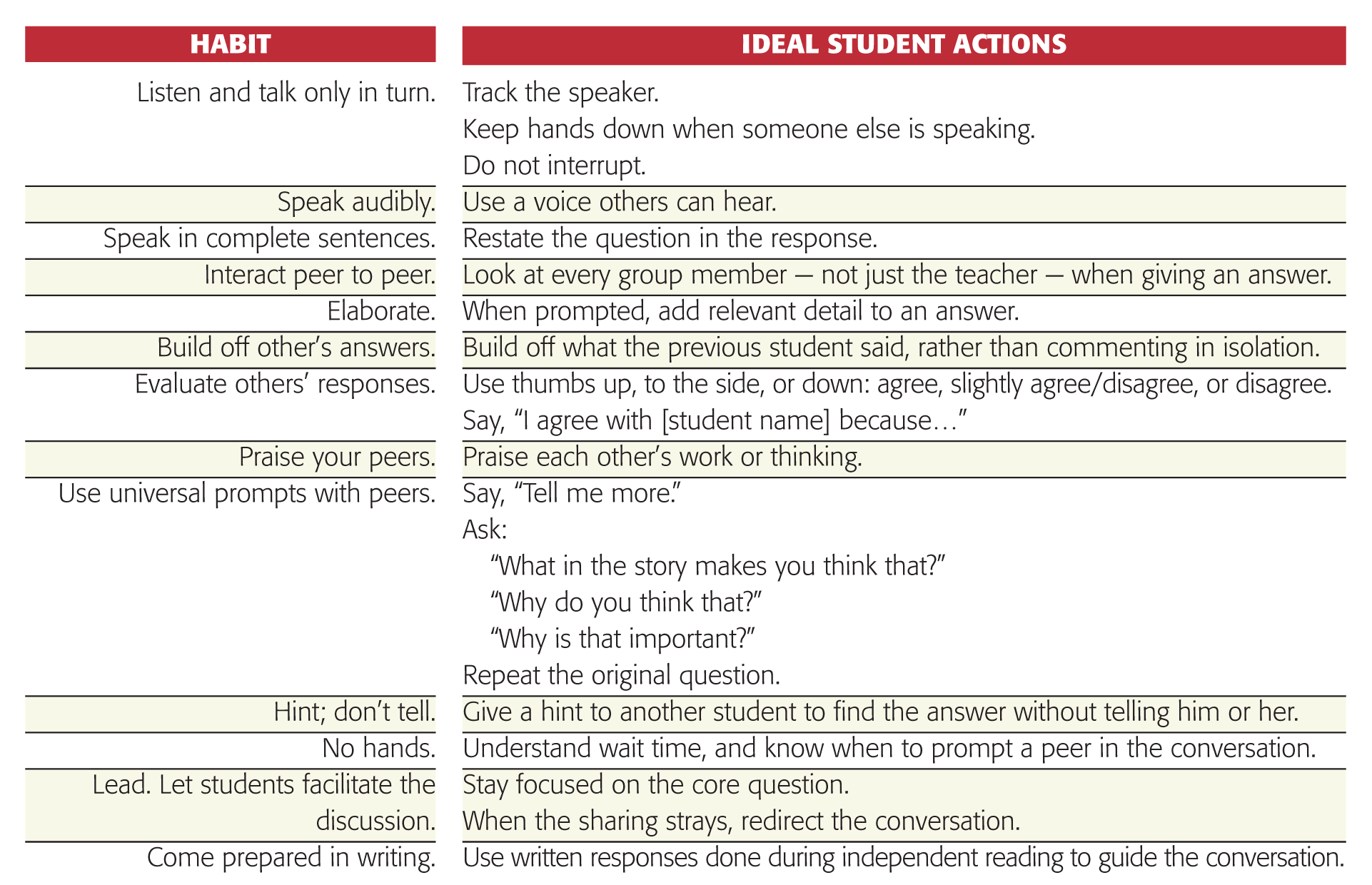
Every magical moment in Settles’ students’ conversation — from Julius addressing Kurtis by name, to Alejandra evaluating Julius’ answer, to Kurtis turning to page six — had science behind it, too. Those students didn’t just dive into Teamwork and come up incredibly lucky: They were applying their best habits of literary discussion to the text. See the list below for the 13 habits as Settles taught them (Bambrick-Santoyo, 2013).
If some of these individual habits look basic — especially compared with the complexity of the discussion we witnessed — it’s because they are. To teach habits of discussion, teachers must break them into pieces small enough that students can practice them in isolation, master them, and then build more habits on top of them.
Students can only build off each other’s responses if they can hear each other. They can only evaluate a speaker’s response if they can wait for the original speaker to finish talking. And it’s amazing how quickly they learn to prompt one another with universal prompts when you’ve prompted them, over and over, to add detail or evidence to their own responses.
Keeping up the magic
The real challenge of building the habits of discussion isn’t teaching them to students, but holding students to them. Consistency here is key: Teachers constantly need to reaffirm and review these habits, making sure they’re happening whenever a discussion is.
Settles has developed a tightly honed strategy for maintaining each habit she teaches her students. For two or three weeks after teaching the habit, she verbally reminds students to use it every time they don’t, accompanying her reminder with a nonverbal hand signal. Then, for the rest of the year, she uses the nonverbal signal alone.
Some examples of verbal and nonverbal prompts for the habits of discussion include:
For “speak in complete sentences,” say “Stretch it out,” and pull your fingers apart as if stretching out a piece of gum.
For “interact peer to peer,” point at the other members of the group.
For “evaluate,” have students put their thumbs up, down, or to the side to indicate that they agree, disagree, or only somewhat agree or disagree.
To see the effect of all of this work, let’s pick up where we left off with Settles’ students’ Teamwork discussion. Taking in the thumbs-up signs around the table, Settles calls on one student to share her thought process. “What are you thinking now, Alejandra?” she asks.
“I changed my answer,” Alejandra announces confidently. “Now I agree, because when it said, ‘They don’t even want me on the team,’ that means the big idea is that they don’t even want her on the team, and she wants to be on the team, but they just don’t let her. So that’s why I agree.”
This is the power of implementing the habits of discussion: Teachers give students like Alejandra, John, and Julius the chance to interpret and evaluate for themselves, rather than piggybacking on the student who already has reached the right conclusion. In discussions built on the foundation of great habits, students blossom into their own as speakers, listeners, and thinkers. And when they need those skills even more — in whatever hundreds of things they choose to spend their lives learning about — they’re ready.
Reference
Bambrick-Santoyo, P. (2013). Great habits, great readers: A practical guide to K-4 reading in light of the Common Core. San Francisco, CA: Jossey-Bass.
Citation: Bambrick-Santoyo, P. (2013). In practice | Leadership: Habits improve classroom discussions. Phi Delta Kappan, 95 (1), 70-71.
ABOUT THE AUTHOR

Paul Bambrick-Santoyo
PAUL BAMBRICK-SANTOYO is managing director of Uncommon Schools, Newark, N.J., and author of Great Habits, Great Readers: A Practical Guide to K-4 Reading in Light of the Common Core .