Online information sources can form the basis of effective inquiry-based learning if teachers construct assignments to promote collaboration, communication, and more inquiry.
Learning what happens as elementary school children read and make meaning of the text and images they see is fascinating, especially when the reading is done in the context of children’s interactions with each other and with online information. But such online inquiry tends to happen with students sitting closely together at a computer or a tablet, when all you can see is the backs of their heads. So how do we know the time they’re spending in inquiry is productive? What influence does a project’s design have on children’s work? Is the chatter that we hear helpful for their thinking and learning?
We have found carefully structured tasks that scaffold the ability to question, navigate, and negotiate the meaning of online text, and we have discovered that images can foster collaborations that are engaging, deeply comprehensive, and fruitful (Coiro et al., 2014). Inquiry-based learning engages students in collecting information, analyzing data, and crafting presentations that create solutions or make arguments. Students become more positive and independent in their learning while gaining new knowledge and meaningful understandings of their world. Yet designing assignments that scaffold inquiry is often necessary to support students’ efforts. Structured inquiry experiences can help learners develop skills for coping with problems that have no clear solutions, dealing with challenges, and adapting procedures to the demands of different situations (Alberta Learning, 2004).
Teachers can support students by setting aside specific times for inquiry and by encouraging them to wonder and explore.
Our research findings reinforce what others have suggested — that while students follow general patterns in thinking and collaboration, the inquiry process “is not linear or lock step. It is highly individual, nonlinear, flexible, and more recursive than might be suggested in traditional models of the research process” (Alberta Learning, 2004, p. 9). Thus, depending on the purposes of inquiry and the abilities of students, there are different ways to frame inquiries to support student success.
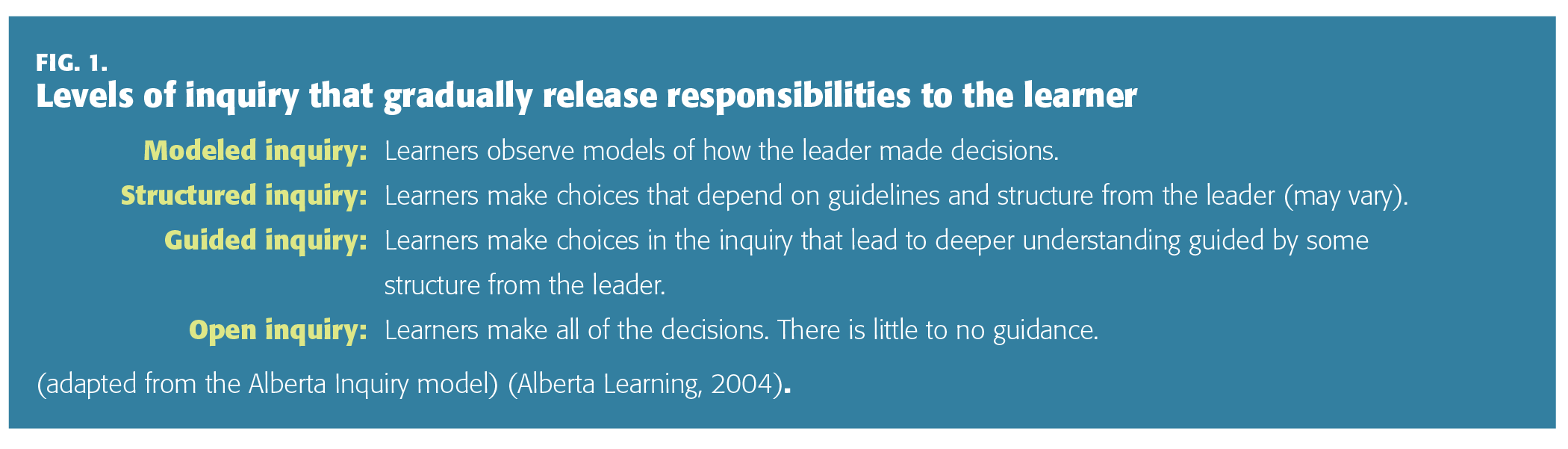
Alberta’s model of inquiry-based learning delineates four gradually less restrictive frameworks designed to encourage students’ wondering with authentic inquiry tasks (see Figure 1). We found that the design of a structured online inquiry supports children’s success in grades 3-5. We also uncovered certain patterns in how children read and talk about their work that enable them to be productive during various phases of the inquiry process.
Designing online inquiry
An authentic inquiry task connects students to relevant, real-world concepts and events. Thus, we based the inquiry task for our study of students in grades 3-5 on some of the curriculum topics their teachers covered. Our study took place in an International Baccalaureate school that used the environment and economics, among other themes, to shape its curricula. We presented the following scenario to the students:
A new Green Toys Shop will open in our town. You have been asked to recommend several toys for the shop that would be eco-friendly and would appeal to children. Use the Internet to learn more about eco-friendly materials and to search for eco-friendly toys. Then, send an email to the Green Toys Shop owner that includes three recommended toys and the reasons that you chose them.
We structured the inquiry by asking students to find particular answers to our teacher-directed scenario and to move through the given materials by working in pairs. We asked students to read an informational overview web page we created with embedded hyperlinks to increase their knowledge of environmentally friendly materials so that they could think about why a toy was eco-friendly. Some students chose to read deeply, visiting and discussing every link and generating additional questions to explore. Others read the words aloud to their partner, choosing not to follow any of the hyperlinks, and went on to search for toys without discussion or additional exploration.
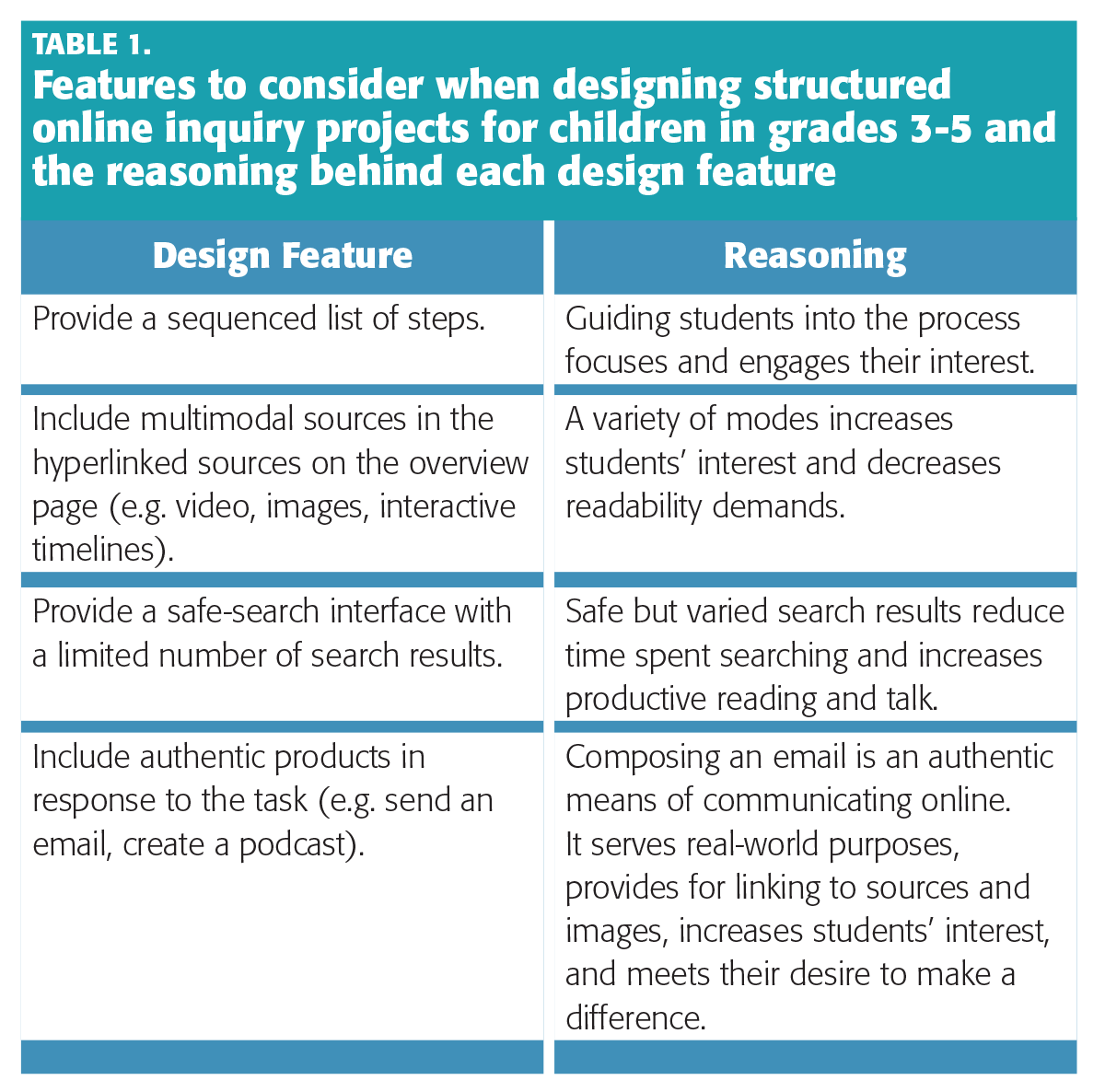
When children were ready to search for toy choices, we directed them to a customized search engine that we populated with a few dozen web sites. These were more or less relevant to the topics at hand in order to reflect an authentic online reading experience, yet they were also appropriate for children. Few of the sites were written specifically for children, so the reading was often challenging. Table 1 highlights this and other key considerations we used to design our structured online inquiry project.
Reading, thinking, and talking
Patterns that developed in the students’ collaboration in the Green Toys task suggest that certain organizational and logistical features of our structured design may have supported their online inquiry in productive ways. We noticed that children who gave more productive responses were those who read the overview web page carefully, checked all the links, and paused at several points to discuss what they encountered.
For example, in reading about paints that were harmful to children (because of lead content) and to the environment (because of particular dyes), 5th grader Evan showed both his understanding of the content and its connection to his own life. “That means some of the stuff that I have could be painted with harmful stuff,” he said. William, his collaborator, elaborated with his own connection: “You know that at (a fast food restaurant), when they sometimes have those cups, the check[ered] ones that came out a couple years ago? My grandma got one, but they had to recall them ‘cause they found lead in it.”
Evan excitedly acknowledged William’s point, beginning a typical back-and-forth exchange in which the pair built on each other’s comments and even completed each other’s thoughts. Evan concluded the conversation with, “Yeah, harmful stuff.” The boys later said that what they read and discussed about paints influenced their choice of toys.
In contrast, other partners did not develop their understanding of readings effectively and could have benefitted from more support. For instance, 4th graders Harold and Melinda’s discussion of the information overview page was not deeply connected to the content in ways that moved their inquiry forward. When they discussed the merits of toy blocks, they were unable to coherently discuss why the dangers of lead-based paints and dyes were important.
Harold: They painted wood.
Melinda: But it doesn’t have to be painted.
Harold: I know, but those are painted.
Melinda: What are those?
Harold: That’s not eco-friendly.
Melinda: Sure it is.
Harold: It’s just plastic.
Melinda: Stained plastic.
Harold: Plastic and paint.
Melinda: OK.
If these partners had been intentionally asked to stop and either summarize what they read or question each other about the meaning of what they were reading, Harold might have been more able to articulate his concern with the offending paint.
We also noticed how students’ productive use of the overview page affected later steps in the inquiry process. Strategic readers were those who recalled information from the overview page and used it to inform their search for web sites related to eco-friendly toy materials. Fifth graders Jack and Jill looked at some organic baby toys and gifts, and Jill commented, “I think they’re made out of cotton.” Jack responded, musing, “Biodegradable cotton.” The pair added “biodegradable” to their search, possibly an unfamiliar term, before encountering it in their reading.
Evan and William, who read about water-based dyes in the overview page, later integrated these ideas into their discussion while reading about manufacturers that used white wooden toys, suggesting they would “probably end up painting it . . . maybe with water-based dyes.” Being intentional about reading the informational overview web page provided useful information for students as they completed the inquiry. Providing organizational support in the form of directions or graphic organizers for recording information would be two ways to ensure students learn to support their thinking with evidence from the texts to support their conclusions.
Not all back-and-forth exchanges between children are relevant to the content of the task
Finally, at least three types of knowledge students brought with them to the task played an important role. First, their prior technological experience was useful in formulating searches. Students who were savvy in their ability to generate topic-specific search criteria and strategically negotiated hyperlinks were able to streamline their search. Second, students often tapped their prior academic knowledge when they related text or images on a web page to activities they completed in science class or when they explained what terms meant in their own words. For example, 3rd graders Sarah and Jamal were delighted to find a video of a solar-powered frog that was the object of a recent experiment in class, and they chose it as one of their toys. Third, knowledge gained through prior personal experiences also helped students make sense of their reading. Often, students who told stories that elaborated on their reading made better toy choices at the end of the inquiry process. Third-graders T.J. and Shantel, who read, “Choose toys that are made of natural or biodegradable materials that will not damage the Earth,” discussed three examples from their own experiences, ones that would “rot and help the Earth”: Sun Chips bags, banana peels, and compost piles. While agreeing that compost “stinks,” they both agreed they would choose to compost garbage “to help the Earth.” Bringing prior knowledge into play was something all the students did subconsciously, but those who consistently and frequently engaged in weaving new knowledge together with what they already knew were also those who were more productive in their inquiry.
Overall, the patterns that we saw repeated across multiple partner sets supported the idea that specific, logistical, and instructional designs can help students work through inquiry tasks in productive ways. Reading together with discussion, making connections, coconstructing interpretations, and evaluating and supporting each other’s thinking are strategies that can be modeled and adapted to many different structured inquiry tasks.
Common Core connections
Structured online inquiry tasks address the call for collaborative experiences that help build students’ content knowledge as early as kindergarten. The speaking and listening strand in the Common Core’s English language arts standards, for example, recommends that children have opportunities to “participate in collaborative conversations with diverse partners . . . in small and larger groups [by] a) following agreed-upon rules for discussions (e.g., listening to others and taking turns speaking about the topics and texts under discussion); b) continuing a conversation through multiple exchanges; and c) confirming understanding of a text read aloud” (NGA & CCSSO, 2010, p. 23). Other standards in the reading and writing strand expect students to be able to use technology and digital media strategically while generating questions, conducting research using print and digital resources, and producing written responses using a range of digital tools.
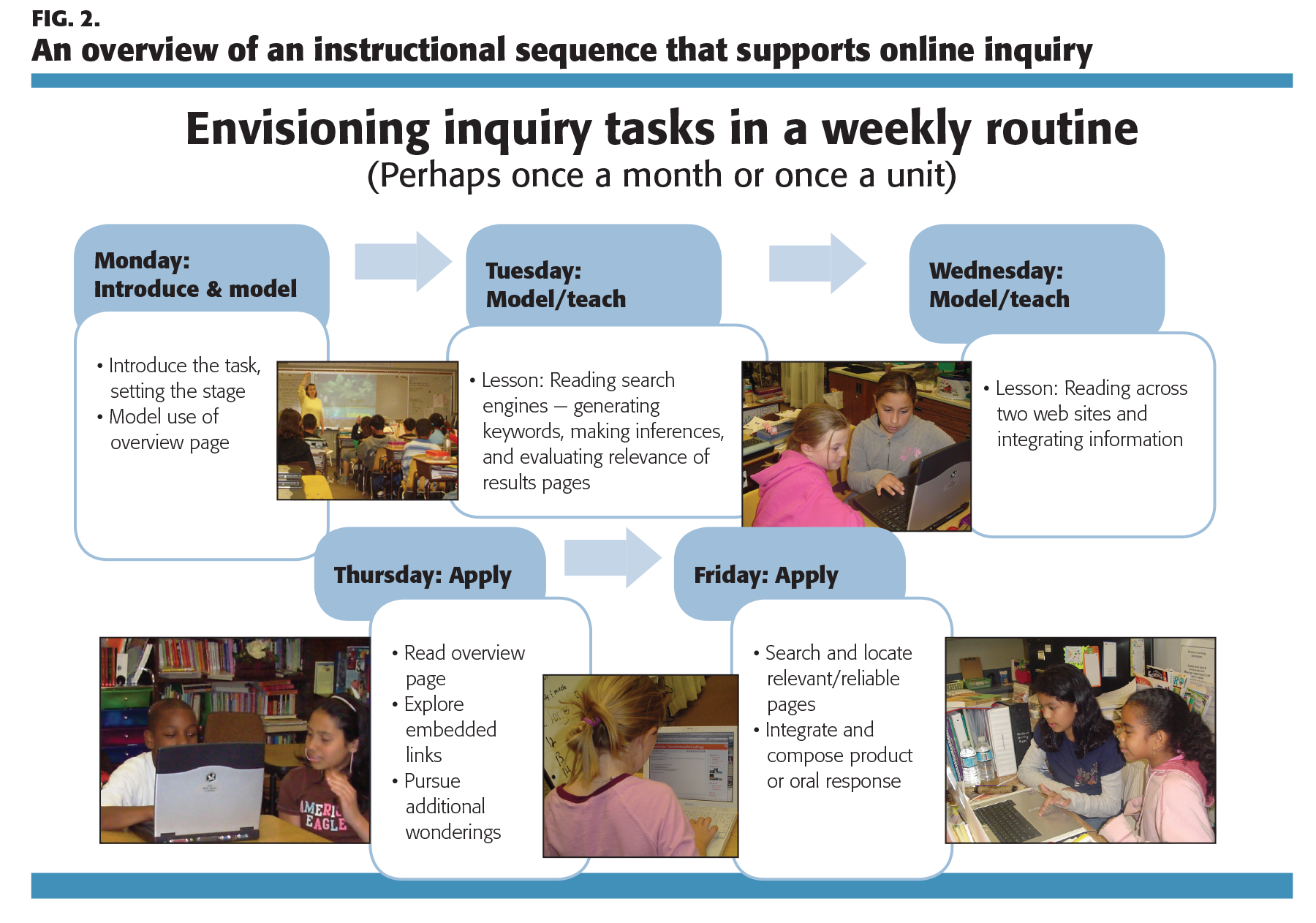
As teachers consider how to integrate explicit, standards-based instruction into an elementary literacy curriculum that supports these inquiry skills, the following carefully designed supports for comprehension instruction can foster the development of online reading skills and content-area learning in elementary school. (See Figure 2.)
Intervention ideas
The collaborations we observed with elementary students suggest a range of ways teachers might intervene to support young learners needing guidance as they work through structured online inquiries. Generally, teachers can support students by setting aside specific times for inquiry and by encouraging the processes of wondering and exploration as integral parts of learning across the curriculum. Students can be reassured that inquiry is both exciting and unpredictable, often yielding unexpected problems and results. Facilitating student discussion around interest-driven wonderings helps clarify their thinking, while monitoring and evaluating student progress adds value to their work. Offering options to share their inquiry products by creating web pages or short videos explaining what they learned may encourage engagement in the inquiry process and also spread new knowledge among other students who engage with the student-made media.
More specifically, we believe at least three sets of practices observed among pairs of young online readers can be springboards for instruction that foster productive talk and higher-level thinking.
#1. Partners should build on each other’s ideas to jointly construct new insights gleaned during their inquiry rather than just individually compiling facts to add to their joint collection of ideas.
This suggests that students who have difficulty co-constructing new knowledge with a partner can benefit from:
- Instruction that clarifies features of collaborative talk (e.g., active listening, ideas exchange); and
- Intentional supports that encourage students’ balanced use of these practices during the inquiry process.
For example, teachers can assign different but mutually beneficial roles for a grouping of students that require collaborative exchange in order to complete their inquiry: Student A gathers and orally summarizes important ideas from her research, and Student B reminds the pair to clarify any confusion while writing ideas in a shared note-taking space. Students might trade jobs part way through the inquiry task or across different days. These types of activities introduce students to the advantages of jointly constructing meaning from text and discussing ideas as part of the inquiry process.
#2. Productive online inquiry partners should actively apply comprehension strategies such as questioning, planning, predicting, clarifying, and summarizing as they gather and integrate new ideas.
Young learners who instead quickly move through large segments of text with few attempts to actively engage with the content are likely to benefit from scaffolds that more explicitly foster their individual and joint thinking. For example, prompts to stop, think, and talk during each phase of inquiry can help partners reflect on their choices early in the process (Harrison, Dwyer, & Castek, 2014). More detailed cue cards with questions such as “What are we trying to find out today?” “Which link should we follow?” and “What’s the most important information here?” offer students opportunities to practice jointly applying active reading strategies with a partner throughout their inquiry.
#3. Encourage partners to regularly self-monitor and stay focused on their purpose while exploring relevant online texts.
For students who lack these monitoring abilities or have difficulty staying on task, visual cues on the overview page — bulleted lists that encourage time to talk after each item, for example — and use of thinking prompts such as those in Figure 3 can be modeled for students and then integrated into the design of the structured inquiry task. More information about these instructional strategies and video clips of student conversations as they engaged in the Green Toys Scenario can be found at http://coiroira2013.wikispaces.com/ 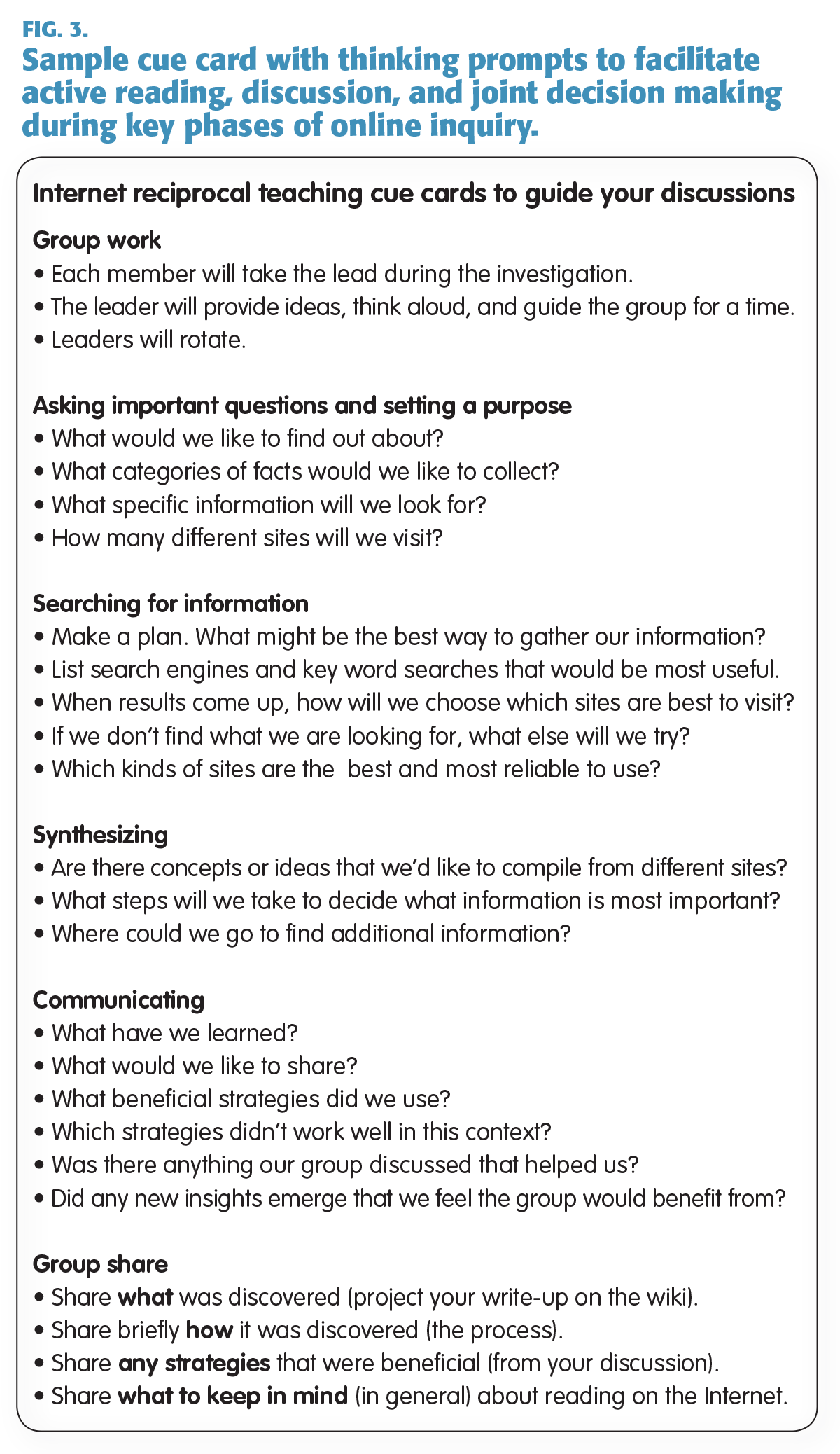
Effective online inquiry for students in our study — and we suspect any learners who work and learn in an online environment — involves a number of strategic processes. For example, close reading of online texts engaged students in making inferences and integrating information. When used in conjunction with collaborative discussion strategies including monitoring, elaborating, interpreting, and extending talk about important ideas, students were successful in making sense of content found online. Partners who used these strategies had more focused searches and relevant academic discussions while navigating multiple web sites; their inquiry products were of higher quality; and they demonstrated greater amounts of evidence-based reasoning drawn from text, discussion, and prior knowledge to support their choices. Inquiry-based learning that pairs students to explore online texts together provides an engaging context for encouraging these strategic practices. In the process, students become more self-directed learners and more productive listeners, speakers, and collaborators — the goals of learning in any century.
References
Alberta Learning. (2004). Focus on inquiry: A teachers guide to implementing inquiry-based learning. Edmonton, Alberta: Author. https://education.alberta.ca/media/313361/focusoninquiry.pdf
Coiro, J., Sekeres, D.C., Castek, J., & Guzniczak, L. (2014). Comparing 3rd, 4th, and 5th graders’ collaborative interactions while engaged in online inquiry. Journal of Education, 194 (2), 1-16.
Harrison, C., Dwyer, B., & Castek, J. (2014). Using technology to improve reading and learning. Huntington Beach, CA: Shell Education.
National Governors Association Center for Best Practices & Council of Chief State School Officers. (2010). Common Core State Standards for English language arts and literacy in history/social studies, science, and technical subjects. Washington, DC: Authors.
CITATION: Sekeres, D.C., Coiro, J., Castek, J., & Guzniczak, L.A. (2014). Wondering + online inquiry = learning. Phi Delta Kappan, 96 (3), 44-48.
ABOUT THE AUTHORS

Diane Carver Sekeres
DIANE CARVER SEKERES is an associate professor of education at the University of Alabama, Tuscaloosa, Ala.
Jill Castek
JILL CASTEK is a research assistant professor at Portland State University, Portland, Ore.
Julie Coiro
JULIE COIRO is an associate professor of education at the University of Rhode Island, Kingston, R.I.
Lizabeth A. Guzniczak
LIZABETH A. GUZNICZAK is a visiting assistant professor of reading and language arts at Oakland University, Rochester, Mich.