Moving on to college or into a career after high school poses an even more daunting challenge for mentally ill students. But laws, standards of practice, and community resources can help.
Walter was no stranger to the high school guidance office. He first came to counselors’ attention during 10th grade when teachers noticed his grades were declining, and he appeared to be losing motivation to complete schoolwork that previously had been easy for him. He often seemed lethargic, quieter, and withdrawn from his circle of friends. In a discussion with his school counselor, Walter said he didn’t understand how his schoolwork was connected to his goal of becoming a biologist. High school work was harder than he expected, and he didn’t know how to manage all the assignment deadlines. He mentioned a variety of somatic complaints — headaches, stomachaches, and difficulty sleeping — that made it hard for him to concentrate. The counselor began meeting with Walter weekly for motivation and career planning discussions that could help him better understand the connection between his classes and his goals to become a biologist, which would require a college degree. She also met with Walter’s parents to review his sleep routine. In addition, Walter’s teachers helped him get better organized to complete assignments and meet deadlines, and increased communication with his parents. By the end of 10th grade, Walter’s grades had improved slightly, but he still reported feeling sad and lethargic much of the time.
In 11th grade, Walter withdrew further, rarely speaking to peers, dropping out of extracurricular activities in the science club, and appearing distracted in class. His absences increased, he began losing weight, and he visited the school nurse frequently. Over winter break, Walter was hospitalized and diagnosed with major depressive disorder and generalized anxiety. Upon returning to school, he was declared eligible for special education services. In collaboration with his family and psychiatrist, the school psychologist implemented a therapeutic counseling plan to provide individualized emotional supports. Walter’s attendance and grades improved, and he began to re-engage with activities and with peers. Continuing to receive mental health supports his senior year, Walter also worked with the school counselor to prepare his college applications and learn more about mental health supports that would be available to him in a postsecondary setting. He is now attending a local community college and living at home while pursuing a science degree and adjusting to the different structure and academic demands with support from the college’s Office of Disability Support Services.
As illustrated with Walter and countless other high school students with mental health needs, school personnel serve a vital role in providing a foundation for students’ success in their adult lives. Whether students want to become entrepreneurs, go straight into the workforce, or continue their education in college, educators can employ strategies and supports to make that transition more successful. These supports are especially important to students with mental health challenges who may have vulnerabilities that require additional preplanning and strategies. In particular, educators can easily support transition in six key areas:
- Awareness of student mental health needs;
- Prevention and early intervention;
- Formal written Individuals with Disabilities Educational Improvement Act (IDEA) transition planning;
- Fostering self-advocacy;
- Supportive assessments; and
- Connecting students and families to resources.
Understanding these six factors and adopting a team approach that includes the family and student are important to helping students reach their potential. Schools are complex systems, so identifying specific school personnel who can assist is important. For example, in Walter’s case the school psychologist and school counselor provided counseling and supported the family by providing information on college transition and postsecondary support systems. His teachers offered additional in-class academic supports by monitoring his organization skills, modifying his assignments, and adding test accommodations.
Awareness of student mental health
Students receiving special education services for emotional disturbance have the highest dropout rate (44%) of any disability category.
Some 20% of adolescents, ages 13-18, will experience a diagnosable mental health disorder (Merikangas et al., 2010). Diagnoses may range from milder forms (e.g., ADHD), which can be managed in the general education classroom with accommodations and modifications, to a major depressive disorder, which requires intensive intervention or special education services. Those identified with emotional and behavioral disorders that require extensive support services represent the fifth largest group served under IDEA. In addition, students receiving special education services for emotional disturbance have the highest dropout rate (44%) of any disability category (USDOE, 2012). These data substantiate the importance of school supports and early intervention to assure high school completion and transition to college or career.
Prevention and early intervention
Educators often think of transition planning as an activity during junior and senior year of high school. But ideally transition to postsecondary life begins in elementary school. Just as students learn core foundational reading, writing, and math skills, we also should be establishing skills to promote social-emotional well-being and mental health. Many mental health problems, such as anxiety and depression, emerge during childhood and early adolescence (Merikangas et al., 2010). As a result, providing prevention and intervention services in the primary grades will allow practitioners to address early symptoms of mental health problems and reduce long-term negative outcomes associated with these disorders.
Schools can deliver these services to students with a multitiered system of supports (MTSS), which addresses student needs with escalating levels of intervention. (See Desrochers, p. 34 this issue.) For older students, short-term, tiered intervention within a multitiered framework can promote the development of valuable skills for school and the workplace.
IDEA transition planning
Major transitions can be exacerbated by existing mental health problems, which can contribute to difficulty making decisions or accepting new opportunities, particularly if the transition involves leaving home.
When a student with mental health needs has an Individualized Education Plan (IEP), IDEA requires that his or her school writes a formal postsecondary transition plan once the student is 16 years old. Students who haven’t been identified with a disability can still request basic transition services — guidance on courses to take, career planning, etc. — but the law does not require a written formal plan. Two organizations — the National Center on Secondary Education and Transition (2002) and the American Academy of Child and Adolescent Psychiatry (2014) — offer parents tips on transition planning with or without disabilities. IEP transition plans should be student-centered and consider a range of life activities, such as education, employment, daily living, and community-life adjustment. Student and caregiver input is essential. Because some students are more aware of their goals than others, career counseling, aptitude/interest surveys, and vocational evaluations also may be helpful (Stroebel, Krieg, & Christian, 2008). Research indicates that caregiver involvement in school planning and activities also has a positive effect on students’ academic performance and emotional well-being (Chu, Saucier, & Hafner, 2010). Keep in mind that the natural anxiety produced by major transitions for most people can be exacerbated by existing mental health problems, which can contribute to difficulty making decisions or accepting new opportunities, particularly if the transition involves leaving home. Staying aware of these barriers and providing opportunities for students to talk about concerns is important.
Student self-advocacy
Throughout the transition process, educators should foster students’ independence and help them develop self-advocacy and self-determination skills. One way to foster self-advocacy is to invite high school students to attend their own IEP meetings and coach them on how to actively participate in decision making. Additionally, educators and students may wish to discuss strategies for self-disclosing one’s disability status in the workplace and academic settings. Practical suggestions for advising students on these topics are available through the Office of Disability Employment Policy in the U.S. Department of Labor. Moreover, students should be encouraged to reflect on and describe services that have been most helpful to them (Stroebel, Krieg, & Christian, 2008). Opportunities to practice communicating their needs and preferences to others may build students’ confidence in addressing similar issues in future work and school settings. These skills are especially important as students reach the age of maturity and enter the workplace or college. Under the Family Educational Rights and Privacy Act (FERPA) regulations, the right to disclose educational records information is transferred from the parents to the student when the student either turns 18 years old or enters a postsecondary institution (at any age). Therefore, it may no longer be feasible for parents to intervene in college disability classification or accommodation discussions with those institutions unless the student invites and consents to their involvement. Additionally, disclosure of personal mental health diagnoses, treatment, or intervention falls under the regulation of the Health Insurance Portability and Accountability Act (HIPAA), which can impose significant penalties to mental health professionals (e.g., counselors, school psychologists) who inappropriately share this information without written authorization. Both FERPA and HIPAA laws are complex, and a complete review is beyond the scope of this article. Additional information for parents on FERPA is available at www2.ed.gov/policy/gen/guid/fpco/faq.html#q1, and additional information for mental health professionals on HIPAA is available through the U.S. Department of Health and Human Services (www.hhs.gov).
Supportive assessments
IDEA also requires that transition plans for high school students include a Summary of Performance (SOP) during the final year as they exit the school system. Although not required to meet college entrance or workplace documentation standards, the SOP is an opportunity for schools to give students information that may help them secure accommodations at work or college (e.g., documenting current needs or disabilities). Schools also can tell parents about local colleges that offer needs-based evaluations at no charge to incoming students. School counselors are an excellent source of knowledge regarding local college requirements.
Disability documentation requirements vary among employers, and the student may need to give the school appropriate documentation forms to complete. In contrast, disability documentation procedures in college settings are more standard. The Association on Higher Education and Disability (AHEAD) and the Educational Testing Service (ETS) specify criteria for documenting disability status at the postsecondary level that include:
- Evaluators who are appropriately credentialed or qualified;
- Recent documentation; and
- Recommendations for accommodations that are accompanied by specific rationale for such supports (AHEAD, 2008; ETS, 2012).
AHEAD requires a diagnosis from a specifically credentialed or licensed professional. Some conditions may require an independent evaluation (e.g., acquired brain injury) to document the need for services.
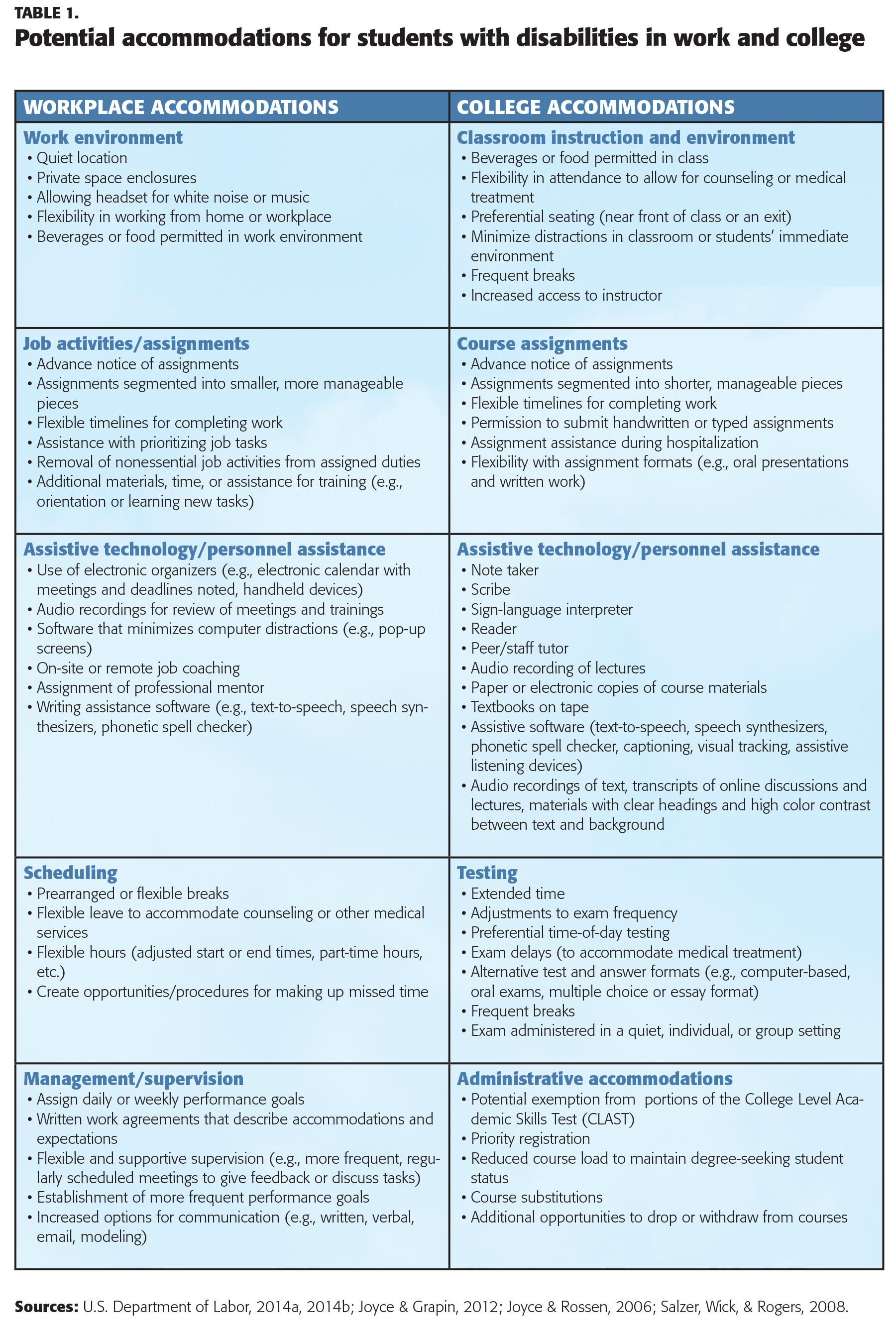
Students and families need to know that the provisions of IDEA do not extend to the postsecondary education systems and may not be relevant to the workplace (except in some background clearance circumstances). Disability accommodations are provided for adults under the Rehabilitation Act of 1973 and Title II of the Americans with Disabilities Act (ADA, 1990) and are defined as physical or mental impairments “that substantially limit one or more major life activities.” Unlike requirements for K-12 school services, diagnoses found in the American Psychiatric Association’s Diagnostic and Statistical Manual of Mental Disorders are required. Therefore, some students receiving services through public schools under IDEA may not qualify for or receive those services at the college level under ADA. For example, if a student is receiving support services under IDEA for emotional disturbance based on past difficulties with depression, that student is not assured services in college without recent data demonstrating a current depression diagnosis and circumstances that substantially limit one or more major life activities. A second example might be a student with significant test anxiety who was provided accommodations as a student with emotional disturbance. Test anxiety by itself is not a diagnosis and thus would not qualify in college as a disability unless sufficient data demonstrate that it’s a symptom of a social or generalized anxiety disorder. Schools should encourage students and families to inquire about required documentation for disabilities from colleges and employers as part of their transition planning. A detailed list of common accommodations is provided in Table 1.
Connecting to resources
Schools can coordinate with community agencies to provide opportunities that enhance students’ employability and college readiness (Stroebel, Krieg, & Christian, 2008), including vocational, career, and internship programs, identifying suitable professional mentors, and inviting local experts who can offer transition support services. To that extent, schools should compile and distribute contact lists of community agencies, including mental health centers, social security, health and human resources, social services, and rehabilitation services.
Students transitioning to the workplace or college should know about specific supports and accommodations available in these settings. Table 1 provides a list of possible accommodations that may be available in workplace settings to individuals with disabilities. College settings may offer additional services, such as free or highly subsidized mental health services, peer support groups, and tutoring sessions. Students should be encouraged to contact representatives from human resources and disability services offices for more information about services offered at specific institutions.
Conclusion
School personnel have many opportunities to assist students and families in preparing for a successful transition to college and careers. Initial high school efforts may include prescreening incoming freshman student files to identify those at risk and assuring that support services and interventions are implemented quickly. Early supports for students with mental health needs will be key to assuring higher graduation rates and building resiliency as they transition to adulthood. For students with IEPs, a formal transition plan that identifies long-term goals and supports achieving those goals as well as an exit summary that may provide accommodation documentation can be helpful. For all students with mental health needs, school personnel can educate students and families regarding the differing provisions of IDEA, the Rehabilitation Act, and the ADA. Schools also can serve students with mental health needs through assistance in identifying and accessing community, employment, and postsecondary education support resources.
References
American Academy of Child and Adolescent Psychiatry. (2014, June). Starting college with a psychiatric illness. Washington, DC: Author.www.aacap.org/AACAP/Families_and_Youth/Facts_for_Families/Facts_for_Families_Pages/Starting_College_with_a_Psychiatric_Illness.aspx
Americans with Disabilities Act of 1990. 42 U.S.C.A. § 12101.
Association on Higher Education and Disability. (2008). Disability documentation guidelines to determine eligibility for accommodations at the postsecondary level. Huntersville, NC: Author. www.ahead.org/affiliates/connecticut/documentation
Chu, P.S., Saucier, D.A., & Hafner, E. (2010). Meta-analysis of the relationships between social support and well-being in children and adolescents. Journal of Social and Clinical Psychology, 29, 624-645.
Educational Testing Service. (2012). Guidelines for documentation of psychiatric disabilities in adolescents and adults (2nd ed.). Princeton, NJ: Author. www.ets.org/s/disabilities/pdf/documenting_psychiatric_disabilities.pdf
Joyce, D. & Grapin, S.L. (2012). School psychologists’ role in facilitating successful postsecondary transitions for students with disabilities. Communiqué, 41 (1), 20-24.
Joyce, D. & Rossen, E. (2006). Transitioning high school students with learning disabilities into postsecondary education: Assessment and accommodations. Communiqué, 35 (3), 39-43.
Merikangas, K.R., He, J.P., Burstein, M., Swanson, S.A., Avenevoli, S., Cui, L., … Swendsen, J. (2010). Lifetime prevalence of mental disorders in U.S. adolescents: Results from the National Comorbidity Survey Replication-Adolescent Supplement (NCS-A). Journal of The American Academy of Child & Adolescent Psychiatry, 49 (10), 980-989.
National Center on Secondary Education and Transition. (2002). Parenting postsecondary students with disabilities: Becoming the mentor, advocate, and guide to your young adult needs. Minneapolis, MN: Author. www.ncset.org/publications/viewdesc.asp?id=208
Rehabilitation Act of 1973 (Section 504), 29 U.S.C. § 794.
Salzer, M.S., Wick, L.C., & Rogers, J.A. (2008). Familiarity with and use of accommodations and supports among postsecondary students with mental illnesses. Psychiatric Services, 59, 370-375.
Stroebel, S.S., Krieg, F.J., & Christian, S. (2008). Best practices in planning for an effective transition from school to work. In A. Thomas & J. Grimes (Eds.), Best practices in school psychology (5th ed., Vol. 4), pp. 1599-1609. Washington, DC: National Association of School Psychologists.
U.S. Department of Education. (2012). Thirty-first annual report to Congress on the implementation of the Individuals with Disabilities Education Improvement Act. Jessup, MD: Author.
U.S. Department of Labor. (2014a). Entering the world of work: What youth with mental health needs should know about accommodations. Washington, DC: Author. www.dol.gov/odep/pubs/fact/transitioning.htm
U.S. Department of Labor. (2014b). Maximizing productivity: Accommodations for employees with psychiatric disabilities. Washington, DC: Author. www.dol.gov/odep/pubs/fact/psychiatric.htm
Citation: Joyce-Beaulieu, D. & Grapin, S. (2014). Support beyond high school for those with mental illness. Phi Delta Kappan, 96 (4), 29-33.
ABOUT THE AUTHORS

Diana Joyce-Beaulieu
DIANA JOYCE-BEAULIEU is a psychologist and an associate scholar of school psychology and early education in the College of Education, University of Florida, Gainesville.
Sally Grapin
SALLY GRAPIN is an assistant professor of psychology at Montclair State University, Montclair, N.J.