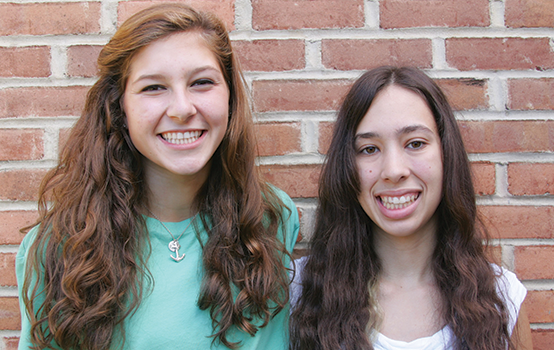
Two future teachers reflect on the value of developing trusting relationships with students.
The most important tool for learning is a positive relationship between the teacher and the student. Communication is the key to making this relationship work. Haley remembers how the teacher of her first high school class set the standard for her. “I was greeted with a welcoming smile and an enthusiastic attitude by my Spanish teacher, Ms. Little. She reassured us she was there to talk about whatever we needed. By extending this invitation to our class, I felt it was now in my hands to accept the invitation and forge a positive relationship. I relaxed and felt comfortable as I sat down to learn. I knew she cared about what I had to say. Ms. Little was genuinely interested in me as a person and continued to show that interest every day of my freshman year. Her welcome set the tone for the rest of my day and the rest of my year. Ms. Little’s faith in me made it possible to take the risk of being wrong and trying new things. I knew she would help me get back up again if I stumbled.”
How do good teachers make this connection? They openly extend an invitation to students beyond their daily school lessons. Teachers can take the first step in forming that relationship by learning more about their students’ backgrounds and hobbies through a few simple activities. They can incorporate these interests into classroom work that makes students feel important and more involved. It is beneficial to both the teachers and students. It promotes learning and understanding between the two extending beyond the classroom. Grace, a student in our Teaching as a Profession class, shared this from her letter to a teacher who made a difference in her life. “You come to school not to just teach, but to understand and care about us. I was not just another student among many. I was special.”
Teachers and students both have to work to develop and nurture this relationship. It begins by showing mutual respect and interest. This leads to an atmosphere of trust and security. If my teacher has faith in my ability and me, I’m more likely to take risks when I’m trying to learn. Our Teacher Academy teacher, Ms. Dear, shared her most influential moment with a teacher back when she was a student. The class had taken a test and no one passed. Instead of making the students feel like failures, her teacher said he was sure they had studied, but obviously he hadn’t taught the lesson well. The teacher then redesigned the previous lesson and said that together they would master the material. He told them, “We are going to work as a team.” Ms. Dear says she remembers this moment each time she plans a lesson.
Teacher and student need to keep open minds to help build trust that leads to increased communication. They also have to really listen to each other. Often, the teacher must be the one who takes the first step toward building a connection. Simple ways to do this are greeting students as they enter the classroom, keeping current bulletin boards with student work and activities, and asking about sports or activities the students are involved in.
Now it becomes the student’s responsibility to help make the connection stronger. A student can help the relationship by making eye contact during a lesson, asking questions, and being ready when class starts. These show students are engaged in the class and respect and appreciate what the teacher is doing.
The teachers we develop special relationships with are also the teachers who get us to work to our greatest ability.
Another good way to continue to develop this relationship is to accept a teacher’s offers of extra help before or after school, showing the teacher that the student has a strong desire to do well. Students can also just stop by to thank their teacher for taking time to help students. This time spent together outside of class provides both the opportunity to ask questions and to get to know each other in a more relaxed and personal way.
Consider Haley’s interactions with her first high school math teacher. “I had a challenging math class my freshman year,” Haley said. “I knew that a personal connection with my teacher, Mr. Piche, would be valuable and greatly beneficial for my learning. I wanted him to know from the first day of class that I cared about what he had to say and about his class. I also wanted him to know I appreciated all the extra time he took to explain things and give individual help if it was needed. In addition to constantly staying engaged and participating in the lesson, I would also visit him before and after school. I was eager to show him my dedication to the class and that I valued his help and support. This resulted in a comfortable and productive connection with my teacher . . . and I really learned math!”
Developing a positive relationship is not about becoming a friend to students, but being a coach and a cheerleader. The best teachers set high expectations for students and model organization skills for them through how they teach the class. They’re always trying new things. Their feedback to students is specific, focused, and fair. It can be especially helpful when students have to write papers, Jenny says. “Writing papers for class always makes me nervous because I want to make sure that it is the best it can be before I turn it in. I love being able to show my teacher the paper beforehand. Last year, my English teacher, Mr. Sackett, always let us come to him to edit and discuss our papers. Throughout the year, I was able to develop my writing skills with his help. He would give me constructive criticism to help me be my best. It was easier to hear his criticism because I was comfortable with him. Instead of discouraging me, his criticism helped to build my confidence.”
A recent assignment in our Teaching as a Profession class was to write a thank you note to teachers who affected our lives. Our letters were addressed to teachers from 1st grade through high school. A common thread was obvious as we shared our reasons for choosing the teacher. The most influential teachers showed they believed in us, set high expectations, and knew that we could do the work. Paige, a student in our Teacher Academy of Maryland class, shared how important it was for her. “Even if I am not a fan of the class, but I know the teacher likes me . . . I’m motivated to do well in the class and to impress the teacher by meeting the standards I know they expect.” The teachers we develop special relationships with are also the teachers who get us to work to our greatest ability.
Jenny reflects, “I wrote my letter to my 1st-grade teacher Ms. Zorzi. She gave me a book for my birthday when I was her student. I still have that book today. I saw her again while I was doing my internship for the Teacher Academy. I talked to her about my life and how she really made a difference in my love of books and school. She continues to inspire me to work harder and to be a good teacher. Ms. Zorzi helped me learn to trust and value my relationship with my teachers.” This early relationship helped me form other great relationships with teachers. For many students, the relationships with their teachers are the first adult relationships outside their family. These strong bonds last beyond the academic year, sometimes a lifetime . . . and sometimes inspire us to follow in their footsteps.
As future educators, we hope to be that teacher who gets a thank you note. We want to make a difference in the lives of students, guiding them to learn more, try harder, get up if they fall, and then to try again. We want to inspire students and give them the confidence they need to be lifelong learners.
CITATION: LaPoma, J. & Kantor, H. (2013). STUDENT VOICES: It’s all about relationships. Phi Delta Kappan, 95 (4), 74-75.
ABOUT THE AUTHORS

Haley Kantor
HALEY KANTOR is a junior at Atholton High School, a member of the national Future Educators Association® Honor Society, vice president of the Atholton FEA, and a student in the Teacher Academy of Maryland.
Jenny LaPoma
JENNY LAPOMA is a senior at Atholton High School, Columbia, Md., a member of the national Future Educators Association® Honor Society, vice president of the Atholton FEA and a student in the Teacher Academy of Maryland.