Since Russia launched Sputnik into orbit around Earth in 1957, well-meaning leaders of business, industry, finance, foundations, and other areas outside education, working through state and federal politicians, have shoved experienced educators aside and promoted education “reforms.”
Propelling their efforts is a theory: Poor academic performance is a people problem. Good schooling is rigorous, and many people avoid rigor. They need to be motivated. Competition motivates.
The theory applied
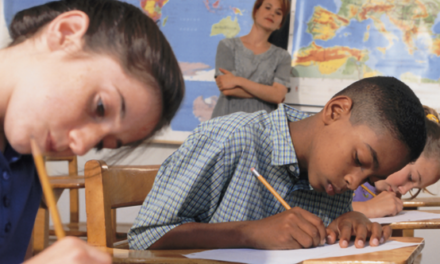
We see the competition-based model play out through high-stakes testing. Schools, teachers, and students receive grades based on test scores. Performance statistics get publicized. Federal funding is at stake. Vouchers and school choice pit schools against each other. Neighborhood schools that lose out have to close or face takeover. But there’s no significant change in learner or school academic performance.
Billions of dollars and hours are spent to promote academic competition, and performance stays flat.
What drives good schooling isn’t competition but the human need to understand, to know, to satisfy curiosity, to build better, to solve problems, to create, and to feel like part of something. In education, competition is a counterproductive distraction blocking the motivating power of these deeper human needs.
Poor academic performance isn’t a people problem. It’s a system problem. The system is the core curriculum America’s high schools adopted in 1894 that continues to organize most of the school day.
What’s wrong with the core?
The universe that schooling is supposed to help the young understand is a seamless, systemically integrated whole. As Leonardo da Vinci is credited with saying, “Everything connects to everything else.” America’s high schools break that whole apart and examine some of the parts in great and useful detail while ignoring other parts and how all parts interact to create a whole. Lacking the big picture, we fail to see unintended consequences of actions and spend too little time imagining and preparing for probable, possible, and preferable futures.
We see the inability to make connections in many of society’s problems. We’ve been generating electricity with nuclear energy for decades but still haven’t figured out how to safely dispose of spent fuel rods. The Cross-Florida Barge Canal was 28% complete before someone realized the saltwater canal would intersect the underground stream that delivers fresh water from Georgia swamps to millions of people in heavily populated south Florida. And, perhaps most importantly, the core curriculum ignores the ancient Greek maxim, “Know thyself.”
Schools don’t teach in a way that helps students step back and see what happens when change collides with humankind’s tendency to resist it. The result? Divisive societal misalignments, misunderstanding, suspicion, distrust of science, conspiracy theories, political conflict, and an inadequately educated electorate. (Scholars agree: www.marionbrady.com/documents/QuotesFragmentation.pdf.)
Institutional inertia and ignorance are locking the “separate subject” core curriculum in an ever-more-rigid place, preventing adoption of a curriculum that models the universe correctly and holistically. Such a curriculum costs nothing to adopt, is free of the core’s theoretical and practical problems, maximizes the relating process that continuously expands human knowledge, and is significantly simpler because it builds on how humans naturally organize information.
Our ‘natural’ information organizers
Change is inevitable and inexorable. To survive, societies must control change they can, adapt to change they can’t, and anticipate probable and possible directions of change. All three require a continuous flow of new knowledge and new uses for existing knowledge. Traditional core-based schooling emphasizes and rewards recall of what’s already known and neglects the dynamic, knowledge-creating relating process essential to understanding and adapting to change.
Fortunately, traditional schooling’s neglect of the relating process hasn’t done us in. That’s because all human brains are “prewired” to think and learn systemically.
We’re born. Confused and upset by the abrupt change of environment, we cry, and a nipple with food appears. We drink, go to sleep, wake up hungry, cry, the process repeats, and we discover a relationship! Long before we’re sent off to kindergarten, discoveries of relationships have taught us countless details we need to live a way of life.
That’s it. Crying and nipples relate. Trying to crawl and parental smiles relate. Bare feet, sand spurs, and pain relate. Icy highway bridges and loss of steering control relate. Fear and racism relate. Solar flares and the quality of satellite communications relate. Customer spending and the layout of supermarkets relate. Societal stability and wealth distribution relate. Tectonic plate movement and earthquakes relate. Attached garages, automatic garage door openers, and the decline of neighboring relate. Time and space relate.
Relating — connecting things not previously thought to relate — is the process that makes possible an explosion of academic performance.
We can improve the odds that students will be able to cope with the mess humans have made of the planet by improving their ability to expand knowledge through the relating process. Instead of having middle schoolers focus on recalling secondhand information we can turn them toward the knowledge-expanding relating process before sending them off to high school.
This fixes traditional core-based schooling’s near-total neglect of the higher-order thought processes that make humanness and civilized ways of life possible. Those thought processes — analyzing, abstracting, applying, categorizing, comparing, extrapolating, generalizing, hypothesizing, imagining, inferring, and so on — are the tools that enable the relating process. But they aren’t being taught because they’re not being tested. They’re not being tested because determining the quality of valid but unanticipated learner thought can’t be done by machine-scored standardized tests, even with AI.
The knowledge-expanding process
When its attention fixes on a matter of interest (usually missing in school), the human brain simultaneously integrates, systemically, five kinds of information — the elements of “stories:”
- Location/setting/environment
- Actor(s) and/or object(s) involved
- Action(s)/action patterns
- Cause of actions/motivations/driving forces
- Relevant time factors/systemic changes
Those five kinds of information — not school subjects, not academic disciplines, not fields of study — are our primary organizers of information. Our brains use them to structure everything from a six-word phone text to a friend about meeting for lunch to the millions of words, diagrams, formulas, charts, measurements, graphs, and algorithms for building a colony on the moon. Cumbersome, idiosyncratic interdisciplinary, multidisciplinary, transdisciplinary, and cross-disciplinary strategies for describing or analyzing complex, real-world matters are unnecessary mental clutter. Our five primary information organizers can do it all.
Learners attempting to understand something new can use the five categories to define, elaborate, and refine their questions. If, for example, they’re investigating traffic patterns around their school, they know to ask:
- What are the patterns? (Actors and objects)
- Have they changed over the last five years? (Relevant time factors)
- If so, why? (Causes)
- What are the relationships between pedestrians and vehicles during peak traffic periods? (Action)
- What controls each kind of traffic? (Causes)
Systems-based instruction that builds on these organizers can do in a couple of hours a day what the core curriculum’s stand-alone subjects can’t do at all — give every kid a simple, working understanding of the knowledge-expanding sense-making relating process. For generations facing increasingly complex, unknowable futures, nothing schooling can provide is of greater value.
For those wanting to know what systems-based learning could look like, my website (www.marionbrady.com) includes systems-based curricula for American history, civics, world history, and world cultures, as well as resources for understanding why our current system needs to change.
Imagining a new system
Deeply embedded, overlapping education bureaucracies make significant institutional change impossible. We need education policy makers to loosen their grip and expand teacher and administrator autonomy. If they do, the middle school movement of the 1960s offers the most direct path to meaningful, lasting improvement in academic performance, not just for middle schools but for all general education beyond the primary and elementary levels.
The middle school movement had just about everything known about effective schooling going for it: a commitment to active and cooperative learning by doing, stress-free small-group dialogue encouraging thinking out loud, learner writing to clarify thought, team teaching and shared teacher planning periods, flexible scheduling, respect for learner differences, daily physical activity, and an appreciation of stable neighborhood schools and “communities” of learners. The movement understood the necessity of integrating information to deal with real-world problems but stumbled on the difficulties of integrating school subjects. That problem disappears if we organize knowledge correctly.
Lacking the big picture, we fail to see unintended consequences of actions and spend too little time imagining and preparing for probable, possible, and preferable futures.
Middle schooling hasn’t escaped the damage done by the last 40 or so years of failed reforms, but the National Middle School Association’s position paper, “This We Believe,” remains the most sophisticated foundation for schooling that produces what’s essential for humankind’s survival — generations that “stand on the shoulders” of the previous generation, each wiser than the generation preceding it.
Stop dumbing America down with standardized testing or other activities that privilege recalling secondhand information to the neglect of the thought processes essential to survival. Make middle schooling’s primary task learner discovery and the exploration and elaboration of relationships between and among aspects of reality. This will give the study of change a running start as students head into high school. Replacing traditional subjects with investigation of relationships is essential.
Immediate experiences and learner dialogue about those experiences are the richest, most accessible teaching resources available in most classrooms. Be serious about identifying individual learner potential and devising ways to develop it. Help the young identify and develop what they possess. That huge store of varied experience and perspective — what’s in the heads of millions of non-standardized kids—can then be put to real-world work to pull humankind’s fat out of the fire.
This article appears in the September 2024 issue of Kappan, Vol. 106, No. 1, p. 56-58.

ABOUT THE AUTHOR

Marion Brady
Marion Brady began his career in education in 1952 and has taught at every level from 6th grade through higher education. He is the author of What’s Worth Learning? (Information Age, 2011) and the Prentice Hall Idea and Action middle school textbooks for world cultures and American history (1977). Visit his website at www.marionbrady.com.