
A Washington state program demonstrated significant progress in promoting inclusive education in participating districts.
The United Nations Convention on the Rights of Persons with Disabilities (CRPD) mandates that its 161 signatory nations ensure an accessible, high-quality, and inclusive education for individuals with disabilities (United Nations General Assembly, 2007). Article 24 calls for the establishment of inclusive education systems at all levels, promoting lifelong learning for people with disabilities alongside their peers in general education. Inclusion has important benefits for school cultures such as providing support and promoting collaboration between general and special education teachers (Hehir, Grindal, & Eidelman, 2012).
To support more inclusive schools in Washington state, the legislature appropriated funding in its 2019-21 budget to the Office of Superintendent of Public Instruction. The Washington Association of School Administrators (WASA) in 2020 was awarded funding for the Inclusionary Practices: Statewide Support for District Change project. It aimed to assist district leadership teams in developing and implementing plans for more inclusive learning environments for students with disabilities.
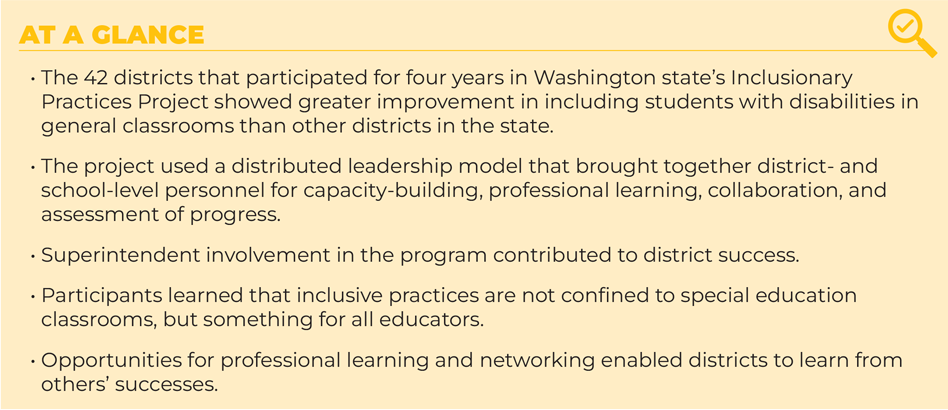
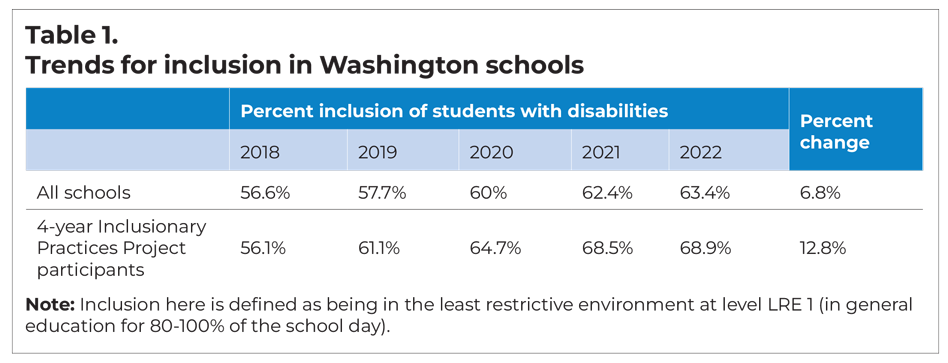
We have been involved in facilitating the Inclusionary Practices Project (IPP) in collaboration with our colleagues. Currently, we are working with a total of 53 district teams in the state. While there have been some changes in participation, 42 district leadership teams have been engaged in the project since 2020. Over four years, the 42 participating districts achieved a 12.8% increase in inclusion in the least restrictive environment at level LRE 1, which Washington defines as being placed in general education for 80-100% of the school day. This surpasses the state average increase of 6.8% ( see Table 1).
The success of inclusive practices should not be measured solely by inclusion rates. While higher rates indicate increased time spent in general education classrooms with peers, inclusion extends beyond placement. To ensure effectiveness of inclusion initiatives, students with disabilities must receive appropriate support and accommodation to meet their unique needs.
How the project worked
Our experiences facilitating this extensive project have broader implications for other educational institutions committed to fostering inclusive practices. One especially important element was that we structured the work to gather and respond to insights and data generated throughout the process.
Establishing a distributed leadership team
For districts aiming to create more inclusive systems, establishing a distributed leadership team is crucial. Members provide leadership, expertise, and decision-making authority to drive the progress of inclusive practices within the district. In our project, the core leadership team typically includes the district’s superintendent or deputy/assistant superintendent; the teaching and learning central office administrator (such as the director of curriculum); and the special education central office administrator. These positions are instrumental in guiding and overseeing the implementation of inclusive practices across the district.
To ensure a diverse range of perspectives and expertise, we also include up to four additional educators in the core team. They could be building leaders, teacher leaders, and/or instructional coaches who bring valuable insights and experiences that inform the implementation process in their schools and classrooms.
Each team chooses a facilitator who plays a central role in district planning, self-assessment work, and meeting minutes. The facilitator works closely with a WASA project lead who serves as an accountability partner. It is crucial for district facilitators to have district-level decision-making authority.
We must recognize that all students are general education students, regardless of whether they require additional support through special education services.
Additionally, one or two members of the core leadership team provide professional development within the district. These individuals receive training to present districtwide professional development sessions on inclusive practice.
Building capacity and collaboration
The project supports district team facilitators through monthly meetings for professional development, collaboration, and feedback. At these regular meetings, teams have access to the resources and guidance to carry out their roles, promoting continuous learning and skill enhancement in a collaborative environment where educators can share experiences and best practices.
In addition to the monthly meetings with district team facilitators and professional development providers, district leadership teams gather four times a year to share progress, exchange ideas, and receive targeted support. After each of these meetings, participants are asked three key questions to assess the impact of the sessions:
- How did what you learned today inform your district’s work?
- What questions have emerged from today’s session?
- What challenges do you foresee as you move forward?
During the early stages of the project, participants often expressed their appreciation for the knowledge they gained regarding multi-tiered systems of support (MTSS) and the clarification of the distinction between universal design for learning (UDL) and differentiation. It was emphasized that UDL benefits all students, not just those with individualized education programs (IEPs). The feedback received during this phase primarily focused on understanding the “what” of the work, which was essential to develop a shared vision and common understanding among the participants.
As time went on, the focus shifted to examining systemwide shifts necessary to create more inclusive, equitable MTSS systems. Consequently, there was a greater emphasis on understanding “how” to implement these shifts. Recent feedback from the teams highlighted productive discussions around various areas, including:
- Data culture. This involved analyzing student data, using it to inform decision making, and establishing effective data collection and assessment practices.
- Scheduling. Teams considered scheduling changes that would support inclusive practices, such as flexible scheduling options, co-teaching opportunities, and dedicated time for collaborative planning and intervention support.
- High-quality instructional materials. Discussions involved the adoption of high-quality instructional materials that align with inclusive practices and provide differentiated support to meet students’ diverse needs.
- Instructional coaching cycles. This approach provides ongoing support and professional development for teachers so they can refine their inclusive teaching strategies and effectively implement MTSS within their classrooms.
- Educator evaluation. Teams wanted to revisit educator evaluation systems to ensure they align with the desired shifts toward inclusive practices.
The project has adapted its support and resources in response to feedback and to address the emerging questions and challenges teams face.
We also foster a collaborative learning environment by encouraging project teams to share their experiences and insights with each other. At the end of each project year, all teams showcase their theory of action; the problem of practice related to inclusion; strategic moves made to address it; outputs that demonstrate completion of their work; and outcomes observed among students, teachers, and the community. This sharing of successes, challenges, and lessons learned promotes peer learning, inspires innovation across districts, and enhances the overall impact of the project.
Assessing progress
Monitoring progress and aligning strategic moves to outcomes are crucial for ensuring the success of educational initiatives, particularly in the context of inclusive practices and student academic growth. We prioritize the development of strategic plans that integrate inclusive practice and establish clear outputs and outcomes. These plans serve as roadmaps for implementation and accountability, aligning the goals of inclusive practices with student academic growth.
To achieve continuous progress and improvement, we use feedback loops that enable teams to monitor their efforts and make data-informed adjustments. Teams submit annual self-assessments that allow them to reflect on their progress and receive valuable feedback and guidance on their next steps. They also collect perception data from students and staff to assess the impact of implemented changes. By combining this perception data with inclusion data and student learning outcomes, teams understand the impact of their efforts so they can make data-informed adjustments and improvements that respond to the needs of everyone involved.
Lessons learned from the project
As we engaged in this project, we learned a lot about what makes it possible to expand inclusive practices. We hope what we learned will support and inspire schools and districts seeking to do the same.
The importance of the superintendent
Superintendents play a critical role in supporting and championing inclusive practice. Feedback received during the first year of the project revealed frustrations arising from inadequate superintendent participation. Team members expressed concerns about gaining the necessary support and guidance. For example, one noted that they didn’t have the financial support of the superintendent or board to make big changes. Another commenter said their superintendent and chief academic officer support inclusionary practices but give no guidance on “where they want to go with that.” One commenter summed it up by saying, “I wish our superintendent was a part of the work.” These comments show the importance of superintendent buy-in and active involvement. Superintendents need to not only endorse inclusive practices but also provide clear guidance and direction for implementation.
Based on this feedback, we made it mandatory for the superintendent or deputy/assistant superintendent to attend all district IPP leadership team meetings. This created a direct line of communication and support between district leadership and the project team. Their participation fosters a sense of ownership and commitment to the project’s goals, which creates conditions for necessary changes within the district. Also, we hold a superintendent onboarding session for new teams to emphasize their role in driving inclusivity.
Superintendent participation provides several benefits. First, it demonstrates a clear and visible commitment to inclusive practices and sets a positive tone throughout the district. When superintendents engage with the project, it signals to others that inclusive practices are a priority. Additionally, superintendent participation ensures that district-level decisions and policies align with the goals and objectives of the project.
Inclusive practice as general education initiative
An additional lesson we have learned through our project is the importance of correcting the misconception that inclusive practice is solely a special education initiative. We must recognize that all students are general education students, regardless of whether they require additional support through special education services. Being part of the general student body is not contingent on not needing special education. Instead, special education services provide targeted and tailored support to meet individual students’ needs within the context of inclusive classrooms.
One of the challenges we encountered was the perception that inclusive practice is the sole responsibility of special education teachers or administrators. Participants wondered how systems could ensure that UDL is not limited to special education but is treated as, as one participant put it, “a framework for teaching and learning that lifts the ceiling (and the floor) for all students.” Comments like this emphasized the need to ensure that all educators and departments within a school embrace inclusive practice.
By recognizing that inclusive practice is a collective effort, districts can appropriately layer services to meet the diverse needs of all students. This collaborative approach not only enhances the effectiveness of inclusive practices, but also creates an environment that supports all students’ overall growth and development. Everyone must understand that inclusive practice is a shared commitment to providing a high-quality education for all students.
The need for ongoing professional learning
Inclusive practice is not a matter of choice or an optional approach for educators. Teachers cannot simply decide whether to be inclusive; it is an inherent aspect of their professional responsibility to meet the needs of all learners. However, we recognize that some teachers may feel uncertain about their ability to effectively address students’ diverse needs in inclusive settings. To help them, districts should develop comprehensive strategic plans to address teacher professional learning.
We strongly advocate for districts to establish a long-term professional development plan that demonstrates a commitment to supporting teachers. The plan should provide continuous and ongoing opportunities for teachers to evolve and refine their practice. It should outline districtwide expectations for inclusive practice and delineate various forms of professional learning that will support teacher efficacy.
These professional development plans should encompass a range of approaches that cater to teachers’ diverse needs and preferences. Collaborative professional learning communities, for example, allow teachers to engage in peer-to-peer collaboration, share best practices, and collectively problem solve around inclusive practice. Instructional coaching can help them implement inclusive strategies effectively in their classrooms. Mentoring programs can provide guidance, support, and opportunities for reflection alongside experienced inclusive teachers.
Teachers cannot simply decide whether to be inclusive; it is an inherent aspect of their professional responsibility to meet the needs of all learners.
Districts also should incorporate inclusive practice into their evaluation systems, providing feedback and support specifically related to inclusive practices. This helps reinforce the importance of inclusive practice and creates accountability for all educators. Lastly, districts should offer more traditional avenues for professional growth, such as conferences, reimbursement for graduate courses, and district-sponsored professional development events. Ongoing learning opportunities give teachers the necessary support, resources, and experiences to foster inclusive classrooms.
The value of networking
Rather than working in isolation, districts can join forces to exchange best practices, showcase evidence of impact, and pool resources. To facilitate this collaborative approach, our project team introduced Problem of Practice gatherings that bring together multiple districts to share specific challenges they are facing and explore potential solutions from others who may have encountered similar obstacles.
In addition to the Problem of Practice gatherings, we organize virtual networking opportunities known as Nosh and Network sessions, which focus on helping districts align their work amid numerous competing priorities. During these sessions, district representatives connect with peers from different districts, learn from their experiences, and make their own efforts more coherent. Through these collaborative initiatives, districts can leverage collective wisdom, overcome common obstacles, and work together toward building more inclusive and effective educational environments.
Inclusive education progress
IPP has demonstrated significant progress in promoting inclusive education within participating Washington districts. The project’s core components, including the establishment of distributed leadership teams, building capacity and collaboration, and assessing progress, have contributed to the success of inclusive practices.
By implementing these strategies and fostering a culture of inclusivity, schools and districts can create equitable and inclusive learning environments that meet the needs of all students, fulfilling the mandate of the United Nations Convention on the Rights of Persons with Disabilities and promoting lifelong learning for individuals with disabilities alongside their peers in general education.
References
Hehir, T., Grindal, T., & Eidelman, H. (2012). Review of special education in the Commonwealth of Massachusetts Department of Elementary and Secondary Education: A synthesis report. Massachusetts Department of Elementary and Secondary Education.
United Nations General Assembly (2007). Convention on the Rights of Persons with Disabilities (61/106).
This article appears in the April 2024 issue of Kappan, Vol. 105, No. 7, p. 14-19.

ABOUT THE AUTHORS

Katie Novak
Katie Novak is the founder and executive director of Novak Education, Groton, MA, and a former assistant superintendent of schools in Massachusetts. She is the author of In Support of Students: A Leader’s Guide to Equitable MTSS (Wiley, 2023).
Helene Paroff
Helene Paroff is the former Inclusionary Practices Project director for the Washington Association of School Administrators.