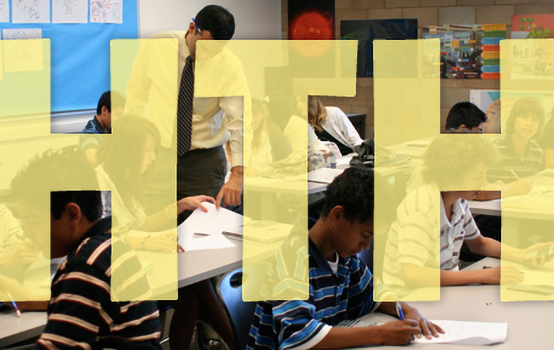
This project-based chain of schools has developed its own teacher training facility that emulates the constant innovation and student focus of its classrooms.
On an unusually warm Friday in February, the High Tech High seniors in Chris Millow’s environmental science course are holding class in the school garden, stretched out in the shade of a large tree, listening to a community garden expert share his knowledge of composting. After reviewing the chemical ratios for optimal composting conditions, students get to work creating a compost pile, mowing the grass, and tending to the vegetables that will grow aided by the compost. Their teacher is a student in High Tech High’s intern program, learning to be a teacher while embedded in the classroom full-time. This is Millow’s first year teaching, but his background includes degrees in wildlife conservation, entomology, and ecology, as well as experience researching and teaching with the Audubon Society, the National Oceanic and Atmospheric Administration, and the Environmental Protection Agency. Millow is teaching seniors full time and earning his California teaching credential through the intern program.
High Tech High (HTH) is a charter management organization that operates 13 schools in San Diego County: four elementary schools, four middle schools, and five high schools. All of these schools serve a diverse, lottery-selected student population; all embody the HTH design principles of personalization, adult world connection, common intellectual mission, and teacher as designer. And all are laboratories for trying new ideas in teaching and learning.
Doing school in a new way requires preparing teachers in a new way, so the High Tech High intern program was a logical outgrowth of HTH’s work to change K-12 learning. We launched the District Intern Program at HTH in fall 2004, four years after opening our first high school, in response to a state law requiring charter school teachers to hold a California teaching credential to be considered “highly qualified.” It was important to us to be able to continue offering teaching contracts to individuals with a range of experiences and expertise who were passionate about teaching but who lacked a credential. These teaching candidates could be fully embedded in K-12 classrooms while learning to teach.
Three years later, in 2007, HTH opened its own graduate school of education — the first graduate school of education to open in California in over 20 years, and the only one in the nation situated in a K-12 learning community. In addition to offering a path to teacher credentialing, HTH’s graduate school awards master’s degrees in educational leadership with concentrations in school leadership and teacher leadership to both HTH employees and outside educators. HTH teacher credentialing programs and the master’s in education program are both fully embedded in K-12 schools. They share a space connected to one of HTH’s elementary schools, and students have the opportunity to practice their learning on a daily basis in their work with K-12 students. To date, 143 teachers have completed the High Tech High intern program: 112 from HTH and 31 from elsewhere; 328 teachers have completed the induction program.
When we began offering the intern program, we had authorization from the state of California to offer single-subject credentials. As our organization has grown from one high school to 13 schools K-12, our intern program has grown as well. We now offer single-subject, multiple-subject, and education specialist credentials. Working under the umbrella of adult learning at High Tech High and with the HTH graduate school, we can share resources with master’s program faculty and students.
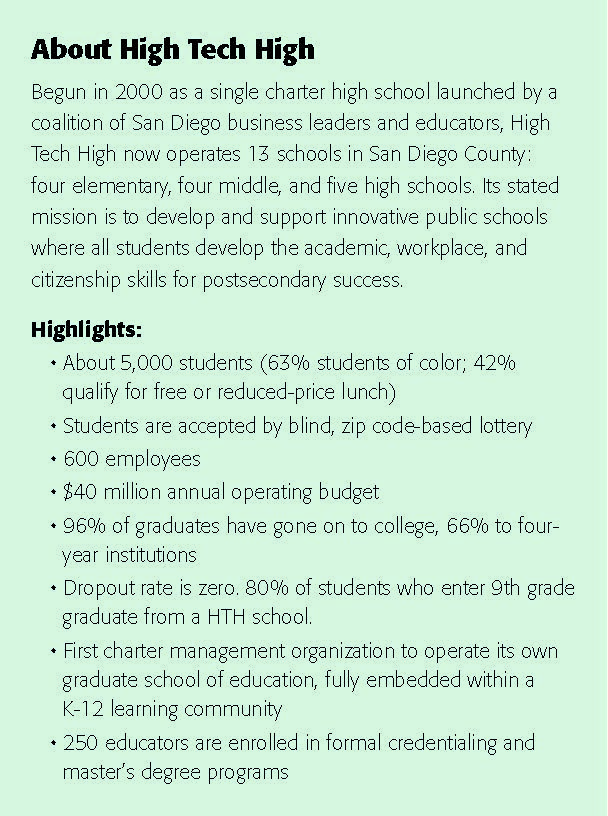
Interns come to the program with a wide range of experiences, including a research biologist, Peace Corps volunteer, professional woodworker, parent volunteer, and the list goes on. All are employed full-time as teachers of record while taking teacher preparation courses and working closely with a mentor who helps them put into practice each day what they are learning in their credentialing classes. Of the 90 intern teachers in the program, roughly a quarter of those teachers work at charter schools other than High Tech High, and the other 75% are at a HTH school. Teacher credential candidates are hired by school directors (at HTH and at local partner schools) and enroll in the credential program if they need a teaching credential. All have college degrees but have not gone through traditional teacher prep.
At the end of the two-year program, participants earn a California Preliminary Teaching Credential, which authorizes them to teach at any California public school. Once they have earned their preliminary credential, they enter High Tech High’s induction program, a two-year teacher support program that focuses on classroom inquiry and includes continued work with a school-site mentor. After completing the induction program, participants have earned a California Clear Teaching Credential, which allows them to teach in any California school.
Leaving behind traditional practices
Our intern program goes beyond merely offering the credential. The program serves three large purposes:
- Train new teachers and build capacity in the HTH organization;
- Train teachers, in and beyond HTH, for success in a wide range of contexts; and
- Disseminate HTH principles and practices.
We knew from the beginning that we would be hiring new and veteran educators, most of whom had never experienced a diverse, untracked learning environment as students. Therefore, it was critical to provide a program where the new teachers could experience project-based learning (PBL) and diverse learning environments as learners. That is why we don’t divide the intern group by subject, grade level, or site, and why we spend so much time modeling approaches to personalization and group building.
It was critical to provide a program where the new teachers could experience project-based learning and diverse learning environments as learners.
Even teachers who come to work at HTH schools after teaching in more traditional environments experience growing pains. Our goal is to disrupt traditional notions of authority, classroom practices, and sources of curriculum. Teachers need to get comfortable with sharing authority with students in a variety of ways — from helping shape curriculum to using the bathroom without a pass. Learning the balance of student productivity vs. social time in an interactive project environment also can be uncomfortable for teachers accustomed to a more tightly teacher-controlled classroom. Giving students a voice in what they learn and how they learn it also can be uncomfortable at first. Nevertheless, interns pick up approaches and skills for planning and management that will serve them well in a traditional environment.
Intern program experience
Key elements make teacher prep courses and support at HTH different. These elements support teachers in learning to teach in student-centered, constructivist classrooms:
- Modeling good teaching: Classes are taught by current K-12 faculty who strive to continuously model the type of teaching we want to see from teachers.
- Changing the subject: Curriculum and projects spring from relevant questions and issues that teachers and students are passionate about.
- Connecting theory and practice: There is a direct connection between what students learn and do in courses and what’s happening in their classrooms.
- Student involvement: K-12 students play an instrumental role in educating new teachers by acting ascoconstructors of curriculum, student faculty members, and school-based student consultants.
- Clinical experience: Teachers acquire work in a diverse, untracked learning environment
- Fostering a teaching community: Teachers meet daily before students arrive to discuss teaching, curriculum, students, and school issues, a practice that creates a robustorganizationwide adult learning environment.
The new teacher Odyssey begins
The intern experience starts in early August — three weeks before school starts — with the HTH New Teacher Odyssey. Odyssey is a week and a half experience that introduces teachers to High Tech High and constructivist pedagogy.
The training opens with Project Slice, a two-day, intensive project facilitated by HTH teachers and school directors. In groups of about 20, Odyssey participants bounce back and forth between the role of student in the project and the role of student learning to be a teacher. Odyssey facilitators frequently freeze the project work to debrief teaching strategies, discuss group formation, critique structures, how to manage project materials, and other teaching moves.
A typical Odyssey slice, Toy Story, focuses on preschool students. Toy Story begins with a fieldwork experience at a local preschool. Slice participants are matched with a preschool buddy. They interview and get to know their buddy to inform the design and construction of a toy and a book to give to their buddy at the end of the week.
A second typical slice, Bees, takes teachers to a San Diego bee farm where they put on bee suits and get in on the action at the farm. After that fieldwork experience, teachers learn about the vital importance of bees as pollinators, and they construct bee hives. Both projects enable participants to experience key elements of project work in the classroom: fieldwork, critique, drafting and revision, project construction, and exhibition for an authentic audience. In each case, facilitators model the type of teaching we want new teachers to be doing, and teachers experience project-based, constructivist learning from the student perspective.
Neither Toy Story nor Bees falls into an easily definable academic discipline. Both projects had their genesis with needs of the community and interests of teachers and students. But each project is rich with content. In Toy Story, students practice English language arts skills such as interviewing, reading, and drafting and revising writing. They learn art and design skills and learn to use construction tools such as sewing machines and power tools. The Bees slice involves students in scientific inquiry and research, persuasive writing, and construction skills.
Rather than starting with content standards, we encourage teachers to begin with an engaging question or real-world need that leads to a project — generated by teachers and students — and then map the standards on to that project as it develops.
Over the remainder of the Odyssey experience, teachers continue to unpack the project structures they experienced at Project Slice. Odyssey candidates participate in student-led workshops on digital portfolio creation. The Odyssey experience culminates with each participant doing a Presentation of Learning (POL) in which they reflect on their learning from the Odyssey experience and receive feedback from peers on a potential project design. POLs are a practice HTH students engage in so we find it essential that teachers experience the process from the perspective of the learner as well.
Modeling good teaching
As in the Odyssey Slice and workshops, teams of K-12 teachers coteach intern courses. Four K-12 teachers — one elementary, one humanities, one math/science, and one education specialist — coteach the Introductory Teaching Methods class. According to Margaret Egler, HTH humanities teacher and second-year intern, one of the greatest strengths of the program is that “HTH teachers teach the intern classes.” The program instructors are themselves engaged in reflective practice and inquiry, and many are participating in action research in their schools. Students in the course practice classroom management with a focus on student-centered classrooms and constructing equitable classroom structures that support all students. Instructors model strategies for successful group work, classroom management, and lesson planning with course participants trying those strategies during class as well as taking them back to their own classrooms. As in Odyssey, course instructors frequently freeze instruction to debrief teaching strategies and moves they are modeling.
Connecting theory and practice
Because interns are teaching full-time, they have a context in which to try strategies and ideas they learn and practice in class. A common weekly course assignment structure is Put it To Practice (PITP). For example, during an introductory method class session focused on assessment, instructors model (and students practice) a variety of ways to formatively check for student understanding. During the class, students also discuss grading scales and the negative effect of a zero on a student’s grade. The PITP assignment for the following week is to:
- Try three different ways of checking for understanding, and submit a reflection on how they worked.
- Bring a video of you checking for understanding to class to share with your video protocol group.
- Retool your grading scale, or consider how you might not use grades at all, eliminating the emotional and mathematical effect of issuing students zeroes for missing work.
The final product for this methods class is an interdisciplinary and collaborative project plan that teachers can put into practice in their classrooms. Participants say the embedded nature of the intern experience makes the experience powerful. “The HTH intern program was effective in preparing me to teach because I was in the classroom at the same time that I was learning new pedagogical strategies and techniques,” said Cate Challen, HTH math/physics teacher.
School-site mentors support intern teachers with applying and practicing what they are learning in their courses. Each intern teacher is matched with a mentor at their school site. Mentor partnerships are one-to-one, and ideally the partners teach similar subjects and are located close together in the school building. Desi Sullivan, middle school English teacher at Urban Discovery Academy, describes her relationship with her mentor: “My mentor is my science/math teaching partner. It could not be more convenient. We have the same students, so we talk about each of them and how to manage different learning styles and different personalities.”
Student involvement
Student voice is at the heart of HTH classrooms, and our intern program places value on student voice by involving students as faculty members and consultants. Twelve middle and high school students participate in the courses as faculty, lending their voices to class discussions. Student volunteers also participate in collaborative protocols used to help intern teachers critique videos of their classroom teaching.
Students also provide feedback to new teachers by serving as consultants. Modeled after a similar program at Bryn Mawr College, pairs of juniors work with new teachers, observing their classes once per week, and debriefing their observations in bimonthly meetings. The student consultants meet as a group twice per week to practice giving feedback, conducting difficult conversations, and supporting each other with dilemmas in their consulting work.
Professional learning community
Perhaps the most distinctive feature of the intern program is that it is embedded in a robust K-12 professional learning community. The intern experience at HTH is surrounded and enhanced by school-site professional development that connects to and builds upon what teachers are learning in their coursework. Improving teaching craft and developing as a professional is an ongoing process. To support this ongoing process, HTH teachers meet in different configurations each morning before school for 45 minutes to an hour. Teams of teachers coplan interdisciplinary projects or small groups of staff members work in action groups to improve their school, focusing on topics such as improving school culture, making advisory more relevant, supporting struggling readers, or planning the schedule for schoolwide presentations of learning. Teachers use tuning protocols to give and receive feedback on their project ideas or to look at samples of student work, asking questions such as: Is the work authentic? Does it provide access and challenge for all students? In these tuning protocols, which offer safe and equitable structures for dialogue, teachers discuss assessment opportunities, delivery strategies, project pacing, grouping decisions, and possibilities for meaningful public exhibitions. The aim from the beginning has been to create a wall-to-wall community of adult learning at High Tech High, and the intern program is a vital part of this larger effort.
Teaching interns experience a current High Tech High project as learners and as instructors, continually bouncing back and forth between the role of student in the project and the role of student learning to be a teacher.
Where we are; where we’re headed
During the 2015-16 school year we have focused on improving the quality and consistency of mentoring across our programs. We have conducted empathy interviews, collected data on using different mentoring tools, and run a series of expert convenings, where we hear from mentors and mentees about what’s working and ideas for change. Based on mentor feedback at these convenings, we are going to strengthen structures for mentor/mentee goal tracking and provide our mentors additional support in conducting classroom observations and supporting mentees in improving their teaching practice. Plans for the future also include expanding our student consultancy model, integrating more competency-based assessments into the intern experience, and creating a student teaching program as part of our graduate school.
High Tech High is a laboratory for innovation in equitable teaching and learning; we strive to make our intern program into a laboratory for innovative approaches to teacher education that can best support teachers in learning to teach in classrooms characterized by student thinking and student engagement. We remain actively engaged in improving the HTH District Intern Program in the same spirit our teachers, both intern and experienced, remain active in improving their professional practice and instructional design. We’re trying to blur the boundaries between university and K-12 and, within K-12, between veteran and new teachers, and between students and teachers. The point is that each of these constituencies (university folks, teachers, students) has a vested interest and something to contribute to the conversation and will benefit from cross-sector dialogue and collaboration.
Citation: Griswold, J. & Riordan, R. (2016). Another innovation from High Tech High — embedded teacher training. Phi Delta Kappan, 97 (7), 25-29.
ABOUT THE AUTHORS

Janie Griswold
JANIE GRISWOLD is director of new teacher development at High Tech High Graduate School of Education, San Diego, Calif.
Rob Riordan
ROB RIORDAN is president emeritus of High Tech High Graduate School of Education.