Kappan authors have long argued that parents can be important advocates for schools and for children. For example, in December 1949, E.T. McSwain (“Parent-teacher leadership for better schools”) pointed out that schools needed the support of parents to address a host of problems, such as teacher shortages, inadequate school buildings, and the pressure to accommodate fast-growing student populations. Parents could help by joining the Parent-Teacher Association (PTA) and pushing as a group for higher salaries, but they could also play a part simply by helping their children with their schoolwork and encouraging them to develop good work habits, said McSwain.
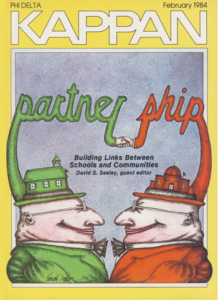
February 1984
However, the relationship between parents and schools has not always lived up to that potential. At times, in fact, it’s been downright contentious, and Kappan authors have struggled with the question of how to improve the relationship.
Adversaries or allies?
A pair of articles in the December 1977 issue debated whether educators really wanted parents to be involved in schools. Dwight Roper (“Parents as the natural enemy of the school system”) noted that, historically, schools hadn’t had much interest in parents’ views and had made deliberate efforts to shut parents out of their children’s education:
Public schoolpeople in America generally take a jaundiced view of parents’ motives, concerns with the school, and interest in their own children. They have even questioned seriously the right or ability of parents to rear their offspring. They have fought efforts to buy the different kinds of training and nurture parents sometimes desire for their children. (p. 239)
According to Roper, education leaders tend to believe that parents’ main roles are to “produce the clientele and . . . pay for the system” (p. 240). Efforts to make school compulsory, to consolidate smaller districts into larger ones, and to place governance in the hands of a single superintendent were, he claimed, all ways that schools had tried to take control away from parents.
Joseph Cronin (“Parents and educators: Natural allies”) responded to Roper’s description of schools as anti-parent by pointing out the many ways that public school leaders have, in fact, sought to involve parents:
The rest of the world marvels at the way American schools actually welcome parental visits, organize parent/teacher associations, and often schedule parent conferences as part of the school day several times a year. In contrast, most of our “motherlands” tell parents to stay home and stay out of the hair of schoolmasters. (p. 242)
The particular reforms that Roper decried, Cronin argued, were not intended to shut out parents but to make schools more well-suited for an industrial age: “To suggest that all of this is a conspiracy of educators against parents is to miss the meaning of the Industrial Revolution, of the rise of the city, of the changing role of the American family” (p. 242).
Making room for all parents
Whether progress is slower or faster than it ought to be, schools have always evolved with the times, and parents have not always been in the loop about why such changes are taking place. In November 1955, Howard Woolum (“Explaining new methods to parents”) posited that schools could do a better job of helping parents understand why classrooms and schools were different from what they remembered from their student days. He suggested that “when criticism is directed at the school, teachers, rather than becoming offended, should consider it a challenge to learn the cause and to meet their public on a friendly cooperative give-and-take study of the situation” (p. 85). Bringing parents into classrooms, whether to help with school programs or just for coffee and conversation, could go a long way, he believed, in helping allay their concerns and stanch some of their criticism.
“Somewhere between confrontation and private grumbling there is a need for parent/administrator dialogue.” — Cy Rowell, February 1981
Similarly, in February 1981, Cy Rowell (“The five rights of parents”) urged educators to take a proactive approach to communicating with parents about what is happening in schools. Parents should not have to quiz their children to know what’s going on, and they should have opportunities to share in decision making:
Confrontation and dramatic protests have become commonplace today. The educational systems of America have not escaped such pressures. But somewhere between confrontation and private grumbling there is a need for parent/administrator dialogue. In many communities, talking to the principal has been the only option. Today that is not enough. (p. 433)
The relationship between parents and schools is one of both rights and responsibilities, he explained:
Encouraging their children, making time for the doing of homework, quickly responding to notes from the teachers, participating in booster clubs or parent associations — these are parent responsibilities. But parents also have rights — perhaps not always in a strictly legal sense, but human rights — the right of citizen participation; the right to be treated by teachers, principals, and administrators as concerned, intelligent people. (p. 443)
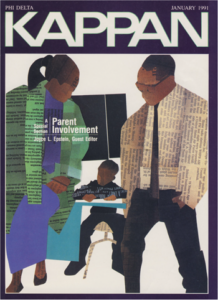
January 1991
Cultivating better relationships with parents requires educators to be open to multiple perspectives and to be aware that different parents may have different needs. In the February 1984 issue on partnerships between schools and communities (including parents), Annette Lareau and Charles Benson (“The economics of home/school relationships: A cautionary note”) described their study of two Bay Area schools, one serving primarily working-class families and the other serving affluent families. They found that the parents in the affluent school formed stronger partnerships with their children’s schools. They tended to be at the school more often, not just for special events, as was the case for working-class parents, and they had wider information-sharing networks than working-class parents, through which they learned how to navigate the school. For these reasons, Lareau and Benson worried that “widespread adoption of a partnership approach could transform cultural diversity into cultural deficiency for the children of working-class parents” (p. 404). However, they explained:
This unfortunate outcome is not inevitable. Educators can explore outreach policies that help to counteract this tendency. To establish effective home/school partnerships in lower-income neighborhoods, teachers will probably have to take the initiative. The task requires that they be determined, patient, and alert to prevailing parental attitudes regarding the “appropriate” relationship between home and school. They should try to foster an attitude of mutual interdependence that will enable an educational partnership to flourish. They must also be willing to explore a variety of partnership alternatives, since some partnership arrangements are better adapted than others to the working class. (p. 404)
Disconnects between parents and educators
Recognizing that all parents should be involved in their children’s education is one thing — figuring out how to make it happen is another. As Anne Henderson explained in the October 1988 Kappan (“Parents are a school’s best friend”), “the general agreement on the importance of involving parents in the educational process tends to break down at the point of implementation” (p. 149). Henderson described David Williams’ research into the differing views among parents and educators about what role parents should play. Parents are interested in a variety of roles, from helping out in the classroom to serving on decision-making committees. But educators were not in agreement about how much power parents should have:
Professional educators are divided on the issue of parent involvement. Williams found that principals and teachers favor more parent involvement in traditional ways (e.g., attending class plays or holding bake sales to benefit the band uniform fund). But a substantial majority of teachers and principals do not view the parental role in educational or personnel decisions as either useful or appropriate. However, superintendents and school board members, who are further away from day-to-day contact with parents, rate parent decision making at the school more highly. (p. 150)
“The issue is not simply one of parent involvement versus noninvolvement. Rather, the issue is the quality of the involvement.” — Anne Walde and Keith Baker, December 1990
In December 1990, Anne Walde and Keith Baker (“How teachers view the parents’ role in education”) asserted that those who are outside the schools do not understand how difficult it is to get parents involved in an appropriate and helpful way:
The principle that parents should play an important role in their children’s schooling is almost universally accepted by researchers and education policy makers. But these educationists frequently do not share with practitioners an understanding of classroom realities. The issue is not simply one of parent involvement versus noninvolvement. Rather, the issue is the quality of the involvement. (p. 319)
Teachers of disadvantaged students, Walde and Baker said, may be dealing with parents whose own literacy skills are limited, to the point that even something seemingly as simple as having them read to their kids at home was a futile effort.
Making the connection
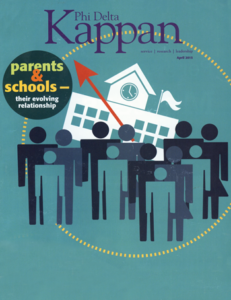
April 2015
In a special section on family involvement, the January 1991 issue of Kappan showed how educators were attempting to strengthen their bonds with families. Section editor Joyce Epstein (“Paths to partnership: What we can learn from federal, state, district, and school initiatives”) explained that there was reason to be hopeful:
Today, most schools embrace the concept of partnership, but few have translated their beliefs into plans or their plans into practice. Sometimes educators feel that it is simply impossible to jump the hurdles, remove the barriers, and solve the real problems that prevent them from viewing families as resources for promoting children’s learning. The contributions to this Kappan special section suggest that this view is too pessimistic. Shared vision and concerted effort have led to a variety of successful programs to connect schools, families, and communities. There is no excuse for not taking the first sure steps down one of the many paths to partnership. (p. 349)
The issue included articles on state initiatives, grant programs, and new policies all intended to direct time, energy, and money to communicating with families that had previously been hard to reach and to developing programs that would enable them to be more effective partners in their children’s education.
“Parents won’t care about what schools want them to do until they know that educators care about them and the concerns of their communities.”
— Muhammed Khalifa, Noelle Witherspoon Arnold, and Whitney Newcomb, April 2015
Even with more programs and policies in place, family engagement remains difficult for schools. In the April 2015 Kappan on “Parents and schools: Their evolving relationship,” Erin McNamara Horvat and David Baugh (“Not all parents make the grade in today’s schools”) pointed out that schools expect more and more from parents, and not all families have been able to meet the new demands. In the same issue, Muhammed Khalifa, Noelle Witherspoon Arnold, and Whitney Newcomb (“Understand and advocate for communities first”) describe how teachers sometimes assume that a lack of participation on the part of parents is a sign that they don’t care about their kids’ education. But, too often, the problem is that school-centered approaches to parent engagement fail to show care for families:
One of the oft-cited points about teaching is that students won’t care about learning until they know that teachers care about them. The same idea translates into relationships between schools and parents. Parents won’t care about what schools want them to do until they know that educators care about them and the concerns of their communities. (p. 21)
By developing programs that respond to parents’ needs, schools can demonstrate that they care.
This article appears in the April 2022 issue of Kappan, Vol. 103, No. 7, pp. 5-7.

ABOUT THE AUTHOR

Teresa Preston
Teresa Preston is an editorial consultant and the former editor-in-chief of Phi Delta Kappan and director of publications for PDK International, Arlington, VA.
Visit their website at: https://prestoneditorial.com/