
Reformers are correct in calling attention to current labor practices in education, but they are wrong to believe that bargaining prohibitions represent the proper remedy.
In recent years, legislatures in several states have enacted or considered limitations on collective bargaining for teachers. In 2011 and 2012, legislators in five states prohibited teachers unions and school districts from bargaining on a range of topics, though voters in two of the states later repealed the limits by referendum. Most recently, legislators in Kansas proposed a bill that would bar school districts and unions from negotiating over anything other than compensation, leave, and union privileges.
Many education policy observers have rejected the most extreme of these laws, including the controversial antibargaining legislation passed in Wisconsin in 2011. But the education community has reached no consensus on the merits of more targeted bargaining restrictions, such as a long-standing D.C. law barring collective bargaining over teacher evaluation. Many reformers have argued in favor of these laws. The D.C. law, some say, made it possible for the district to create a cutting-edge evaluation system.
There is a logical argument for targeted bargaining prohibitions, which goes like this: When an education policy issue is determined through collective bargaining, the public is shut out of the policy-making process. The bargaining process is not transparent, and the teachers union exercises disproportionate influence. As a result, education policy becomes less responsive to the interests of the broader community, including students. To break that pattern and to facilitate reform, the law should prohibit teachers unions and school districts from bargaining over important policy topics like teacher evaluation.
This argument seems convincing — but it’s wrong. Bargaining prohibitions aren’t likely to empower the public or facilitate reform. Aiming to provide an alternative template for reform, this article offers three lessons for reformers.
Lesson #1. The Wisconsin approach should be off the table.
Before analyzing targeted bargaining prohibitions, let’s first deal with a preliminary matter: the merits of the more severe approach to restricting collective bargaining reflected in the Wisconsin legislation of 2011. Championed by Gov. Scott Walker, the law confined collective bargaining for teachers to base wages and, even on that topic, barred the parties from negotiating raises outpacing inflation. With such a limited scope for negotiations, meaningful collective bargaining became impossible. Meanwhile, through separate provisions, Walker’s bill made it much harder for public sector unions to maintain certification and collect dues.
Reformers should focus on clarifying and expanding the scope of the permissive category in collective bargaining.
Some education reformers immediately condemned the bill, among them Joe Williams, the head of Democrats for Education Reform, who expressed concern that “this kind of overreach will set education reform back years.” Other reform leaders were more circumspect, suggesting that Walker had the right idea but had gone too far.
In fact, even the harshest critics of teachers unions should reject the Wisconsin approach. To begin with, most states in America and many democracies around the world have recognized that workers have a right to engage in meaningful collective bargaining in both the private and public sectors. But even for those who put no stock in that consensus, there are pragmatic reasons to avoid the Wisconsin approach.
Reformers risk undermining their goals by joining the deeply controversial movement to cripple unions. The resulting entanglement distracts from core education issues, attracts intense political opposition, and damages prospects for collaboration with unions. The consequences can be severe: In Idaho and Ohio, voters repealed attempts to drastically limit collective bargaining, and in Wisconsin, Gov. Walker suffered a divisive recall campaign only to see two federal judges and one state judge deem parts of his law unconstitutional.
Finally, while reformers often disagree with unions on education policy, their central values are aligned with those of the American labor movement. Reformers fight for excellent schools, focusing particularly on racial and socioeconomic achievement gaps because they value equal opportunity and the empowerment of those who are often disadvantaged. The American labor movement at its best is a champion of the same ideals. What a good school can be for a student, a good union can be for a mother or father: a path to the middle class, to a productive occupation, and to participation in civic life.
Lesson #2. Give school districts real discretion by using the “permissive” designation for bargaining topics.
Recognizing that the Wisconsin approach goes too far, many reformers have supported more limited laws that prohibit bargaining on specific topics. The D.C. law on teacher evaluation is one example. Similarly, in 2011, the Ohio legislature prohibited bargaining on a number of topics, including class size, the selection of teachers to be laid off, and the length of the school day. These restrictions were later repealed by referendum. Meanwhile, Indiana State Superintendent Tony Bennett led an effort to ban bargaining on subjects aside from pay and benefits.
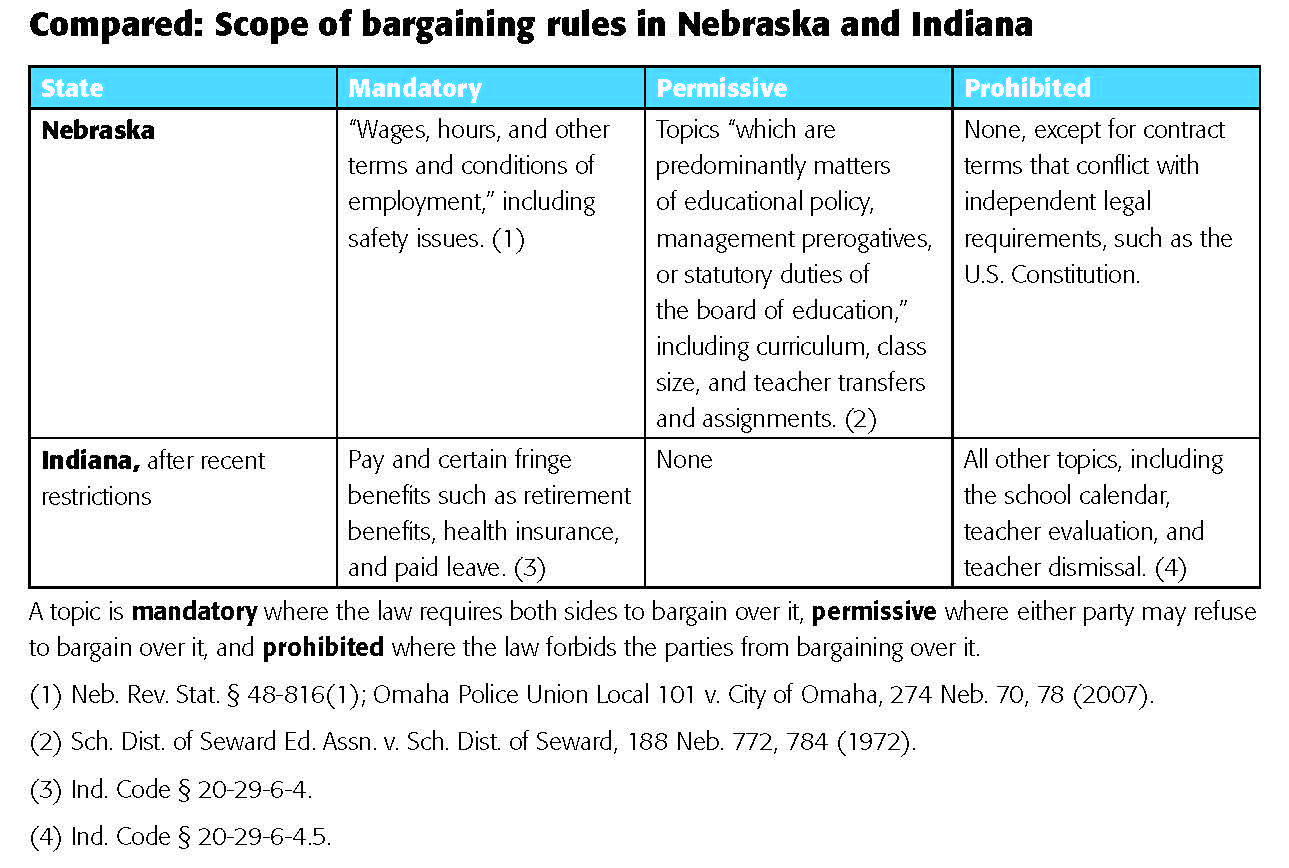
This targeted style of bargaining restrictions, while more reasonable than the Wisconsin approach, does not deserve reformers’ support either. To see why, it helps to understand the legal framework that governs negotiations between school districts and unions. State law generally classifies bargaining topics in three categories. First, some topics are “mandatory,” meaning that the union and school district are legally required to negotiate on those topics. For example, teachers’ wages are a mandatory topic in all states with collective bargaining.
Other topics are classified as “prohibited,” meaning that districts and unions are not supposed to negotiate them. If an agreement between a teachers union and a district includes a contract term on a prohibited topic, that term cannot be enforced in court. As a practical matter, when a topic is classified as prohibited for bargaining, policy on that topic should be determined legislatively by the local school board or city council, or administratively by district or school leaders. For example, this is now the situation in Indiana for teacher evaluation.
The third category of bargaining topics — so-called permissive topics — is rarely discussed but extremely important. Here, the school district and union are allowed to bargain, but either party can opt to end negotiations at any time. For example, if the length of the school day is a permissive topic, the school district can decide whether to bargain over the issue, or let the school board decide when schools should start and finish. The limits to a school district’s discretion on permissive topics are relatively loose. Experience shows that most (but not all) districts will bargain over some (but not all) permissive topics.
Many reformers have supported expanding the prohibited category, as in the D.C., Indiana, and Ohio laws. Instead, reformers should focus on clarifying and expanding the scope of the permissive category.
The permissive designation gives districts a full range of options in deciding how to resolve policy issues. Where a school district sees an opportunity for compromise on a permissive topic, it can use collective bargaining to collaborate with unions. Indeed, unions sometimes agree to reforms in the context of bargained compromises that they would oppose in the legislative process. For instance, recent teacher contracts in Washington, D.C., and Newark, N.J., included significant reforms to pay, dismissal, and evaluation of teachers. Meanwhile, where compromise appears unlikely, the permissive designation gives school districts the discretion to avoid collective bargaining. Further, unions will be more likely to compromise when they perceive a credible threat that the district will use that discretion.
A robust category of permissive topics also alleviates the concern that collective bargaining is undemocratic. When citizens and reform groups feel that collective bargaining on a permissive topic is heading in the wrong direction, they can lobby government officials to withdraw the topic from bargaining and can hold officials accountable if they insist on continuing to bargain.
As it turns out, most states already have a category of permissive topics, and, in many cases, that category is quite broad. For example, according to research by the National Council on Teacher Quality, teacher evaluation is already classified as permissive in more than half of states with collective bargaining. In these states, then, reformers concerned with teacher evaluation practices should encourage districts to use the discretion they already have rather than advocating for new limits on collective bargaining.
Reformers should also support state laws that clarify or expand the permissive category. For example, some states provide that the permissive category includes “management prerogatives,” a term that is usually left undefined. In those states, reformers might propose legislation that defines “management prerogatives” to include policy issues such as teacher evaluation and criteria for transfers and layoffs. And in states with no permissive category, like Delaware, reformers should support legislation that creates one.
Lesson #3. Hold local government officials accountable for their decisions in bargaining.
The most important lesson for reformers, however, is that real change is most likely to come from local political advocacy rather than by changing the rules for collective bargaining. Indeed, much of reformers’ ire at teachers unions — and at collective bargaining generally — would be more effectively focused on local government officials who choose not to pursue reform even though they have the power to do so.
For example, many reformers have complained that local government institutions, especially local school boards, tend to side with unions against reform. According to Stanford University Professor Terry Moe, “the district side of the table cannot be counted upon to push for what is best for children” because school boards are “overly inclined to give in” to unions in negotiations (2011, p. 177). In Moe’s view, the solution is to restrict collective bargaining.
Yet targeted bargaining restrictions do nothing to eliminate the influence of school board members who are allegedly beholden to teachers unions. To the contrary, the same officials who oversee collective bargaining have the authority to make policy outside of it. Put another way, if the San Francisco school board fails to insist on meaningful teacher evaluation when negotiating with the teachers union, there is little reason to expect the same school board to use its policy-making authority to improve teacher evaluation after bargaining on the topic has been outlawed.
As an illustration of the limited effectiveness of bargaining rules in the absence of accompanying political action, consider this: In states where bargaining has been limited or outlawed, school districts often have continued to negotiate on banned topics through a meet-and-confer process or even through traditional collective bargaining. I recently published a study of teacher collective bargaining detailing numerous instances of this phenomenon (Rosenthal, 2013). For example, although the Delaware Supreme Court has ruled that bargaining on assignment, transfer, and layoff of teachers is prohibited, many collective bargaining agreements in Delaware cover those topics anyway.
In short, reformers should focus on political advocacy rather than changes to bargaining rules. To be sure, reformers face several obstacles to effective political advocacy, including for policy made through collective bargaining. Labor negotiations sometimes occur in secret, allowing government officials to escape accountability for their actions in bargaining. Notably, however, many of the traditional systems for setting policy — such as administrative policy making and school board deliberation — also suffer from limited transparency and little accountability.
Real change is most likely to come from local political advocacy rather than by changing the rules for collective bargaining.
There are several ways to bolster accountability in bargaining. Local governments might be required to hold regular public meetings to discuss bargaining proposals, and media could be more active in covering negotiations — measures advocated by several education experts. Furthermore, school boards could be required to take public votes on whether to bargain on significant permissive topics. These votes would take place at the outset of bargaining and perhaps at regular intervals afterward. As a result, local officials would be accountable for failures to exercise control over the bargaining process.
With these changes in place, reformers could more effectively advocate for reform-friendly collective bargaining agreements. There are several recent examples of this kind of advocacy. In Washington state, the reform organization Stand for Children has led organizing campaigns to influence collective bargaining agreements. Although these campaigns have so far achieved mixed success, they provide an example of the strategies that reform groups might pursue. Stand for Children formed coalitions of community and education groups, together with parents and teachers, to advocate for including reform policies in teacher contracts. One of these coalitions, for example, publicized a “Community Values statement” after posing questions to the union and the school district, holding meetings, and soliciting feedback from the broader community. The coalition presented the statement to the district, union, and local media, then continued to advocate as negotiations unfolded.
Reformers might also advocate at the state and federal level, seeking laws that require or incentivize school districts to adopt reform policies, whether through collective bargaining or other forms of policy making. For example, the Race to the Top program tied federal grants to states’ adoption of laws requiring that schools use student achievement data in evaluating teachers, and many states enacted these laws. State and federal policies can minimize the possibility that local collective bargaining agreements will impede reform. But school policy must still be implemented at the local level, so local political support remains essential.
A reform approach to collective bargaining
Bargaining prohibitions will likely spread, particularly if they continue to enjoy support from the education reform community. But while reformers are right to question current labor practices in education, they’re wrong to believe that bargaining prohibitions will solve the problems.
A smarter reform approach to bargaining would begin by putting down the sledgehammer wielded in Wisconsin and Idaho and picking up a scalpel. At the state level, reformers should push for laws aimed at two goals:
- Clarifying or expanding the category of permissive topics without eliminating mandatory bargaining on fundamental terms and conditions of employment.
- Ensuring that collective bargaining is transparent and that local government officials are accountable for their decisions in bargaining.
Most important, reformers should focus on local political advocacy for change. Rather than rewriting the fundamental rules of bargaining, reformers should convince parents, community members, and local government officials that change in schools is needed — and that this change is worth pursuing both within collective bargaining and outside it.
References
Moe, T. (2011). Special interest: Teachers unions and America’s public schools. Washington, DC: Brookings Institution.
Rosenthal, D. (2013) Public sector collective bargaining, majoritarianism, and reform. Oregon Law Review, 91 (3), 673-724.
CITATION: Rosenthal, D.M. (2014). What education reformers should do about collective bargaining. Phi Delta Kappan, 95 (5), 58-62.
ABOUT THE AUTHOR

Daniel M. Rosenthal
DANIEL M. ROSENTHAL is a graduate of Harvard Law School and former high school math teacher who has practiced law on behalf of both education organizations and labor unions.