
How well do urban school boards represent their communities?
The face of public education has changed dramatically in the last three decades. As the country has seen greater diversity in its school-age population, new models of schooling to meet students’ diverse needs have emerged and changed how “public education” is defined. In particular, the rise of public charter schools exemplifies the effort to move away from a standardized model of public education, where schools are governed by democratically elected school boards (or school boards appointed by democratically elected leaders). The charter school model, where schools are typically run by reform-minded individuals and organizations, has become the majority mode of education in urban districts such as New Orleans and Detroit. Reformers have argued that charter schools offer the opportunity to undercut the monopoly school districts have enjoyed over public education funding, while better serving families and communities that have been marginalized by public education’s model of governance. Indeed, some charter advocates have argued that removing electoral politics from public education can lead to a more democratic system (Chubb & Moe, 1990).
But does the shift in governance from the political model of school districts to the charter school model actually lead to greater participation by different communities? There are various ways of determining this, such as by looking at enrollment figures or measuring the gap in educational outcomes. But what about the question of who actually runs the schools? This issue is of particular importance because many charter schools were designed specifically to give voice to groups that had been silenced (Nathan, 1996). By opening up opportunities not only for students to attend a different school, but for individuals and organizations outside the traditional system to start and run new schools, reformers hoped to broaden democratic input into publicly funded education to reflect the needs and preferences of marginalized communities.
Some charter advocates have argued that removing electoral politics from public education can lead to a more democratic system
To understand whether charter schools have lived up to their ambition to promote greater diversity and broader representation in educational governance, we collected and analyzed data that reveal who actually holds decision-making authority in various types of schools. And, as we describe below, we took an especially close look at one charter school model in particular, the Knowledge is Power Program (KIPP), which has become renowned among policy makers, reformers, and education philanthropists for its efforts to serve — successfully, some would say — urban and minoritized youth.
KIPP was founded by a pair of former Teach For America corps members who started schools in Houston and New York City in the mid-1990s. Since then, KIPP Charter Schools has become the largest charter school network in the country, with schools running in virtually every major U.S. urban area. Our question was simple: Compared to the people who govern traditional public schools, are the people running KIPP’s schools more reflective of the communities they serve?
Understanding board representation
We gathered data on public school boards and KIPP charter boards mainly through their district and company websites. (Because KIPP schools receive public funding, they are — like regular public schools — required to publish their board members’ names, meeting minutes, and schedules.) We began by collecting board members’ names and locations, as well as any photos or professional information listed. When necessary, we searched LinkedIn, company sites, Facebook, and other websites to determine what gender and racial categories board members fell into.
This method allows for quick and easy determination of demographic categorization, but without surveying the board members themselves, we cannot be certain the categories are completely accurate. For example, some KIPP board members have a limited digital footprint, preventing accurate classification. Retired board members often did not have current professions or an active work profile on LinkedIn. And board members with common names and without current job listings on KIPP websites could easily be mistaken for other people in the same locale. We reduced data confusion as much as possible by trying to find regionally similar foundations and KIPP-supporting organizations associated with the person’s name through a Google image search. If we could not make a definitive determination, that board member’s race was not included in the board’s racial makeup. They were, however, still included in their board’s gender profile, with the gender determination being made based on their name’s associated gender.
When comparing KIPP’s 31 regions with public school boards in the same metropolitan areas, we found that, overall, traditional public school boards are smaller, more racially diverse, and tend to include more women than their self-selecting charter school counterparts.
Women’s representation
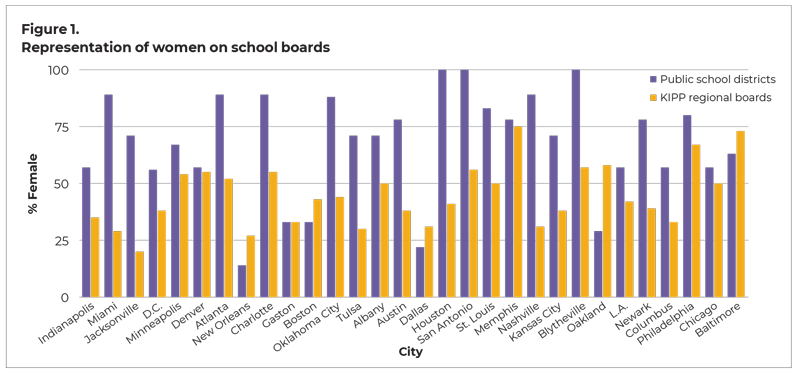
Public school districts seem to favor female representation. As a whole, women represented 68% of total public school board members, versus 44% of total KIPP charter board members. Therefore, it is not surprising that in 26 out of the 31 (83%) public school districts, women outnumbered men on the democratically elected school board. Similarly, when comparing public school districts to KIPP charter boards in the same cities, 26 out of 31 public schools had greater female representation than their KIPP counterparts (see Figure 1). In fact, women held at least 75% of board positions in more than a third of major metropolitan public schools — only the Memphis, Tennessee, KIPP charter reached that same mark.
Racial diversity
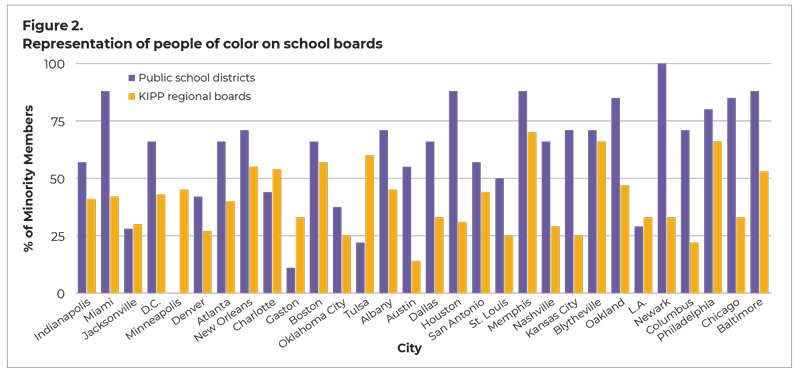
We found more racially diverse leadership among elected school boards than among KIPP boards. When we examined each school board for racial diversity, we found that 61% of public school board members are from minority, non-white groups, compared to 41% of KIPP charter board members. And of the 31 public school boards reviewed, eight (25%) had greater than 75% minority representation. However, no KIPP charter boards were greatly diverse regarding race — in only eight out of 31 KIPP boards were a majority of board members from a racial minority in the United States. However, white-dominated racial representation (more than a third white) characterized 13 out of 31 (42%) KIPP boards, compared to five out of 31 (16%) public school districts (see Figure 2).
Board size
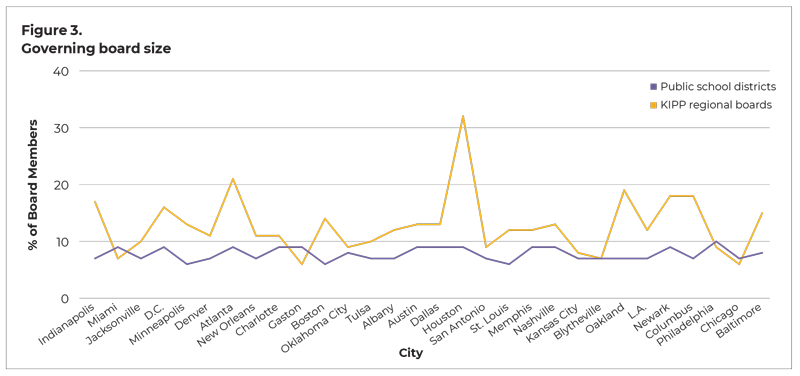
An unanticipated finding from our diversity research is the overall variance in KIPP and public school board sizes. Public school boards relatively consistently had six to10 elected board members. Often, these members are elected to represent a certain district or are selected by a state’s educational agencies or local government officials (such as a mayor). Conversely, KIPP boards seem to vary greatly in size, ranging from six to 32 board members (see Figure 3). Having a larger board can make it difficult to come to consensus, but it can also allow for a wider variety of skills among board members who can focus on their specific areas of expertise, such as finance, recruitment, marketing, and fundraising.
Roots of underrepresentation
A common belief is that more diverse representation leads to more substantive representation: As more minority members serve in traditional school boards, more policies favor minority students (Berkman & Plutzer, 2010). Traditional public school boards are elected by their community or appointed by elected representatives; however, charter school boards are typically selected by private charter school management organizations, which leaves the community out of the process, reducing or eradicating many of the gains people of color realized in school board and school district leadership from community movements and voting rights movements in the 1960s and 1970s (DiMartino & Scott, 2013). Even without political requirements, charter school boards are able to offer opportunities for diverse community representation, but that doesn’t necessarily happen in practice. Charter founders are responsible for putting together their own governance board when establishing a charter, and may tend to rely on their own connections when doing so; once those founding members leave, they self-appoint their replacements, which can often narrow and entrench the same perspectives (Miron & Nelson, 2001).
The comparative lack of diversity in KIPP’s charter leadership may also be due to lack of diverse senior leadership within businesses themselves. Our research found that many charter board members were senior or executive leaders within their organizations (e.g., CEO, founder, partner, vice president). Given a history of glass ceilings and exclusionary practices, many women and minority-group members may not have had the opportunities to reach the kinds of professional heights expected of KIPP charter board members.
Running a public or charter school network well requires a diverse range of skills to troubleshoot problems that include human resources, budgeting, legal concerns, and marketing. Charter boards are able to select individuals based on their particular needs, which could reduce the pool of candidates. Comparatively, anyone can run for a public school district seat regardless of skills and experiences, and public school superintendents and school leaders are then required to work with their board, regardless of their areas of expertise. The removal of community choice in the board-selection process seems to result in larger, less diverse charter school boards, although charter proponents might argue that they are better able to involve individuals with business acumen and connections to improve schooling options.
Shifting the power — or not
Going back to the foundations of the public education system in the common school era, the history of American schooling is often the history of school reformers — mostly white, wealthy men — imposing their ideas, undoubtedly often well-intentioned, on poorer populations.
Charter school reforms offered a possible alternative to these patterns. These schools allow new participants, including those from marginalized communities, to start and run schools that better articulate and reflect the unique needs and preferences of those communities. Unfortunately, the data suggest that this potential is still unmet. Schools designed for urban and minoritized youth are disproportionately still run by white, wealthy men, while traditional public school boards are more representative of the communities they serve.
The evidence presented here focuses on only one charter organization, albeit one that is the largest and most ubiquitous charter school chain across urban America. Certainly, there are other charters that are more reflective of the communities they aspire to serve; however, it stands to reason that many of these smaller, independent, local charter operators are sidelined by larger operators such as KIPP in the competition not only for students, but also for philanthropic and political support. In that regard, it appears that policy makers and leaders in the charter sector need to focus on diversifying school governance to make it more representative of the communities served, instead of letting it be sacrificed to the desire for more politically and financially connected leadership that reflects the preferences of funders rather than the families served.
References
Berkman, M. & Plutzer, E. (2010). Ten thousand democracies: Politics and public opinion in America’s school districts. Georgetown University Press.
Chubb, J.E. & Moe, T.M. (1990). Politics, markets, and America’s schools. Brookings Institution.
DiMartino, C. & Scott, J. (2013). Private sector contracting and democratic accountability. Educational Policy, 27 (2), 307-333.
Miron, G. & Nelson, C. (2001). What’s public about charter schools: Lessons learned about choice and accountability. Corwin Press.
Nathan, J. (1996). Charter schools: Creating hope and opportunity for American education. Jossey-Bass.
This article appears in the April 2022 issue of Kappan, Vol. 103, No. 7, pp. 47-50.

ABOUT THE AUTHORS

Garrett Wilson
Garrett Wilson is a lead teacher at the Excel Center School, Lafayette, Indiana, a charter school that is part of Goodwill Education Initiatives.
Christopher Lubienski
Christopher Lubienski is a professor of education leadership at Indiana University, Bloomington, and was previously on the board of a faith-based school in Chicago. He is a co-editor of The Rise of External Actors in Education.