
Data on children’s academic preparation at kindergarten entry tell a story of both declining achievement and shrinking gaps.
If you’ve ever watched an infant crack their first smile or seen a preschooler learning to sound out words, then you’ve witnessed the kinds of remarkable developmental leaps children can make in their first few years. Many of these early achievements have powerful implications for later life, too. For instance, the extent of children’s learning and skill development before kindergarten strongly predicts their eventual college completion rates, adult earnings, and other long-term outcomes (Chetty et al., 2011; Duncan et al., 2007; Pace et al., 2019).
Unfortunately, however, differences in families’ socioeconomic status often translate to differing learning opportunities during these early years. Decades of research have shown that children who are raised in poverty tend to have fewer educational resources than their more advantaged peers, their caregivers tend to have less time to provide informal instruction (Guryan, Hurst, & Kearney, 2008), and, as a result, their skills and content knowledge tend to lag behind (Duncan & Murnane, 2011).
For all the recent investment in state-funded early childhood education, little is known about the impact of that investment.
To help close the gap in early learning opportunities, state and federal policy makers have, in recent years, made significant new investments in prekindergarten programs designed to serve children from low-income families (though eligibility requirements vary somewhat among states, and some state programs target children with developmental delays or other risk factors regardless of family income level; Burchinal et al., 2015; Friedman-Krauss et al., 2018). As of 2017, there were 60 state-funded preK initiatives operating in 43 states and Washington, D.C., enrolling 33% of all U.S. four-year-olds — that represents a 9% increase from a decade earlier (Friedman-Krauss et al., 2018). From 2010 to 2017 alone, funding on state preschool surged by almost $4 billion (when adjusted for inflation; Friedman-Krauss et al., 2018).
Yet, for all the recent investment in state-funded early childhood education, little is known about the impact of that investment. From 1998 to 2010, national data on early childhood learning were collected by the U.S. Department of Education (DOE) through its Childhood Longitudinal Survey, Kindergarten Cohort (ECLS-K), and this allowed researchers to spot improvements in children’s academic skills and the narrowing of some racial/ethnic gaps during that period (Bassok & Lathom, 2017; Reardon & Portilla, 2016). The DOE hasn’t collected this data since 2010, however, leaving researchers unable to monitor students’ progress nationwide. While states and school districts often use early reading assessments such as DIBELS and the Developmental Reading Assessment to gauge children’s academic skills as they enter kindergarten, those measures haven’t been used extensively or systematically enough to provide reliable insights into national trends.
Not only has the lack of national data made it impossible for researchers to study the effects of recent investments in preK programs, but it has also made it difficult to measure the ways in which other political, economic, and demographic changes have affected early learning. For instance, income inequality in the U.S. has grown modestly since 2010 (Fontenot, Semega, & Kollar, 2018), and the population of students who are English learners and/or from immigrant backgrounds — who typically enter school with lower levels of reading and math skills than other children (Espinosa, 2013) — has continued to increase dramatically (Camarota, Griffith, & Zeigler, 2017). It seems likely that such trends have had an effect on skills gaps among young children, but without good data, the details remain fuzzy.
However, and as we describe below, national data on learning in the preK years are finally becoming available again, now that NWEA’s MAP Growth interim assessments are being used to assess early reading and math skills in thousands of public kindergarten programs across the country. MAP Growth was developed and normed to allow for both across-state and across-time comparisons, making it a unique data source for researchers seeking to understand overall trends in students’ academic skills at school entry, and specifically to gain insights into the effects of recent investments in public preK programs for children from low-income backgrounds. (For more information as to which skills are assessed on the MAP Growth assessments in kindergarten, see NWEA, 2019.)
Declines in achievement, but a narrowing of gaps
We examined fall MAP Growth test scores for more than 2 million students, attending 10,960 schools, who entered kindergarten from fall 2010 to fall 2017. While the number of students tested each year varied, the coverage of our sample was strong enough to allow us to analyze national trends. (By the last three years of the study, the MAP Growth test was taken by more than 10% of kindergartners attending public schools in the U.S.)
Given recent investments in improving early childhood education across the country, we expected that students’ academic skills in kindergarten would show gains since 2010. But, between 2010 and 2014, their math and reading scores were largely unchanged and between 2014 and 2017 they decreased slightly. Overall, between 2010 and 2017, kindergartners’ MAP Growth scores dropped, on average, 0.24 standard deviations (SD) in math and 0.14 SD in reading, with Black, Latinx, Asian, and White students all seeing slight decreases (see Figure 2 in Kuhfeld et al., 2019). As a point of reference, the average student grows 1.52 SD from the spring of kindergarten to the spring of first grade (Bloom et al., 2008).
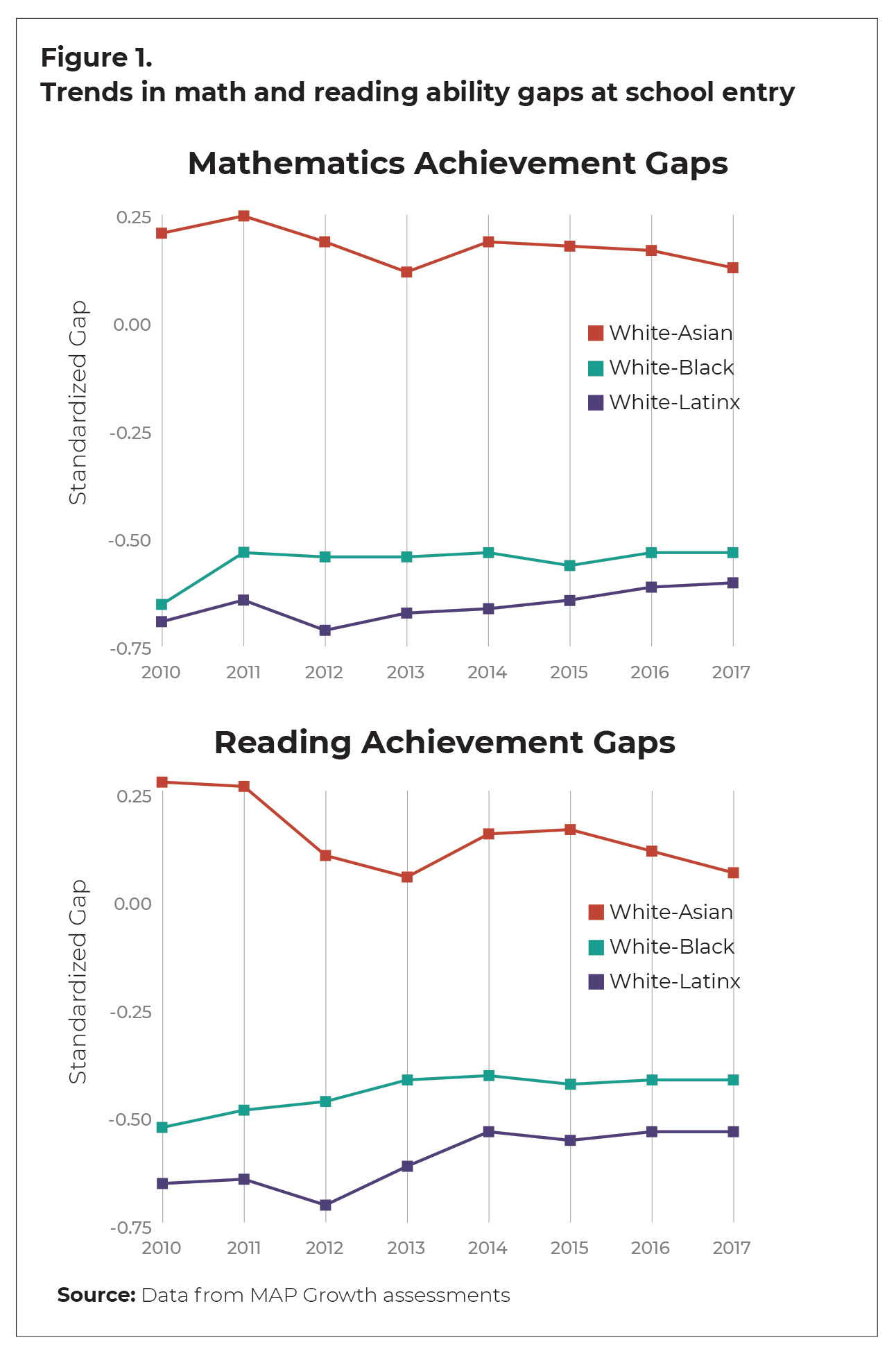
At the same time, though, racial/ethnic skills gaps between Black and white and between Latinx and white students at kindergarten entry narrowed significantly (albeit modestly) during those eight years (see Figure 1). The Black-white achievement gap at kindergarten entry decreased from 0.66 to 0.54 SD in math and 0.53 to 0.42 SD in reading, while the Latinx-white achievement gap narrowed from 0.7 to 0.61 SD in math and 0.66 to 0.54 SD in reading. The narrowing of achievement gaps remained significant across all years included in the study, even after controlling for school-level poverty. Finally, when comparing low- and high-poverty schools from 2010 to 2017, we found the mathematics achievement gap declined from 0.95 to 0.90 SD and the reading gap narrowed from 0.88 to 0.77 SD.
Implications for educators and policy makers
These findings tell a contradictory story about students’ academic skills at kindergarten entry over the past decade. On one hand, children’s early math and reading skills mostly remained flat or decreased from 2010 to 2017. On the other hand, gaps by race/ethnicity and school-level poverty narrowed modestly.
Digging deeper into the findings, we see that the Black-white mathematics skills gap was significantly smaller in 2017 than in 2010 not because the skills of Black youngsters improved but, rather, because white children lost more ground than did Black children. Similarly, while the reading skills of white students declined, those of Latinx students remained unchanged, resulting in a narrowing of the Latinx-white gap in reading (Kuhfeld et al., 2019).
These overall declines in reading and math achievement raise an obvious question about the effectiveness of recent efforts to improve early childhood education: Why haven’t investments in public preK programs resulted in stronger academic skills for children entering kindergarten? The current study does not enable us to make definitive conclusions about why these trends occurred, but we do see likely explanations that merit further research.
Although no other studies examine national trends in student reading and math achievement at kindergarten entry since 2010, these findings are consistent with recent results from the National Assessment of Educational Progress (NAEP). Recent NAEP scores indicate that the performance of U.S. 4th graders showed small increases from 2011 to 2013 and either flattened or declined slightly between 2015 and 2017 (Petrilli, 2018).
Are these similar findings for incoming kindergartners and 4th graders due to the same phenomena? What policy and practice mechanisms led to the discouraging achievement results alongside the promising gap reduction? The answers are not clear from the data, but education policy thought leaders, such as Michael Petrilli (2018) from the Thomas B. Fordham Institute, have suggested that NAEP trends may be illustrative of lingering effects of the Great Recession, which lasted from 2007 to 2009, including declines in the financial well-being of families with young children and decreases in school spending. The same could certainly be true of the downward trends in early learning. It is possible, then, that the investments in public preK programs did have positive effects — without them, we may have seen even larger declines in early math and reading skills from 2010 to 2017.
These possibilities warrant further exploration by researchers and policy makers. Building better connections between preK systems data and K-12 school district data in localities, states, and nationwide would allow for a better understanding of the relationship between childcare access, the quality of early childhood experiences, and school readiness in kindergarten. The more we understand about the effects of early childhood investment, the more strategic we can be in our efforts to improve achievement across the board while also closing the gaps in children’s kindergarten readiness.
References
Bassok, D. & Latham, S. (2017). Kids today: The rise in children’s academic skills at kindergarten entry. Educational Researcher, 46 (1), 7-20.
Bloom, H.S., Hill, C.J., Black, A.R., & Lipsey, M.W. (2008, October). Performance trajectories and performance gaps as achievement effect-size benchmarks for educational interventions (MDRC Working Papers on Research Methodology). New York, NY: MDRC.
Burchinal, M., Magnuson, K., Powell, D., & Hong, S.S. (2015). Early child care and education and child development. In M. Bornstein, R. Lerner, & T. Leventhal (Eds.), Handbook of Child Psychology and Developmental Science. (Vol. 4, 7th ed., pp. 223-267). Hoboken, NJ: Wiley.
Camarota, S., Griffith, B., Zeigler, K. (2017). Mapping the impact of immigration on public schools. Washington, DC: Center for Immigration Studies.
Chetty, R., Friedman, J.N., Hilger, N., Saez, E., Schanzenbach, D.W., & Yagen, D. (2011). How does your kindergarten classroom affect your earnings? Evidence from project STAR. Quarterly Journal of Economics, 126 (4), 1593‐1660.
Duncan, G.J., Dowsett, C.J., Claessens, A., Magnuson, K., Huston, A.C., Klebanov, P., … Brooks‐Gunn, J. (2007). School readiness and later achievement. Developmental Psychology, 43, 1428‐1446.
Duncan, G.J. & Murnane, R.J. (Eds.). (2011). Whither opportunity? Rising inequality, schools, and children’s life chances. New York, NY: Russell Sage Foundation.
Espinosa, L.M. (2013). Early education for dual language learners: Promoting school readiness and early school success. Washington, DC: National Center on Immigrant Integration Policy, Migration Policy Institute.
Fontenot, K., Semega, J., & Kollar, M. (2018). Income and poverty in the United States: 2017. Washington, DC: U.S. Census Bureau.
Friedman-Krauss, A.H., Barnett, W.S., Weisenfeld, G.G., Kasmin, R., DiCrecchio, N., & Horowitz, M. (2018). The state of preschool 2017. Newark, NJ: National Institute for Early Education Research.
Guryan, J., Hurst, E., & Kearney, M. (2008). Parental education and parental time with children. Journal of Economic Perspectives, 22 (3), 23-46.
Kuhfeld, M., Soland, J., Pitts, C. & Burchinal, M. (2019). Trends in children’s academic skills at school entry: 2010 to 2017 (EdWorkingPaper: 19-137). Providence, RI: Annenberg Institute at Brown University.
NWEA. (2019). MAP Growth K-2 reading & mathematics content. Portland, OR: Author.
Pace, A., Alper, R., Burchinal, M.R., Golinkoff, R.M., & Hirsh-Pasek, K. (2019). Measuring success: Within and cross-domain predictors of academic and social trajectories in elementary school. Early Childhood Research Quarterly, 46, 112-125.
Petrilli, M.J. (2018). NAEP 2017: America’s “Lost Decade” of educational progress. Washington, DC: Thomas B. Fordham Institute.
Reardon, S.F. & Portilla, X.A. (2016). Recent trends in income, racial, and ethnic school readiness gaps at kindergarten entry. AERA Open, 2 (3), 1-18.
ABOUT THE AUTHORS

Christine M.T. Pitts
CHRISTINE M.T. PITTS is a policy advisor at the Collaborative for Student Growth at NWEA, Portland, OR.
Megan Kuhfeld
MEGAN KUHFELD is a research scientist at the Collaborative for Student Growth at NWEA, Portland, OR.