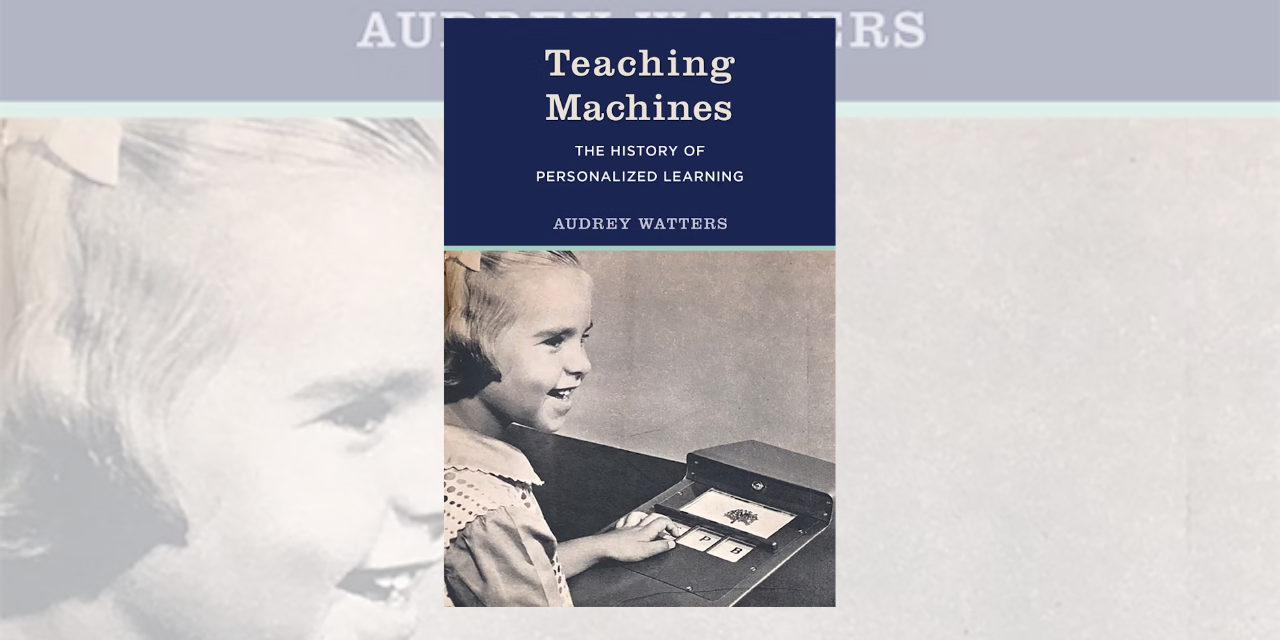
Teaching Machines: The History of Personalized Learning
Audrey Watters (MIT Press, 2021)
Recommended by Charles Logan
“Now where have I heard this before?” The question has become a constant refrain whenever I encounter a new claim that this or that technology will revolutionize education. The source of my reflexive question is Audrey Watters and her evergreen Teaching Machines: The History of Personalized Learning. Her book traces the emergence of programmed instruction in the U.S., with a specific focus on B.F. Skinner’s teaching machines. That Skinner’s teaching machines were based on his behaviorist learning principles is not surprising. What is surprising is the persistence of behaviorism in today’s educational technologies, despite rhetoric that technology will open up educational possibilities. An enduring benefit of Watters’ book is the way it functions like an X-ray machine, providing readers with the ability to see through terms like “personalized learning” to reveal familiar pedagogies and politics of control and conformity.
Threaded throughout the book are stories of resistance to assertions that any specific technology is inevitable. The experience of Robert Parris Moses, a leader of the Student Nonviolent Coordinating Committee (SNCC) and later the founder of the Algebra Project, is one such story I find instructive. Moses was initially attracted to programmed instruction as a means of improving adult literacy in the South. Eventually, Moses rejected the approach after hearing how Mary Varela, another SNCC volunteer, co-designed with local residents culturally situated and politically empowering learning materials. For me, Moses’ experience is a cautionary tale that should help us question technologies sold for their efficiency and ability to scale, and instead, consider how we build relationships and cultivate student agency.
Technology does not just happen. Reading Watters, I’m reminded that powerful people and companies use time-tested strategies to bulldoze public oversight and install their products in classroom after classroom, device upon device. Watters’ book, and her years of criticism, encourages educators, students, and caregivers to construct barriers reinforced by the historical record, skepticism, and a desire for an education grounded in caring relationships.
This article appears in the Winter 2025 issue of Kappan, Vol. 107, No. 3-4.

ABOUT THE AUTHOR

Charles Logan
Charles Logan is a post-doctoral research fellow in the Center for Responsible Technology, Policy, and Public Dialogue at Northwestern University, Evanston, Illinois.