Students who are preparing to become teachers share how their life experiences will inform their approach to teaching.
At a Glance
- Born between 1997 and 2011, Generation Z came of age at a time of massive cultural and geopolitical shifts and technological advances.
- The conditions Generation Z educators faced made them vulnerable but also helped them build resilience.
- This new generation of educators are bringing a strong sense of empathy, comfort with technology, and an activist mindset into the profession.
- Incoming Gen Z educators value leaders who accept them for who they are and help them develop professionally.
- Adequate pay, access to resources, opportunities for development, and a sense of belonging will encourage them to stay in the profession.
- Leaders will need to adapt their mentorship and induction programs to recognize the values of these new educators.
As professors who teach, interact with, support, and guide students of Generation Z, we want to understand the expectations, aspirations, and many strengths Gen Z will bring to the teaching profession. As educators and parents of Gen Zers, we admit to being fans, enjoying our daily interactions, and learning of their expectations for their futures. As teacher educators, we are particularly curious about why our students choose education as a career.
We believe that many of the broad opinions about this generation reflect a misunderstanding of where members of Gen Z are coming from, what they are facing, and what their strengths are. Insights from research and from students themselves will help future supervisors, mentors, instructional coaches, and colleagues as they navigate their professional relationships with their Gen Z colleagues.
To better inform ourselves and other educators about this new generation, we wanted to know what expectations and aspirations Gen Z education students have of the teaching profession. What kinds of work experience, school culture, and leadership will lead them to persist through difficulty? And what do Gen Z future teachers believe they will bring to the teaching profession? We constructed and distributed surveys to more than 100 college students in December 2024 and January 2025 at Linn-Benton Community College in Albany, Oregon, and State University of New York at New Paltz with a return rate of 25%. This survey had both open-ended and multiple-choice questions (see below). Students who completed the survey were entered in a drawing for a $50 Amazon gift card.
Survey questions
In addition to two questions asking for name and date of birth, we asked:
- What is driving you to become a teacher? What do you hope to gain from the profession?
- What conditions would help you to persist in the teaching profession?
- Collegial atmosphere
- Shared decision making
- Opportunity for professional development
- Sense of belonging
- Appropriate pay and benefits
- Access to materials and equipment
- How do you identify your gender?
- Male
- Female
- Nonbinary
- Which race/ethnicity best describes you?
- Are you a first-generation college student?
- What strengths do you bring to the teaching profession?
- What do you hope the education profession can learn from your generation of teachers?
- What attributes would you most value in a school leader?
- Collaborative stance
- Knowledgeable instructional leader
- Fair-minded supervisor
- Leader who recognizes you as a person and professional
- Efficient manager
- Supportive administrator
A different kind of resilience
We can persevere through hard times. We can find the light at the end of the tunnel. When I think of my generation, I think of COVID. And we all persevered and made it through, and even after all the school changes because of COVID we still want to be teachers! (survey respondent)
Our respondents are public college students, predominantly white, male and female, and between the ages of 18 and 27. Nearly 40% identified themselves as first-generation college students, which indicates a certain amount of resilience. Gen Z are currently between the ages of 13 and 27, born between 1997 and 2011. In the U.S., many of them began their lives with Bill Clinton as president in a relatively peaceful time within a strong economy. The technology-information age was fledgling and the 20th century was coming to an end. By 2001, 9/11, the dawn of the information age, climate change, political polarization, high-stakes testing, and forever wars tumbled on the scene.
In Gen Z Explained, Roberta Katz and her co-authors (2021) write:
A perpetual atmosphere of crisis, whether local, regional, or global, has been brought right into their bedrooms through their internet feeds. Terrorist bombings; mass shootings in movie theaters, classrooms, and places of worship; wars in Iraq, Afghanistan, and elsewhere; pandemics; and typhoons, earthquakes, floods, wildfires, and hurricanes of unprecedented size have been their felt realities, even if their experience of them was indirect.
Living with fear, crisis, trauma, and uncertainty about the future appears to be contributing to increased anxiety. The National Institutes of Health reports that even before the pandemic, Gen Z displayed significant rates of depression and required more emotional support than previous generations. As college educators, anecdotally, we have noticed that more students have reported mental health concerns as barriers to completing courses. Despite the increase in personal, community, and global trauma, we see this generation as enormously resourceful, independent, creative, and committed to the greater good. David Brooks (2019) writes, “People my age rag on the younger generation for being entitled and emotionally fragile, etc. But this generation is also seething with moral passion and rebelling against the privatization of morality so prevalent in the boomer and Gen-X generations.” Isn’t it remarkable that they display such resilience in how they challenge social norms, engage in initiatives, and build in-person and online networks of collaborators and friends in the face of so many challenges?
Empathy for others
[I bring] empathy for students of many backgrounds, passion/commitment to my students, and an artistic background that I hope to use within my teaching to make lessons more engaging. (survey respondent)
In our surveys and in the research, Gen Z is characterized by empathy, inclusivity, and action. They are impassioned advocates of individuality and inclusivity, in particular: They want to be who they are and want the world to accept and include people making all manner of individual choices. Throughout their responses, the words empathy, patience, and inclusivity came up repeatedly. In answer to the question, “What do you hope the education profession can learn from your generation of teachers?” one student responded:
I hope they learn that each individual child learns their own way and at their own pace. I also hope they learn that teaching goes beyond the classroom and beyond education — it includes personal connections.
This desire for differences to be recognized and to have community connection also influences what Gen Zers value in a school leader. In our survey, respondents said the most valuable attribute of a leader is when someone “recognizes you as a person and a professional.” Leaders may find taking the time to engage one-on-one with Gen Zers a key strategy to building their growth and persistence.

Figure 1. Gen Z priorities for teachers
Understanding of technology
Technology has always been a part of my generation’s lives so I feel that we may have a better understanding and new ideas on how to incorporate it into the learning process. (survey respondent)
Gen Zers are sometimes referred to as the first digital natives, and they seamlessly navigate back and forth between the online and the in-person world (Katz et al., 2021). Research by the Pew Research Center from before the pandemic found that 45% of American Gen Zers are “almost constantly” connected to the internet, with an additional 44% saying “they’re online several times a day” (Parker & Igielnik, 2020). As adults raised without the internet or social media, we can underestimate — and even demean — the need our students seem to have to stay connected.
Despite the increase in personal, community, and global trauma, we see this generation as enormously resourceful, independent, creative, and committed to the greater good.
Yet, despite this ease with technology, respondents to our survey indicated an understanding of the power and potential for harm in the digital world. They can be critical of how both younger and older generations view and use technology, and some feel they are in the best position to bring technology to a higher level. One student shared: “I hope that the teaching profession can adapt better to the unique struggles of the students of the next generations and to the prominence of modern technology and communication.” This generation may be the digital stewards we need to connect the generations before and after them in discerning the wisest and most beneficial ways to use technology.
Activist mindset
I hope we can put to bed misogyny, racism, and prejudice and make schools safe spaces for everyone. I hope we can help people enjoy learning. (survey respondent)
College students are often at the helm of social and political movements. From the 1960s to the present, young people protest the injustices and aggressions of their time and hope for a different future for themselves. In spring 2024, students built encampments at more than 100 college campuses to demonstrate against the aggressions of Israel in Gaza (Honeycutt, 2024). In his article, “Will Gen-Z Save the World? The Revolt against Boomer Morality,” Brooks (2019) states:
I’ve also found that college students are eager to talk about a moral project … Doing inner work, growing in holiness. Many seem to have rediscovered the sense, buried for a few decades, that one calling in life is to become a better person. Your current self is not good enough. You have to be transformed through right action.
However, older generations can reject, misunderstand, and mishandle the actions that young people take in their quest for a better world, hindering cross-generational understanding with sometimes serious consequences. Princeton University’s Bridging Divide Initiative (2024), which seeks to find effective ways for colleges and student activists to communicate during political actions, found only 20 of the roughly 100 colleges that experienced ceasefire encampments were effective in maintaining lines of communication and negotiation with their student activists, avoiding police action. But, as Brooks (2019) acknowledges, the passion of young people has value:
It’s often uncomfortable and over the top, but we’re lucky to have a rebellion against boomer quietism and moral miniaturization. The young zealots may burn us all in the flames of their auto-da-fe, but it’s better than living in a society marked by loneliness and quiet despair.
Aspirations and practical considerations
I hope older educators can take our vision seriously. I hope the education profession can learn to take students seriously and truly listen to their situation. (survey respondent)
Many of the strengths Gen Z brings to the teaching profession are in their prosocial values and behaviors, yet our respondents also had practical concerns. When asked what conditions would help them persist in teaching, our respondents prioritized money and benefits above everything else (se Figure 2).
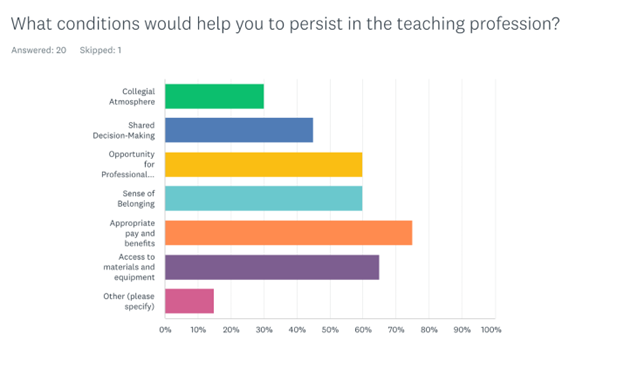
Figure 2. Conditions for persistence
Growing up in this challenging era, these students seem clear about the importance of a decent wage; adequate funding for supplies, materials, and equipment; and opportunities for professional growth. And yet, a sense of belonging is also crucial to a majority of respondents:
I want to become a teacher because I want to be someone who makes a difference in people’s lives. I’ve had teachers who really affected me and made a huge difference in my life, so I want to be able to give that to others. (survey respondent)
Unlike previous generations of teachers, they do not struggle with the dichotomous relationship between the “call” to teach and adequate resources. Establishing these conditions from the start must be an integral piece to leading and retaining the Gen Z educator.
Leadership for the next generation
Our survey participants want leaders who see them personally and professionally. They want leaders who won’t fall prey to common misperceptions about this generation based on what they wear or the number of tattoos they have or their propensity to question established ways of doing things. On the contrary, effective leaders of this future generation of educators will set aside the misguided denigrations and discover for themselves who these educators are.
This will require leaders to consider how this generation’s experiences have shaped how they approach the challenges of their time and how their work ethic has evolved. They have arrived at their own logic about organizational hierarchies in a time when many organizations have failed them. (Katz et al., 2021).
Effective leaders of this future generation of educators will set aside the misguided denigrations and discover for themselves who these educators are.
Gen Z also seeks balanced leadership. They want opportunities to manage themselves and to be included in the decision-making process, but they also want to be guided. They crave empathy and patience, and they want to see it, feel it, and practice it throughout their school, not just in the classroom. Guidance, under the auspice of a caring relationship, is what they seek.
One Gen Zer, Jonah, said in Gen Z Explained, “Guidance — I like this term the best because I so value individual autonomy, but I like someone who can maybe guide me but not restrict me” (Katz et al., 2021). Members of the Gen Z population about to enter the teaching profession clearly envision a career where they’ll have both autonomy and the ability to make a difference through their empathy, knowledge, and creativity. They seek leaders who guide and support their efforts.
Induction and mentorship
In an EdWeek Research Center study (Najarro, 2024), school administrators were asked about strategies they implemented to attempt to increase teacher retention. The top choice was increased pay, but mentorship was the second most popular response, chosen by 22% of respondents. Conversations about teacher retention and attrition cite mentor models as a way to instill a sense of belonging in new educators.
Our research indicates that Gen Zers want leaders, mentors, and colleagues to move past the judgments of their generation and recognize their unique contributions as individuals. When asked what Generation Z can teach the older generation of teachers and leaders, one student in our survey responded: “To move past the divide between generations and gain a mutual respect between teachers and students that helps the latter to better mature into adulthood.”
Older generations can reject, misunderstand, and mishandle the actions that young people take in their quest for a better world, hindering cross-generational understanding with sometimes serious consequences.
Mentorship programs are designed to transfer both the theoretical and experiential knowledge base of experienced teachers to those new to the profession. This complex transfer relies on the “fit” between the mentor and the new educator. Often the relationship rests on an imbalance of power and depends on the skills and abilities of the mentor. While teachers and principals have expressed the value of instilling a sense of belonging through mentorship, they need to continually modify this practice to address the unique attributes of the new educator.
Creating a space for a new generation
Our Gen Z participants want their leaders to see and accept them as professionals. Beyond technique, skill, and approaches to problem solving, members of Gen Z have a distinct need to be seen in the fullness of who they are. Indeed, as we consider the findings in our research, we must recognize that the Gen Z population is saying in concert, “I hope they take the time to get to know who I am — and what I bring to the table.”
As teacher educators who value the identities of Gen Z while understanding the state of the profession, we have growing concerns about how we will invite the next generation of teachers into the field and keep them engaged in the long term. Mentorship, collaboration, and relationship-building are all tactics for building supportive environments. Done well, they can lead to retention. Whatever tactics schools choose, they need to offer something deeper than the old routines, because this new generation is bringing something different.
References
Bridging Divides Initiative. (2024). Analysis of U.S. campus encampments related to the Israel-Palestine conflict: Action, reaction, and engagement in dialogue (Issue Brief). Princeton University
Brooks, D. (2019). Will Gen Z save the world? The revolt against Boomer morality. New York Times.
Honeycutt, N. (2024). Students more likely to face arrest on campuses with poor free speech climates. Foundation for Individual Rights and Expression.
Katz, R., Ogilvie, S., Shaw, J., & Woodhead, L. (2021). Gen Z explained. The University of Chicago Press.
Kim, H., Rackoff, G.N,, Fitzsimmons-Craft, E.E., Shin, K.E., Zainal, N.H., Schwob, J.T, Eisenberg. D., Wilfley, D.E., Taylor, C.B., & Newman, M.G. (2022). College mental health before and during the COVID-19 Pandemic: Results from a nationwide survey. Cognitive Therapy and Research, 46 (1), 1-10.
Najarro, I. (2024). How effective mentors strengthen teacher recruitment and retention. Education Week.
Parker, K. & Igielnik, R. (2020). On the cusp of adulthood and facing an uncertain future: What we know about gen Z so far. Pew Research Center.
This article appears in the Fall 2025 issue of Kappan, Vol. 107, No. 1-2, pp. 23–27.

ABOUT THE AUTHORS

Michelle Hughes
Michelle Hughes is an adjunct professor at the State University of New York at New Paltz. She is the author of When Teachers Belong: Cultivating Resilient Teaching Communities (Routledge, 2025) and Habits of Mind Playbook: Smart and Small Lessons for PreK through 12th Grade (Institute for Habits of Mind, 2023).
Kanoe Bunney
Kanoe Bunney is an education faculty member and department chair at Linn-Benton Community College in Albany, Oregon.