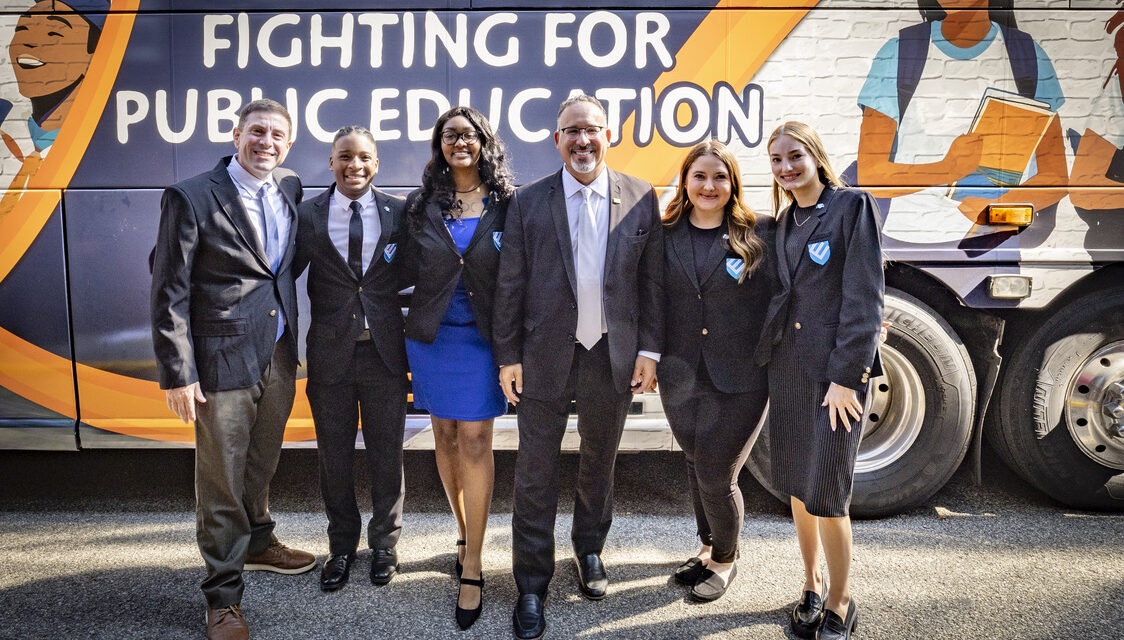
An interview with former Secretary Miguel Cardona
I had the pleasure and honor for this edition of Kappan to interview former Secretary Miguel A. Cardona, who served as the 12th U.S. Secretary of Education during the Biden administration. Previously, Secretary Cardona was the Connecticut commissioner of education, leading its Department of Education from 2019 to 2021. A son of Puerto Rican parents, he grew up in Meriden, Connecticut, speaking Spanish as his first language.
His leadership at the national level came at a time when America’s schools were in the process of reopening after a historic closure during the COVID-19 pandemic. In our interview, we touch upon some of the highlights of his term as the nation’s lead adviser to the president on preK-12 and higher education issues.
Q: Secretary Cardona, before we dive into your time as secretary of education, could you share your personal journey in education? What was the moment you knew you wanted to become a teacher?
A: Thank you, Dr. Lane. I’m so happy to be here and proud of the work you’re doing. Growing up in a big family in Connecticut, with parents who came from Puerto Rico, I didn’t initially see myself as a teacher. I attended a technical high school where I studied auto mechanics, but I had a passion for helping people and my community.
In my third year, I used my art to address social issues. I created a watercolor piece with the message, “We’re all one race — the human race,” to express my feelings about division and prejudice. One day, my art teacher tapped me on the shoulder and said, “You should consider becoming a teacher.” That moment changed everything. It made me think big—maybe I could be the first in my family to go to college and give back as a teacher. That spark stayed with me, leading to a career I love, from serving students in my hometown to now advocating for millions.
Q: Your journey is truly inspiring. You’ve gone from an award-winning principal to the U.S. secretary of education.
For many, the role of the Department of Education isn’t entirely clear. In your words, what is the department’s mission, and how does it impact schools across the country?
A: That’s a great question. Even as a teacher, principal, and state leader, I didn’t fully grasp the department’s role until I became secretary.
Public schools are the cornerstone of our democracy, and we’ve worked to ensure they’re adequately funded and accessible to every child.
At its core, our mission is about protecting students’ rights and ensuring equity in education. When I started, more than half of our schools were closed due to the pandemic. It was critical to protect students with disabilities and ensure they received the accommodations they needed. Beyond that, we focused on promoting equity — ensuring all students could read at grade level, had mental health supports, and could access higher education without crippling debt. We also stood firm in defending public education, which has been under attack in recent years. Public schools are the cornerstone of our democracy, and we’ve worked to ensure they’re adequately funded and accessible to every child.
Q: There’s no shortage of challenges in education, but let’s focus on the positives. What are some things going well in American education, and how can we build on those strengths?
A: I’m an optimist, and there’s much to celebrate.
First, we’ve secured historic funding for education, including resources for 16,000 more mental health professionals in schools. This is critical given the youth mental health crisis.
I’m also excited about the expansion of college and career pathways, enabling high school students to earn college credits and prepare for well-paying jobs without needing a four-year degree. Programs like these are vital for economic development and student success.
We’ve also made strides in affordability — boosting Pell Grants, simplifying the FAFSA (Free Application for Federal Student Aid), and providing $170 billion in student debt relief. These efforts have opened doors for first-generation students, like me, to access higher education.
Q: You’ve often spoken about the teacher shortage and respect for the profession. Can you share how your administration addressed this issue?
Teaching is the most critical profession, and we need to invest in its future — through giving teachers agency, better working conditions, competitive salaries, and increased diversity.
A: The teacher shortage reflects a broader respect issue. We acted by establishing paid teacher apprenticeships. In 2021, no state offered them. Today, 47 states compensate student teachers as they learn. This shift is monumental. It’s about moving from talking about shortages to creating pathways that support aspiring educators. Teaching is the most critical profession, and we need to invest in its future — through giving teachers agency, better working conditions, competitive salaries, and increased diversity.
Q: Looking back on your four years as secretary, what are you most proud of? If there were a book about your tenure, what would it be titled, and what would its key themes be?
A: I’d call it Thriving Despite All Odds. When I began, schools were closed, public confidence was shaken, and educators faced immense challenges. Within nine months, we reopened schools, provided record funding, and tackled disparities that had long been normalized. The book would highlight themes like believing in possibilities, lifting up the teaching profession, and disrupting broken systems. I’d emphasize the importance of evolving to meet students’ needs, from reforming FAFSA to expanding career pathways. These efforts are about creating a more equitable, accessible, and effective education system.
Q: Your cultural heritage has been a cornerstone of your leadership. What does it mean to you to bring your bicultural identity to this role?
A: My grandparents left Puerto Rico for the projects of Connecticut so their children could have better opportunities. Their sacrifices shaped me. I was born rich in faith, culture, and family values — qualities I carry with pride. I often say I’m as American as apple pie and rice and beans. As a Latino, I want students to embrace their identities. Whether they’re bilingual, from rural areas, or part of marginalized communities, they should feel empowered to thrive without abandoning who they are. My role is to honor my ancestors’ sacrifices and show students that their diversity is their strength.
Q: Now, a new administration is taking over. What advice would you give the next secretary of education?
A: Listen. Policies are only as effective as their implementation, which requires understanding the needs on the ground — from students and parents to educators and leaders. Build on public education’s legacy. It’s the foundation of our democracy and a pathway to opportunity. Protect it fiercely and work collaboratively across sectors — whether with health care, labor, or higher education. Most importantly, stay focused on the students. They are why we do this work.
Q: Finally, what are some unfinished priorities you hope the next administration will continue?
A: We’ve planted seeds that will be harvested for decades, from closing achievement gaps to redesigning high schools for career readiness. I hope they continue making education affordable and accessible, particularly through public service loan forgiveness. Investing in the teaching profession is non-negotiable. We need high-quality educators in every classroom. If the next administration can sustain and expand these efforts, they’ll be building a brighter future for all students.
Listen to Lane’s conversation with Secretary Cardona at PDK’s podcast, There’s Power in Teaching:
This article appears in the Spring 2025 issue of Kappan, Vol. 106, No. 5-6, pp. 30-32.

ABOUT THE AUTHOR

James F. Lane
James F. Lane is CEO of PDK International.