
Teaching was transformed during the COVID-19 pandemic. What supports do teachers need today?
At a Glance
- During the COVID-19 pandemic, teachers faced new challenges specific to the shift to online learning.
- There has been little research into how the demands teachers face have changed since the pandemic.
- Alexandra Boardman, Jacquelyn Chestnut, and Molly Fisher asked teachers to identify and rank the demands they face, both now and before the pandemic.
- While some demands (such as salary needs) have remained consistent over time, other demands (such as teacher shortages) seem to have increased.
- A new version of Maslow’s hierarchy of needs, adapted to the teaching profession, shows what today’s teachers need.
The traditional classroom transitioned to virtual screens during the COVID-19 pandemic, with nearly 93% of households reporting that their school-age children engaged in some form of distance learning (McElrath, 2020). With this sudden shift came an increased concern for students’ learning loss, with educators reporting students’ progress as two months behind expected learning levels in November 2020 (Dorn et al., 2020).
At the same time, educators expressed a sense that their teaching was less effective (Dorn et al., 2020) and their feelings of self-efficacy declined (VanLone et al., 2022). Additionally, during the peak of COVID-19, educators reported changes in work patterns, increased workload, and loss of regular pay (Thakur et al., 2022). Concerns about the change in work patterns and challenges of remote learning were specific to the pandemic; however, other concerns, such as salary, were present before the pandemic (Fisher & Royster, 2016). This suggests that some educator concerns changed during the pandemic, while others remained constant.
Teachers’ needs during the pandemic
Researchers have found that educators faced several new demands in the height of the COVID-19 pandemic. These include:
- Learning loss among the poorest students (Moscoviz & Evans, 2022).
- Difficulty maintaining discipline (Thakur et al., 2022).
- Struggle to balance work with personal lives (Kraft, Simon, & Lyon, 2021).
- More time spent troubleshooting problems with technology (Herold & Kurtz, 2020).
- Barriers to e-learning (Maatuk et al., 2021).
- Disparities in student access to resources (Ansorger, 2021).
- Worsened student mental health and social isolation (Lee, 2020).
During the peak of the pandemic, 90% of educators reported feelings of moderate to high levels of stress, thus classifying the psychological well-being of teachers in the deficient to low categories (Thakur et al., 2022). Another analysis showed similar findings, with “stress, anxiety, and depression being the most reported mental symptomatology” among teachers (Oramiz-Etxebarria et al., 2021).
While these studies give insight into teachers’ needs during the peak of COVID-19, there is not enough research on teachers’ needs in the present day.
Maslow’s hierarchy for teachers
To understand how teachers’ needs have evolved, we used a version of Abraham Maslow’s hierarchy of needs adapted for teachers (Fisher & Royster, 2016). The direct comparison between the pre-pandemic and post-pandemic needs enables us to develop a revised hierarchy of educator needs.
Maslow’s (1943) hierarchy of human needs includes five tiers:
- Physiological
- Safety
- Love and belonging
- Esteem
- Self-actualization
Each tier builds on the others, meaning that a person must first have their physiological needs met before their safety needs can be adequately met. This hierarchy has been reconstructed to depict human needs within the educational system (Ansorger, 2021; Fisher & Royster, 2016; Fisher & Crawford, 2020). Specifically, Molly Fisher and David Royster (2016) found that teachers’ needs can be organized into the following categories:
- Subsistence
- Security
- Love and belonging
- Esteem
- Self-actualization
Figure 1 shows how teachers’ reported needs correspond with those in Maslow’s original hierarchy.
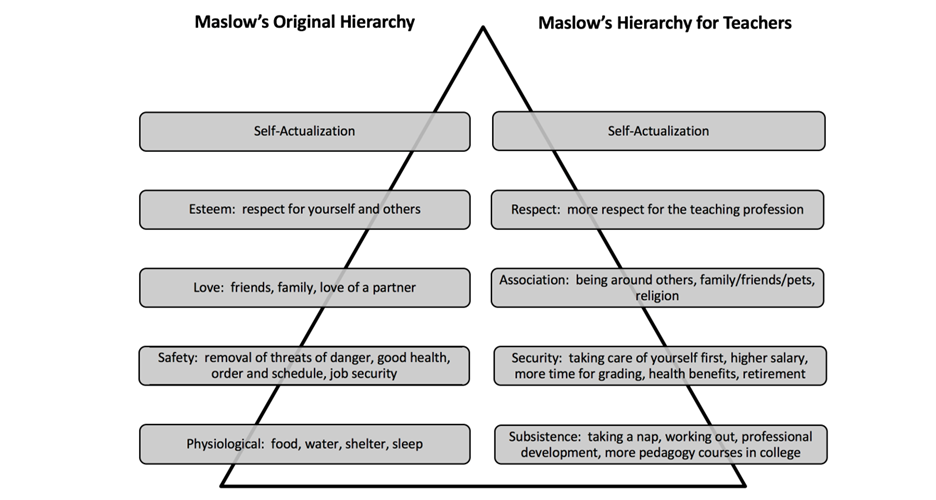
Figure 1. Maslow’s original hierarchy and the hierarchy for teachers. Source, Fisher & Royster, 2016
Surveying today’s teachers
To learn whether and how teachers’ needs have changed since the pandemic, we developed a quantitative survey based on the Fisher and Royster (2016) study.
What we asked
We began with the demands identified in that study to build the list of items to include on our survey. Next, we reviewed the available literature on the impacts of the pandemic within education to identify additional demands. These included items focused on technology use, student engagement, student and teacher mental health, and student absences.
On the survey, we asked educators to select demands they are currently experiencing from our list and to add any other demands not listed. Then we asked educators to rank their selected list of demands from the “most demanding” to the “least demanding.” We then repeated these questions, asking teachers to select and rank the demands they faced before the COVID-19 pandemic.
Next, we included open-ended questions that allowed educators to elaborate on their choices. Upon completing the questionnaire, we asked participants if they would volunteer for a 15- to 20-minute post-survey interview to expand further on their responses.
Who participated
We used email and social media to distribute the survey to K-12 teachers across the United States. Specifically, we emailed the survey to school administrators with whom our research team had personal connections for distribution to teachers, and we posted it to multiple educator Facebook groups.
In total, 197 educators completed the survey, and 41 volunteered to participate in a 15- to 20-minute virtual interview. The surveys were collected from a total of 16 states, with most of the educators working in Kentucky (54.8%) and Indiana (26.9%). Additionally, the largest proportion of educators who responded came from either a high school or elementary school setting. Further, from the educators who specified their subject area, the most frequently taught subjects were special education, math, and English, respectively. From the individuals who volunteered for a virtual interview, our research team selected 11 to interview. The educators interviewed represented a diverse range of ages, years of experience, grades and subjects taught, and geographical regions.
What teachers told us
We assigned the 17 demands listed on each survey a point value, with the top-ranked demand receiving 18 points, and each lower-ranking demand receiving fewer points, according to their ranking. Therefore, if an educator selected and ranked a 17th demand, that demand would be scored with a 1.
After completion of the scoring, we averaged all educators’ responses for their pre- and post-COVID ranking. Table 1 lists each demand with its respective pre- and post-COVID mean scores (with the highest scores representing higher ranks on teachers’ lists); standard deviation (with higher numbers representing higher variation in responses); change in mean scores; and p-value (with values below .05 representing a statistically significant change).
| Demand | Mean Pre | SD Pre | Mean Post | SD Post | Change | p | |
|---|---|---|---|---|---|---|---|
| 1* | Respect for teaching profession | 8.89 | 8.24 | 10.36 | 7.00 | .016 | 1.47 |
| 2 | Relationships with colleagues | 1.35 | 4.25 | 1.36 | 3.70 | .01 | .476 |
| 3 | Salary | 8.03 | 7.97 | 8.27 | 7.4 | .24 | 1.000 |
| 4* | Time for rest and rejuvenation | 7.39 | 7.74 | 9.75 | 6.87 | 2.36 | <0.001 |
| 5 | Time management | 5.45 | 7.47 | 6.58 | 7.15 | 1.14 | .254 |
| 8 | Professional development | 2.37 | 5.28 | 2.07 | 4.30 | -.30 | .287 |
| 7* | Student mental health | 5.22 | 7.20 | 10.20 | 6.69 | 4.98 | <0.001 |
| 8* | Your own mental health | 3.68 | 6.43 | 7.48 | 7.15 | 3.81 | <0.001 |
| 9* | Gaps in student knowledge | 5.76 | 7.58 | 11.06 | 6.91 | 5.31 | <0.001 |
| 10* | Your confidence in using technology | 2.24 | 5.41 | 1.32 | 3.88 | -.92 | 0.0009 |
| 11* | Student behavior | 7.73 | 8.15 | 11.24 | 7.08 | 3.51 | <0.001 |
| 12 | Pressure from parents | 3.45 | 6.25 | 3.13 | 5.35 | -.31 | .762 |
| 13* | Student engagement | 7.36 | 7.95 | 9.12 | 7.24 | 1.76 | <0.01 |
| 14* | Student absences | 3.43 | 6.19 | 6.57 | 6.60 | 3.14 | <0.001 |
| 15* | Faculty and staff shortages | 1.55 | 4.25 | 7.88 | 6.72 | 6.34 | <0.001 |
| 16 | Class sizes | 6.25 | 7.72 | 6.01 | 6.92 | -.24 | .714 |
| 17* | State/local assessment | 5.62 | 7.08 | 4.31 | 5.79 | -1.31 | .046 |
| *p value <.05. The bold text and asterisks represent those that had statistically significant changes from pre- to post- pandemic. |
We collated and organized the educators’ interview responses according to where they would fall within Maslow’s hierarchy for educators (Fisher & Royster, 2016). The self-actualization tier is unique for each educator, so we did not include it in the study.
Subsistence
The subsistence tier includes the fundamental needs that must be satisfied for educators to succeed. In the interviews, educators’ most basic demands included a higher salary, mental health care, and increased staffing.
Regarding teacher pay, Joy, an English teacher for eight years, expressed that she feels her “time isn’t being compensated” and that her income is not sufficient for life, which has led her to be “ready to leave the classroom.” Joy’s experience is not unique. Eight of the 11 educators interviewed also expressed concern regarding their low compensation.
While mental health support was undoubtedly a concern for the educators, this need was met to varying degrees.
Similarly, when prompted to discuss mental health resources, eight out of the 11 educators expressed a need for mental health resources for both students and educators. However, the degree to which they felt this need depended on their current supports. Emily, a second-year elementary school teacher, stated that she felt “mentally and emotionally broken down” and could not find “any more time to give to [herself] or anyone else.” However, Joy expressed her appreciation for a packet she received that outlined that the teachers in her district “are now going to have better mental health supports.” Therefore, while mental health support was undoubtedly a concern for the educators, this need was met to varying degrees.
Educators also indicated that they were feeling a teacher shortage. Specifically, teacher Amelia observed that during the 2022-23 school year “two seventh-grade teachers, two eighth–grade teachers, and one sixth-grade teacher quit” in her building. These educators were “within their first seven years of teaching.” Second-year music teacher Maria explained that the teaching shortage is “not a shortage of people who could do the job. It’s a shortage of people who are willing to do all that work for so little money and respect.” These teacher vacancies directly impact the educators who remain in their jobs. In the words of seventh-year high school math teacher Jack:
If there were more teachers, then theoretically, there would be more students to spread out. If there’d be more students to spread out, then each individual teacher and therefore each individual administrator would probably not have as much to deal with as they currently do.
Security
The second tier of the hierarchy relates to teachers’ security needs. Our study found that educators feel secure when they have manageable class sizes, administration support, and adequate resources.
Large class sizes were a concern for four out of the 11 educators, with Jack reporting the highest number of students: 34 in one classroom.
Furthermore, eight out of the 11 teachers mentioned administration support, with only three reporting negative experiences. The educators with positive attitudes toward their administration emphasized how this support aided them in their work. Emily, who began her career without a prior in-person student teaching experience, valued the support from her administration, saying that “every teacher needs [support] but especially as a new teacher and someone that hadn’t had a lot of in-person experience.”
The need for various classroom resources was a concern for five out of 11 educators. For example, one educator, Sophie, struggled to simultaneously teach and discipline her students and said she could not use “meaningful consequences for [inappropriate] behavior.” Specifically, she mentioned an instance when a student used vulgar language in her classroom and the administration “just let [the student] sit in the student area and play on [the student’s] phone.” Sophie noticed that the students seem to be rewarded for undesirable behaviors, rather than punished. She hoped for behavioral supports that would deter, rather than encourage, students from behaving inappropriately in her classroom.
Association
The third tier of the hierarchy is association, which in this study focused primarily on educators’ relationships with colleagues and students’ parents. The majority, seven out of 11 educators, expressed having positive relationships with these individuals pertaining to their work.
As a novice teacher, Emily described how her mentor teacher was her “team partner” and “did all of [the] grade-level planning” with her. This positive relationship gave Emily someone to “assist [her] and guide [her]” through the realm of education. In contrast, first-year special education instructor Samantha did not feel this support from her co-teachers and instead felt “power struggles” with those who “have been there longer.”
Like relationships with colleagues, the educators had mixed feelings on their relationships with parents, with the majority indicating both positive and negative relationships with parents. Most often, the educators felt positive associations with the parents who supported and encouraged their children’s education. Martin communicated the complexity of his relationship with students’ parents as he has “kids with really solid home [lives], parents who are pushing [their child]” and others where “there’s not a lot of support being done” within the student’s household.
Respect
Of the highest level with this study, the need for respect, educators communicated their need for increased recognition for their work and heightened respect for the teaching profession. Out of the 11 interviewees, seven individuals expressed feeling like administrators and parents did not respect their work enough.
In addition to respect from administrators, educators declared their need for greater respect from parents.
To increase recognition for educators’ work, 23-year English teacher Amelia recommended that administrators “thank [teachers], tell [teachers] that you appreciate them.” For Emily, the principal’s presence in her classroom signals respect. She cited not feeling “super [supported] by [her] principal,” who only visited Emily’s classroom once all year.
In addition to respect from administrators, educators declared their need for greater respect from parents. Amelia recounted how she “routinely got emails from one parent who cussed [her] out on a regular basis” because she had told the parent that their student’s “behavior was lacking.” Maria communicated a lack of respect for her professional role as an educator when she sensed a misconception among “the parents that the teachers are supposed to . . . raise [their] child.”
Understanding teachers’ needs today
Figure 2 shows how these findings fit in with a new version of Maslow’s hierarchy for teachers that takes into consideration the post-COVID realities. Some needs (denoted by an *) were present in both the Fisher and Royster (2016) pre-COVID study and our post-COVID study. Others are new additions.
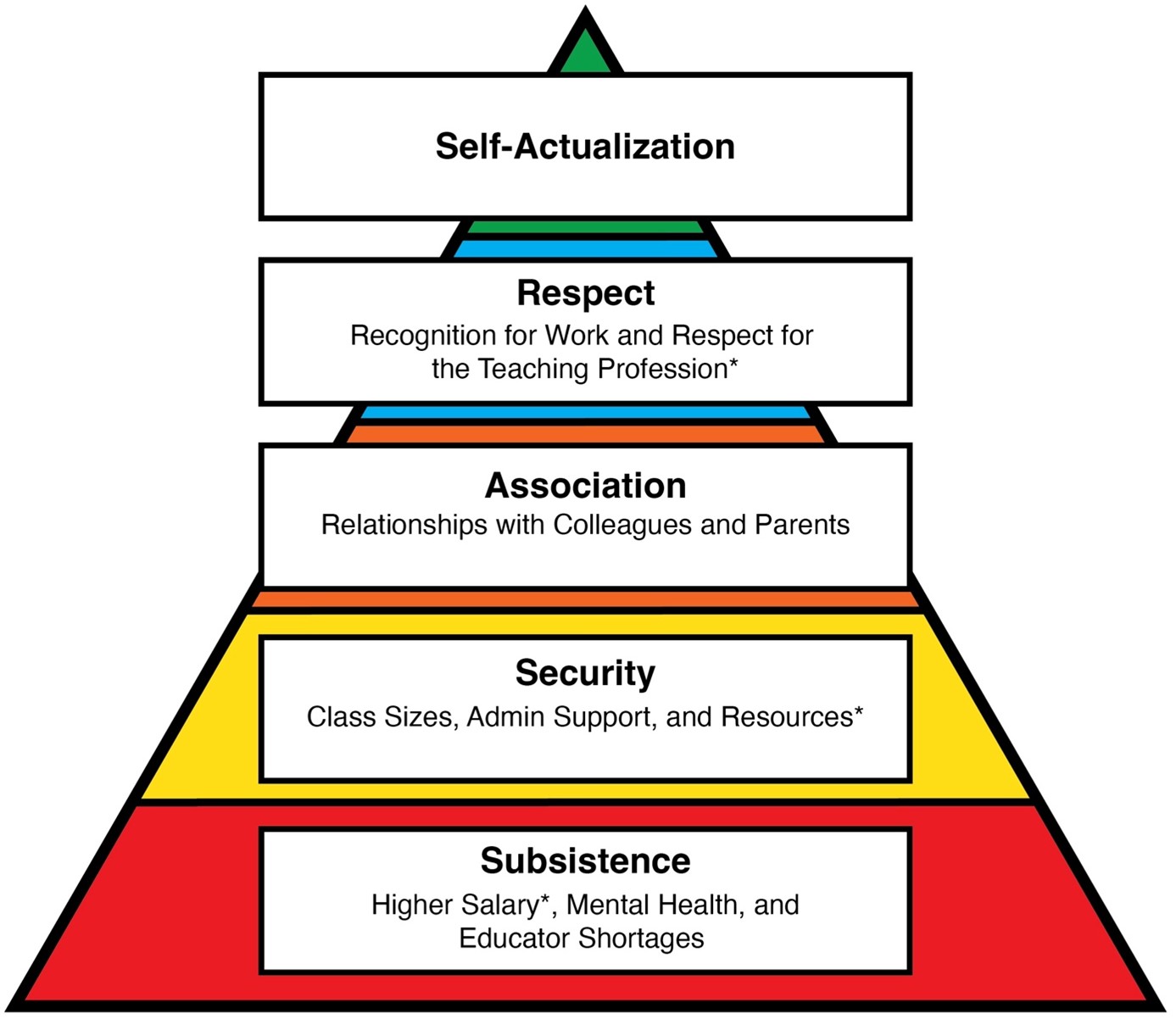
Figure 2. Updated Maslow’s hierarchy for teachers
*A need identified in Fisher and Royster (2016) before COVID and the current study after COVID.
Support mechanisms for teachers
Meeting teachers’ needs will largely require the support of administration. Fisher and Royster (2016) stated that “without the support of administrators [who] have the resources,” educators “cannot initiate many of these suggestions.” Most of the educators expressed some demands in our study, namely higher salary and sufficient staffing, that are beyond their control.
This finding suggests that consistent and honest communication between teachers and their administrators could potentially aid in better meeting educators’ needs. In our interviews, the satisfaction teachers expressed with their job largely seemed to depend on their relationship with their administration.
In her eighth year of teaching, Joy had decided that she was leaving education in pursuit of another job. One of her greatest challenges in education was that she “[did] not feel that [her] administration, both at the building-level and the county-level, really provided any support.” However, when asked if she had considered leaving teaching, another teacher, Chloe, stated that she would not “because [she is] happy with her admin” and confirmed that “so much of it has to do with [the] admin” when determining if an educator will seek out a different career path.
What’s changed since COVID
It’s notable that nine of the 17 demands had statistically significant growth from pre- to post-pandemic. The three demands that showed the greatest increase in teacher ranking before and after COVID were faculty and staff shortages, gaps in student knowledge, and student mental health. Survey participants ranked respect for the teaching profession as the greatest demand prior to the pandemic. While remaining high after the pandemic, gaps in student knowledge and student behavior ranked higher, with student behavior being the highest-scored demand post-pandemic. It is important to note that this does not mean that the shifts are a result of COVID, merely that teachers ranked them as greater demands.
The standard deviations of the pre- and post-pandemic data show much greater differences in teacher rankings of pre-pandemic demands. This is most likely due to recency bias because teachers were recalling demands from at least two years ago. Current, post-pandemic demands were more in the forefront and there was less variability in these demands. Due to this bias, we chose to use the Fisher and Royster (2016) hierarchy as the “pre-pandemic” hierarchy for comparison purposes.
The subsistence needs of the educators in the original study (Fisher & Royster, 2016) primarily focused on physical needs, such as taking a nap and working out. However, in our study, educators were more focused on psychological needs, including mental health resources and classroom support. Higher salary was found to be significant to educators’ well-being in both studies; however, the revised hierarchy categorizes salary as a subsistence need rather than a security need (Fisher & Royster, 2016), because teachers now indicated pay was an essential need.
Administration support and manageable classroom sizes were integral to participating educators’ sense of security in their job. In the original study, this category of demands focused on educators’ need to take care of themselves, their health benefits, and retirement. In the current study, teachers’ security demands extended beyond individual benefits to consider the needs that could enable teachers to meet the demands of students. Both studies found that an increased number of educational resources, in all respects, improved educators’ sense of security in their jobs.
Educators’ needs do not remain fixed but, rather, alter with time. Therefore, administrators and educators must regularly evaluate, communicate, and adapt to the ever-changing needs in the classroom.
The association category varied as the 2016 hierarchy focused on the educators’ needs in their personal lives outside of school, while this study focused on improved relations with students and parents.
The respect category generally reflects the original study, as both found the need for increased respect for the teaching profession, with educators’ desire to be recognized for their work as a demonstration of this respect.
Meeting teachers’ needs now
Educators’ needs do not remain fixed but, rather, alter with time. Therefore, administrators and educators must regularly evaluate, communicate, and adapt to the ever-changing needs in the classroom. Past policies and support systems may no longer be relevant. Our study suggests that policies and strategies designed to support students, administrators, and educators are needed.
Educators are regularly asked to differentiate instruction for the students in their classrooms based on students’ needs. The same should be afforded for the support provided for those educators. Using Maslow’s hierarchy allows leaders to differentiate teacher support based on where they are in the hierarchy. Support should not follow a one-size-fits-all approach; rather, it should be linked to an educator’s current needs.
We encourage policy makers and administrators to focus on the here and now and not on actions that worked in the past. These results demonstrate how educator needs have shifted and illustrate a lack of support for teachers in the post-pandemic classroom, which threatens not only educators, but also their students.
References
Ansorger, J. (2021). An analysis of education reforms and assessment in the core subjects using an adapted Maslow’s hierarchy: Pre and post COVID-19. Education Sciences, 11 (8), 376.
Dorn, E., Hancock, B., Sarakatsannis, J., & Viruleg, E. (2020, December 8). COVID-19 and learning loss-disparities grow and students need help. McKinsey & Company.
Fisher, M.H. & Crawford, B. (2020). From school of crisis to distinguished: Using Maslow’s hierarchy in a rural underperforming school. The Rural Educator, (41) 1, 8-19.
Fisher, M.H. & Royster, D. (2016). Mathematics teachers’ support and retention: Using Maslow’s hierarchy to understand teachers’ needs. International Journal of Mathematics Education in Science and Technology, (47) 7, 993-1008.
Herold, B. & Kurtz, H. (2020, May 11). Teachers work two hours less per day during COVID-19: 8 key EdWeek survey findings. Education Week.
Kraft, M.A., Simon, N.S., & Lyon, M.A. (2021). Sustaining a sense of success: The protective role of teacher working conditions during the COVID-19 pandemic. Journal of Research on Educational Effectiveness, 14 (4), 727-769.
Lee, J. (2020). Mental health effects of school closures during COVID-19. The Lancet Child & Adolescent Health, 4 (6), 421.
Maatuk, A.M., Elberkawi, E.K., Aljawarneh, S., Rashaideh, H., & Alharbi, H. (2021). The COVID-19 pandemic and e-learning: Challenges and opportunities from the perspective of students and instructors. Journal of Computing in Higher Education, 34 (1), 21-38.
Maslow, A. H. (1943). A theory of human motivation. Psychological Review, 50(4), 370–396.
McElrath, K. (2020, August 26). Nearly 93% of households with school-age children report some form of distance learning during COVID-19. United States Census Bureau.
Moscoviz, L. & Evans, D.K. (2022). Learning loss and student dropouts during the COVID-19 pandemic: A review of the evidence two years after schools shut down [Working paper 609]. Center for Global Development.
Thakur, M., Jagadeesha, H.N., Sharma, R., Mohanan, K., & Hari Hara, S. (2022). Job satisfaction, psychological well-being, and perceived stress among teachers during the pandemic. Asian Journal of Psychiatry, 71, 103049.
Oramiz-Etxebarria, N., Idoiaga Mondragon, N., Bueno-Notivol, J., Pérez-Moreno, M., & Santabárbara, J. (2021). Prevalence of anxiety, depression, and stress among teachers during the COVID-19 pandemic: A rapid systematic review with meta-analysis. Brain Sciences, 11, 1172.
VanLone, J., Pansé-Barone, C., & Long, K. (2022). Teacher preparation and the COVID-19 disruption: Understanding the impact and implications for novice teachers. International Journal of Educational Research Open, 3, 100120.
This article appears in the Spring 2025 issue of Kappan, Vol. 106, No. 5-6, pp. 44-50.

ABOUT THE AUTHORS

Alexandra Boardman
Alexandra Boardman was a research fellow at the University of Kentucky’s Department of STEM Education, Lexington.
Jacquelyn Chestnut
Jacquelyn Chestnut was a research fellow at the University of Kentucky’s Department of STEM Education, Lexington, Kentucky.
Molly H. Fisher
Molly Fisher is a professor and associate dean of research and innovation at Rowan University’s College of Education, Glassboro, New Jersey.