Last month’s surprise election results highlighted what can happen when journalists don’t know how to cover communities that are not their own. These 5 tips can help.
By Cici Yu, Sarah Conway, Ariel Hart, Katie Licari, and Yanqi Xu
Journalists frequently find themselves reporting on communities outside their own experience.
A recent IRE AccessFest panel explored effective strategies and tools for approaching unfamiliar communities, uncovering untold stories, and building trust with sources.
We discussed how to engage with diverse stakeholders to ensure that our coverage accurately and comprehensively reflects the full spectrum of experiences within these communities.
The goal: to ensure that our coverage accurately and comprehensively reflects the full spectrum of experiences.
Republished with permission. IRE members can watch a replay of the October session here.
Tip #1: Building trust/relationship
Building trust requires investing in the work. This is best practices for reporting anyway, but extra important when asking for the stories of people who may see me as an outsider just out to extract content for my own purposes.
- Build long-term relationships with community members and groups. Take time to understand the people, spaces, and groups who are genuinely invested in an issue and often impacted by it.
- Trust and relationships are built over time.
- Be humble. Know my limitations and the fact I have limitations I may not know. Try to constantly learn about my own knowledge gaps.
- To any extent possible, go to the community. If at all possible, spend the time to drive/transit there. Don’t expect people to see my mission as their mission, and just call me back and tell their story because I asked.
- Do all that, and try to find a sherpa, a guide. Earn the trust of a member of the community who can introduce me to other members of the community and answer questions, give tips, and tell me where I might be going wrong.
- After you find your guide ask where the community gathers in person (can be a coffee shop, a laundromat, or anywhere)
- Contact the business to organize office hours where community members can meet you in person and help shape coverage about their own communities.
- Always know the County Clerk, neighborhood council president, someone who knows the history and context and loves their community and just wants to see it portrayed accurately. (invaluable for fact checking)
- Always ask “who else should I talk to” this helps build your web of sources in the community.
Building trust requires investing in the work.
Tip #2: Listening and Learning
- Listen, listen, listen. Harder than one might think since we all come to interviews with preconceptions of what a tale is about. Listen to their concerns and lived experiences.
- Do the research. Talk to the experts who’ve already been in this space. Come to the table with homework done before and while asking for people’s stories.
- Conduct offer office hours / coffee chats with community members. It’s a good way to check in with the communities
- If your workplace allows, donate time in the community in a non-partisan way
Listen, listen, listen.
Tip #3: Using Data and Resources
- Use data to find real people and that involves a lot of cold-calling and quickly trying to get them to talk to media. Avoid making these conversations purely one-off and utilitarian. Be transparent with sources about them how you found their information/cases, share things from data findings about the topic you are researching too and answer their questions.
- Acquire data, records, and information that people and organizations might not.
- Share the tools and resources of journalism with people you meet in reporting (i.e. how to file a FOIA) or just transparency on where, when and how we acquire information.
Tip #4: Complex Narratives / Humility in Reporting
- Don’t be afraid of nuance and complexity. The best stories about who we are live in this space. It makes sure that communities are reflected accurately.
- Think creatively about sourcing at the start and always try to find sources that are from a diverse or underrepresented background.
- Recognize oftentimes people in marginalized groups are not heard by the media or anyone in power. Be available and listen. Also recognize that sometimes people from marginalized groups dont want to talk about X maybe they want to talk about Y (for ex: An indigenous source of mine doesn’t want another article about the 1939 land exchange – he wants to talk about mining in Conglomerate Mesa or Tenopah which impacts his community today).
- Avoid flat narratives and lean into the complexity and autonomy of sources.
- Love the work and the people you are reporting for.
- Approach the work with humility, honesty, transparency and care.
Love the work and the people you are reporting for.
Tip #5: Post-publication: How to connect with the community?
- Be creative – Resources are often sparse in newsrooms, but be open to working across the newsroom or brainstorming free or low-cost ways to get your story to impacted communities. It’s a great way to build trust and show that you care beyond including them in a story. They are an important audience and should be regarded as such.
- Center accessibility – Make sure impacted communities can access your story. Go to them, not vice versa. Consider translating the story in another language or co-publishing with trusted community media outlets to further your reach.
- Go analog – Be mindful of only publishing digitally. Would your editors be open to printing a story and doing distribution in neighborhood haunts or genuine community spots? Could you place printed copies in a community space? Is there a community group invested long-term in providing services on an issue you could consult about the best way to get information to communities?
- Engagement – Share your story with your audience. Consider emailing or texting all your sources and intentionally asking whether you hit the mark and how you could improve in future stories. Make sure you share your story in the digital spaces you inhabit (Reddit groups, Facebook community groups, etc.).
- Office hours – Make yourself available to the public. Set up office hours in a coffee shop. Consider reaching out to leaders of community spaces and ask if you could join a meeting or event to briefly speak about your story. Be visible and connect with sources.
- Events – Consider hosting a digital or in-person community event to foster relationship-building and civic engagement on an issue and get feedback directly from folks. This could be a panel with expert sources or even a group of sources or organizations that work on an issue to further public discussion.
- Resources – Consider creating resource lists or guides as part of your story package to connect with community members. Follow up with sources to see how these resources are being used through feedback loops, such as including your email or a link to a form so you can know how the resource is being used.
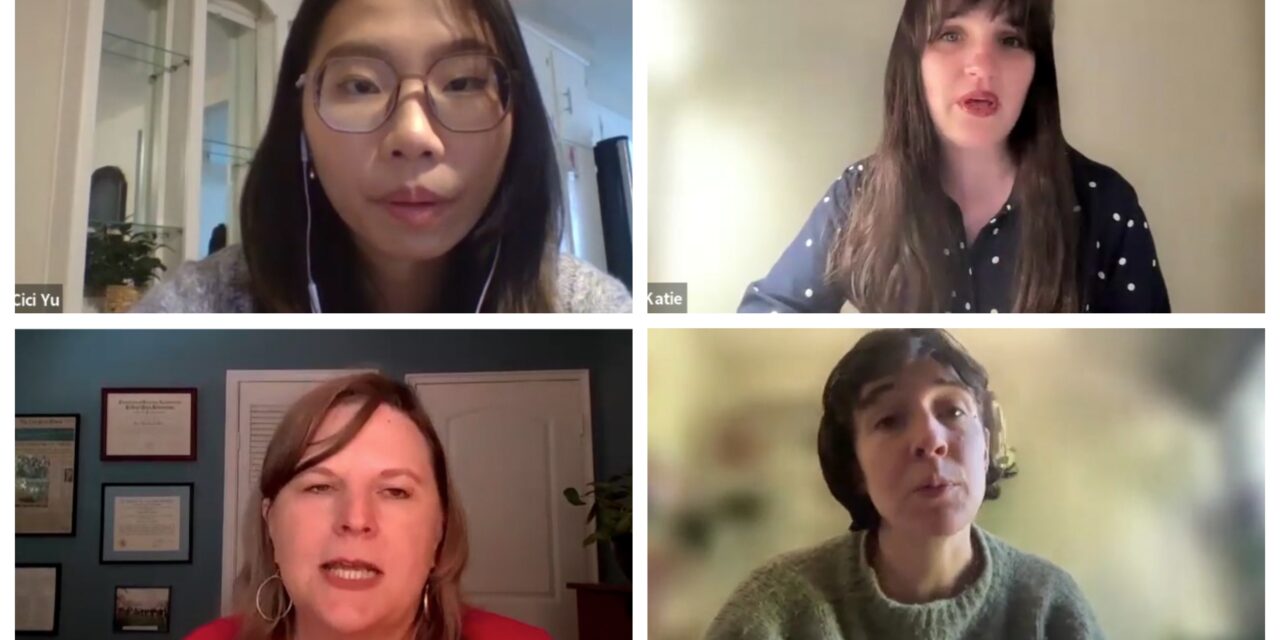
Sarah Conway (City Bureau), Ariel Hart (Atlanta Journal-Constitution() Katie Licari (AfroLA), Yanqi Xu (Flatwater Free Press), and Cici Yu (WBUR).
Previously from The Grade
Community-based solutions will deepen your reporting (Deepa Fernandes)
Covering communities that are not your own (Lee Romney)
Improving source diversity in education journalism (Amber Walker)
Key elements of community-driven education coverage (Brent Brewer)
Racial diversity in education news? Two steps forward, one step back