A LOOK BACK
Examining the challenges of learner-centered education
By Charles M. Reigeluth & Sinem Aslan
December 2015, pp. 63-68
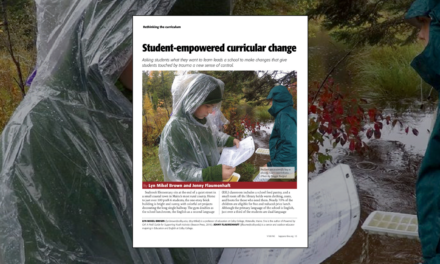
Student-driven learning is a goal of many educators, but schools often face obstacles when implementing a nontraditional approach to instruction. This 2015 Kappan article examines the on-the-ground challenges faced by the Minnesota New Country School (MNCS) in Henderson, Minnesota. A charter school founded in 1994, MNCS was organized around two core values — choice and responsibility. “Project-based learning gives students more freedom and voice in their education: The side effect is that students have a lot of responsibility to drive their own education,” note authors Charles M. Reigeluth and Sinem Aslan. That fact, the authors found, was by far the biggest challenge for the school’s teachers (called advisers).
After interviewing a dozen advisers and other school leaders, Reigeluth and Aslan learned that even when families choose a project-based education for their child, “not all students are ready to take such ownership of their learning.” Self-regulation is crucial to the success of learner-centered education, and not all students entered MNCS — which at the time served grades 6-12 — with those skills. In particular, students who were used to a more traditional educational approach often had a hard time acclimating. “Learner-centered schooling offers many benefits to students, but it also presents many challenges to students and educators,” the authors conclude. “From the experience at the Minnesota New Country School, we have learned that schools interested in moving in this direction must be prepared to help students adopt a different mindset about their education, one in which they think about their future, have the power to pursue their interests, and assume responsibility for their learning.
“This is the way our ancestors taught us, and so it isn’t anything new to those of us who have maintained these practices. You can put all the acronyms you want — MBL (mastery-based learning), PBL (project-based learning), competency-based learning — what it really is, is Indigenous forms of transferring knowledge that have sustained us generationally.”
– Sui-Lan Ho’Okano, Competency Works Blog (Aurora Institute, July 11, 2024)
CONVERSATION PIECE
This issue of Kappan examines how schools can structure learning to focus on mastery. Use these questions to reflect on the issue with your colleagues:
- How do you think educators can ensure students have mastered the required material and are ready to move on to something else?
- What kinds of resources are available to schools that are interested in shifting to a focus on mastery?
- What subjects do you think are especially well-suited to a mastery approach? Why?
- What do you see as the potential downsides or challenges to a mastery orientation?
PDK members have access to discussion guides related to specific articles in each issue of Kappan. Log in to the member portal and access the discussion guides at https://members.pdkintl.org/PDK_Member_Discussion_Questions.
“All pupils can learn all things, given the right time and appropriate conditions — and these conditions include impactful teaching.”
– Mark McCourt, Teaching for Mastery (John Catt, 2019)
RESEARCH CONNECTIONS
AI and mastery learning
Researchers at the University of Denver are exploring whether artificial intelligence (AI) could reduce the barriers that have traditionally been emblematic of mastery learning. Dubbing their efforts “a work in progress,” Stephen Hutt and Grayson Hieb detail their experiences using ChatGPT to generate quiz questions for undergraduate students. The code they developed in their research is freely available via GitHub, an open-source developer platform.
Using videos of lectures from a flipped classroom, ChatGPT was able to generate 10 questions in about 40 seconds. Researchers note that the tool, given the proper precautions, could prove quite useful in the support of mastery learning. In mastery learning, students who don’t fully grasp a concept upon its introduction are given extra assistance and additional assessments to reach mastery. Although an effective leaning method for students, the model traditionally has been tough to implement due to the time demands it places on educators. The advent of AI could change that, the researchers posit, calling their code “a promising tool for scaling mastery learning methods.”
Source: Hutt, S. & Hieb, G. (2024, July). Scaling up mastery learning with generative AI: Exploring how generative AI can assist in the generation and evaluation of mastery quiz questions. L@S ‘24: Proceedings of the Eleventh ACM Conference on Learning @ Scale, 310-314.
Competency-based learning and graduation rates
A study of students in Illinois found that high schoolers who were involved in a competency-based education (CBE) pilot program in 2020 were more likely to graduate than peers who did not participate in the program. Students in the pilot boasted a 97.2% graduation rate, versus a rate of 93.1% for students outside the program. The gains were observed in CBE students overall, with significant increases also noted within the subgroups of white students and students eligible for free and reduced-price lunch. Interestingly, no increase in postsecondary entry was noted among the CBE students. Researchers say further study is needed to determine how a student’s level of CBE involvement (i.e., taking one course versus enrolling in several CBE courses) impacts academic achievement.
Source: Blankenberger, B., Kerr, R., & Dooley, T. (2024). Competency based education pilot in Illinois: Preliminary findings. Educational Policy, 38 (5), 1229-1256.
“It’s one thing to replace seat time with a focus on mastery. But do we actually know how to measure mastery? And are we willing to hold the line on it?”
– Rick Hess, “Is it time to ditch the Carnegie Unit?” (Education Week, Sept. 25, 2023)
Preservice teachers and personalized learning
Are aspiring teachers properly prepared to support personalized learning in their classrooms? A 2024 article published in the Journal of Teacher Education examined that question. Ultimately, researchers found that 193 of 654 standard components within the U.S. educator preparation system were coded for alignment to conceptualization and implementation of personalized learning.
The standards examined were developed by various national organizations, ranging from the National Council of Teachers of Mathematics to the American Council on the Teaching of a Foreign Language. The study serves as an initial effort to explore how personalized learning is addressed in educator preparation. In the paper, researchers call for further study of the intersection of personalized learning and educator preparation. “The way preservice educators are prepared should align with the urgent needs of supporting diverse learners in ever-changing learning environments,” the paper states.
Source: Zhang, L., Carter, R.A., Bloom, L., Kennett, D.W., Hoekstra, N.J., Goldman, S.R., & Rujimora, J. (2024). Are preservice educators prepared to implement personalized learning? An alignment analysis of educator preparation standards. Journal of Teacher Education, 75 (2), 219-235.
State policies for competency-based education
State policies have the potential to drive educational change. But so, too, do the people, procedures, and structures who put those policies in place. Researchers at Idaho’s Boise State University emphasized that point in a comparative case study examining competency-based education policies in Idaho and Utah.
Although the policies in each state were similar in language, there were notable differences in implementation — offering important insights for policy makers. “The passing of policy is not enough for change within the field of education,” researchers note. Policies need to fit the specific context where they’ll be implemented. Policy makers need to be prepared to answer difficult questions about the communities and students their policies will serve.
Source: Williams, H.P., Shoup, K., Diffenbaugh, M., & Brady, K. (2022). Competency-based education in the state policy arena: Comparative case study of two neighboring states. Policy Futures in Education, 20 (2), 166-187.
This article appears in the October 2024 issue of Kappan, Vol. 106, No. 2, p. 5-6.