Everyone at our middle school knew that Mrs. Moses didn’t play. She was a portly woman with mocha skin and hair like the golden fields of California. She stood out, even among her fellow teachers, as a regal figure who walked the hallways with a stern disposition. I was never a student in her 8th-grade class, but even in passing, I could feel the force of her expectations. She embodied the old guiding principle of tough love.
Years later, I learned that her love was tough for a very specific reason. When she was just 15 years old — only two years older than I was at the time — she was the lead plaintiff in a class-action lawsuit against our school system leadership. The case, Jackson, TN Board of Commissioners, was filed in 1967 (13 years after the Brown v. Board of Education ruling). Mrs. Moses, technically Mrs. Monroe-Moses, spent the following two decades fighting for justice in the courts, city hall chambers, and the classrooms, even as our school district oscillated between separate and blended.
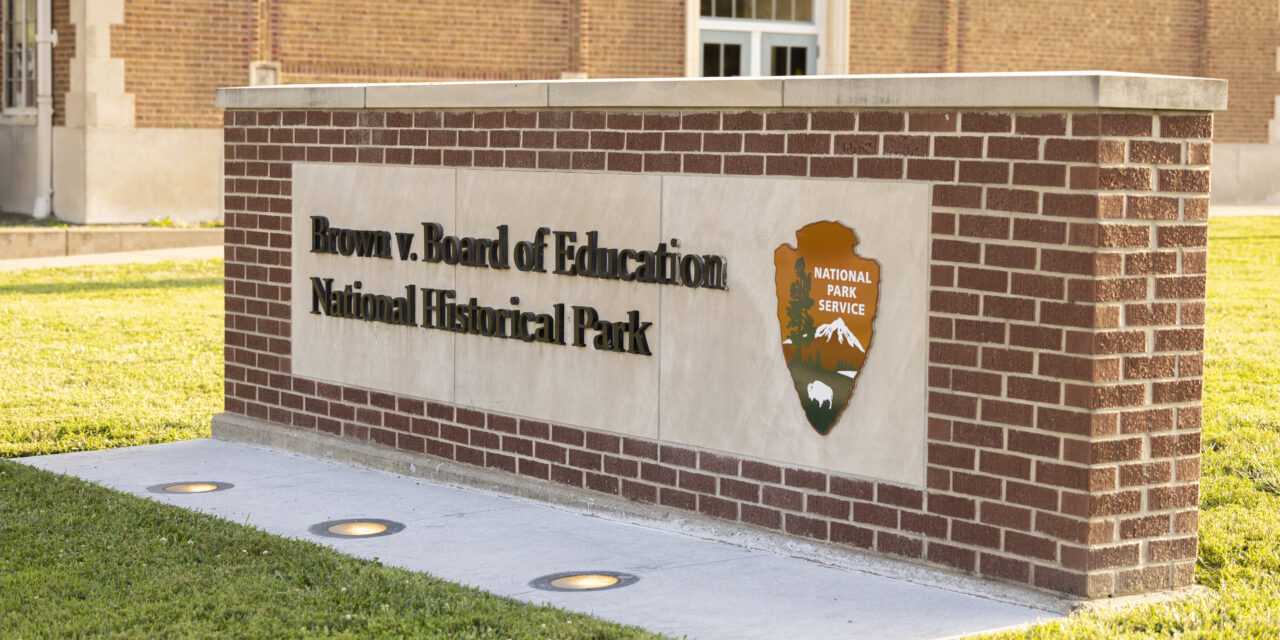
In May, we reached the 70th anniversary of the Brown v. Board decision. It has been a major inflection point in American history. What’s most incredible is that it was a moment hoisted to the center of our political discourse by the brave acts of mere children — kids who sat in tense courtrooms and walked past white nationalist rioters to get to school.
Mrs. Moses’ story adds to our understanding of Brown v. Board and its legacy. The decision, as important as it was, didn’t end the fight for these children. I think of all the courage mustered by little Black girls like Mrs. Monroe-Moses — and also my mother-in-law, Felicia Friendly-Thomas, who as a child helped integrate schools in Berkeley County, South Carolina. And I think about my own daughter — a toddler who I worry about as she will soon enter an apartheid education system. These thoughts provoke an important premise: The Brown v. Board ruling may be America’s greatest underachievement.
Why have we underachieved? The racial injustices we see in our education system don’t persist because of a lack of effort. The force of tough love of heroes like Mrs. Monroe-Moses has struggled for decades to lift an immovable object. Persisting school segregation is not a policy failure. It’s a power problem.
The fundamental flaw of Plessy
The legal pathway we traveled to outlaw school segregation was the wrong one from the outset. The Brown v. Board case sought to overturn Plessy v. Ferguson, which was then the law of the land on public facilities. The Plessy ruling allowed racial separation so long as the conditions of those separated facilities were equal in quality. The center of the critique of the Plessy ruling was that separate facilities are inherently unequal. The problem is not that this is not true. The problem is that this doesn’t go far enough.
That argument against Plessy — that separate facilities are inherently unequal — best applies to what Plessy was designed for, which is public transportation. In 1890, Louisiana Gov. Francis Nicholls signed the Separate Car Act into state law, which required railcar companies to provide separate accommodations for Black passengers (Bell, 2004). Two years later, a biracial activist and shoemaker named Homer Plessy conspired with a civil rights group of Black and Creole agitators called Comite des Citoyens (Committee of Citizens) to dismantle the new law through the courts (Hoffer, 2012). Plessy bought a first-class ticket on a train that would only travel within Louisiana’s borders. By refusing to give up his seat, he orchestrated his own arrest. Plessy lost the appellate case and, famously, lost again at the U.S. Supreme Court.
By upholding the Separate Car Act, the U.S. Supreme Court opened the floodgates for states to create more Jim Crow laws. They deemed that forced separation, so long as conditions were equal, did not violate the equal protections under law promised by the 14th Amendment to the U.S. Constitution. This meant that laws requiring schools to separate kids by race were perfectly legal.
Brown v. Board directly refuted this. In 1951, Oliver Brown and 13 other Black parents went to the school district office in Topeka, Kansas, seeking to enroll their children in white-populated schools that were closer to their homes than the all-Black schools (Bell, 2004). After being denied, they filed the class action lawsuit that would forever change America.
In its 1954 decision, the U.S. Supreme Court overturned a Kansas district court ruling that cited Plessy v. Ferguson as justification for Topeka’s segregated system. The Court offered the opinion that the psychological effects of separation, even under equal conditions, violated the 14th Amendment.
Public facilities aren’t enough
While seismic in its impact, the decision was inherently constrained by focusing on Plessy v. Ferguson. Why? Because Plessy and Brown had incredibly different stakes.
A segregated railcar is a stain on the moral fabric of a society. A segregated school is a buzzsaw through the tree trunk of opportunity. Schools help determine literacy and numeracy. They teach and spread cultural values. They reinforce ideas of what it means to be a citizen. They define and dictate economic outcomes by sorting us into labor markets. They open the door to mobility. They also nail shut that very same entryway.
Turning the American education system into one of “equal opportunity under the law” is a complicated endeavor. It requires much more than laws banning segregated facilities. We need families to resist the urge to send their kids to “good schools” when high-quality is another way of saying white. We need parents pushing policy makers to require that money for schools go to ones with the kids who need the most support. We need desegregated facilities with integrated classrooms and hallways, where kids learn together, grow together, fail together, and then overcome together.
Educational inequality can’t be treated as a fixed, static problem. It shifts and evolves over time. After the Brown ruling, we saw a massive wave of white flight. White communities, primarily in the South, created new “private academies” in the 1950s (Andrews, 2002), and some districts in Virginia chose to close public schools, rather than integrate (Lassiter & Lewis, 1998). Across the decades, white parents have continued to file lawsuits against districts that successfully implemented school desegregation plans under the thumb of court orders pressuring them to comply with the Brown rulings (Ayscue et al., 2018; Orfield & Eaton, 1996; Rosiek, 2019; Underwood, 2019). Every positive action meets an equal and opposite reaction.
Overcoming underachievement
At 70 years, this is where we stand. We’re in a bizarre place. Brown v. Board was a colossal effort. It changed national legal precedent and instantly struck down segregationist laws across the South. It led districts to implement court-ordered desegregation plans. Those plans worked. We saw more than a decade of real progress on school desegregation that crescendoed around the late 1980s and early 1990s (Boger & Orfield, 2005; Reardon, 2016). Black-white achievement gaps have been shrinking (slightly) since the mid-1970s.
It hasn’t been enough. The reactions and backlash have weighed down the progress. A third of all U.S. students attend racially segregated schools (Government Accountability Office, 2022). The expansion of school choice has been segregation’s right-hand man (Mickelson et al., 2008; Singer, 2024). The persisting school segregation is statistically explaining the persisting racial gaps in academic achievement (Reardon, 2016). Court orders are largely an anachronism. We’ve built a giant Airbus plane that seems to only have flown a few blocks forward.
I think about our nation’s collective underachievement, and I think back, again, to Mrs. Brenda Monroe-Moses. She desegregated my high school. She leveraged that local celebrity to successfully run for city council in 1988. She was living history, who taught that very same subject in the public schools. She showed us that reforming our education system is going to require tough love from us all. “You[’re] either [a] part of the problem or you’re [a] part of the solution,” Mrs. Moses told reporters in a 2019 news story commemorating her historic case. “There are no innocent bystanders.”
References
Andrews, K.T. (2002). Movement-countermovement dynamics and the emergence of new institutions: The case of “white flight” schools in Mississippi. Social Forces, 80 (3), 911-936.
Ayscue, J.B., Siegel-Hawley, G., Kucsera, J., & Woodward, B. (2018). School segregation and resegregation in Charlotte and Raleigh, 1989-2010. Educational Policy, 32 (1), 3-54.
Bell, D. (2004). Silent covenants: Brown v. Board of Education and the unfulfilled hopes for racial reform. Oxford University Press.
Boger, J.C. & Orfield, G. (Eds.). (2005). School resegregation: Must the South turn back? University of North Carolina Press.
Government Accountability Office. (2022). K-12 Education: Student population has significantly diversified, but many schools remain divided along racial, ethnic, and economic lines (GAO-22-104737).
Hoffer, W.H. (2012). Plessy v. Ferguson: Race and inequality in Jim Crow America. University Press of Kansas.
Lassiter, M.D. & Lewis, A.B. (Eds.). (1998). The moderates’ dilemma: Massive resistance to school desegregation in Virginia. University of Virginia Press.
Mickelson, R.A., Bottia, M., & Southworth, S. (2008). School choice and segregation by race, class, and achievement. National Education Policy Center.
Orfield, G. & Eaton, S.E. (1996). Dismantling desegregation. The quiet reversal of Brown v. Board of Education. The New Press.
Reardon, S.F. (2016). School segregation and racial academic achievement gaps. RSF: The Russell Sage Foundation Journal of the Social Sciences, 2 (5), 34-57.
Rosiek, J. (2019). School segregation: A realist’s view. Phi Delta Kappan, 100 (5), 8-13.
Singer, J. (2024). How do socioeconomic differences among low-income and racially minoritized students shape their engagement and access in school choice systems? American Educational Research Journal.
Underwood, J. (2019). Under the law: Segregation and secession. Phi Delta Kappan, 100 (5), 74-75.
This article appears in the October 2024 issue of Kappan, Vol. 106, No. 2, p. 50-51.

ABOUT THE AUTHOR

Jonathan E. Collins
Jonathan E. Collins is an assistant professor of political science and education at Teachers College, Columbia University, New York, the associate director of the Teachers College, Columbia University Center for Educational Equity, and the founder and director of the School Board and Youth Engagement (S-BYE) Lab.