The public’s view of education influences teachers’ working conditions, pay, and the pipeline of new educators. Change requires taking control of the narrative.
When Rebecka Peterson tells people she meets that she’s a high school math teacher, they’ll sometimes react with “Oh, I’m sorry.” Her answer is that she loves her profession. “I get to teach teenagers who are earnest and fun and funny, and I find so much meaning in my work.”
As the 2023 National Teacher of Year, Peterson got the opportunity to speak to many people during her travels around the country. She sometimes asked the people she met about the teachers in their lives. “What happened next, almost every single time, is the person would start to tell me about their teachers and how they changed their trajectories.”
Peterson encountered firsthand the contradiction of public perception of public schools and the teaching profession. For many years, the PDK Poll has revealed that while members of the public give high marks to their local schools, they don’t give similarly high ratings to public schools nationally. “Locally, the vast majority of people love their local public schools,” Peterson says. “But then when you start having like these macro conversations, their opinions change.”
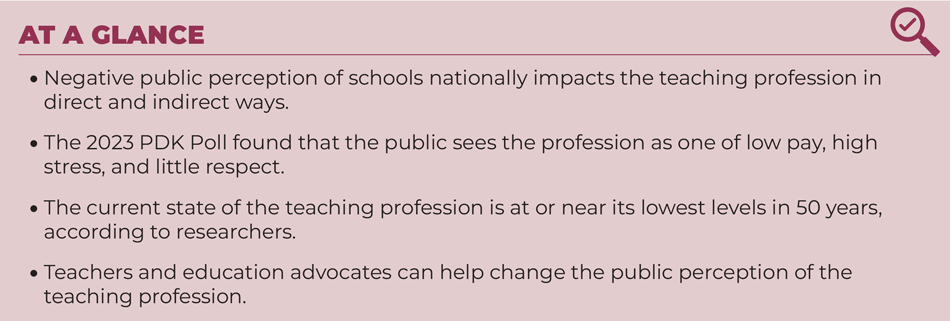
Negative public perception of schools nationally impacts the teaching profession in direct and indirect ways. The 2023 PDK Poll found that the public sees the profession as one of low pay, high stress, and little respect. This perception has depressed the number of students in teacher preparation programs at universities. Indirectly, public perception affects teacher working conditions, compensation, and morale.
“It’s almost a cliché in this country to say, ‘our failing public schools,’” says education historian Diane Ravitch. “And it’s not true.”
National vs. local
For many years, polls and surveys — including the PDK Poll — have shown that parents support their children’s schools and teachers. However, when asked about the state of public schools nationally, parents and those without children have a more negative perception.
“It’s a common theme,” says Linda Darling-Hammond, president and CEO of the Learning Policy Institute. “There’s support in the public for teachers, but there is a declining perception of public schools.”
The media has a role in those perceptions, since the people whose perception is declining the most are those with the least contact with public schools, Darling-Hammond says. “How do you shape the perception of people who have little context about public schools? These perceptions impact teacher salary and working conditions.”
Teachers around the country feel they are being blamed for many of the problems facing public education, says Evan Stone, the cofounder of Educators for Excellence (E4E). Teachers bear a deep responsibility for their individual students and their classroom success. “They feel like they have little agency in changing the system overall to drive broad changes for the profession,” Stone says.
How did we get here?
When COVID hit in March 2020, school officials scrambled to meet their students’ and families’ needs, and many schools moved to online instruction. Online instruction provided a window into the classroom where parents could witness how hard their teachers were trying to bring normalcy and instruction to their isolated and anxious students. Parents saw how difficult the job was, and there was an outpouring of gratitude toward teachers.
Ravitch says she felt optimistic during those early days as teachers were lauded. She read parents’ social media posts commenting on how teachers were doing an amazing job under difficult circumstances. “I thought, ‘This is going to be a new era because people understand now how hard it is to teach.’”
As Ravitch notes, the goodwill of the early days and months of the pandemic didn’t last. Some communities began to argue about school closures, which were in many cases unfairly blamed on teachers who did not want to return to potentially unsafe learning environments. Mask and vaccination mandates also became flash points of disagreement.
Teachers themselves can be the biggest advocates for the profession by taking back the narrative and telling the public about the realities of their jobs.
These disagreements morphed into scrutiny of what teachers were teaching about controversial subjects such as diversity; LGBTQ acceptance; and the history of racial groups in the U.S., including Black Americans. Some groups, particularly those on the political right, took the opportunity to protest at school board meetings and encourage banning certain books from school curricula and libraries.
“This polarization that exploited the anxiety of the after-effects of COVID wasn’t working to change hearts and minds” of the public, says Randi Weingarten, president of the American Federation of Teachers (AFT). “But what it has done is it’s made the job of teaching much harder. Teachers are on eggshells. They feel like they can get in trouble at any moment just for answering a question of the students. How can you teach that way?”
A historical perspective
Brown University professor Matthew Kraft researches the reputation and prestige of the teaching profession. His recently released study looks at the state of the U.S. K-12 teaching profession over the last half-century. The study compiled nationally representative data on four areas: occupational prestige, interest among students, the number of individuals preparing for entry, and on-the-job satisfaction.
The current state of the teaching profession is at or near its lowest level in 50 years, Kraft and co-author Melissa Arnold Lyon of the University at Albany, New York, found. This recent dip in professional prestige for teachers is part of cyclical changes in attitudes toward public schools and teachers. The 1970s saw a rapid decline in attitudes, followed by a rise in the 1980s, which extended into the mid-1990s. The profession experienced relative stability, and then saw a sustained decline beginning around 2010, which continues today.
Some states, including California and North Carolina, offer tuition help or forgiveness for preservice teachers who agree to teach in hard-to-staff areas.
An advantage to looking at the historical arc of the state of the teaching profession, Kraft says, is that there is evidence that the U.S. was able to recover from the large-scale decline in the overall well-being of the teaching profession that occurred in the late 1970s. “We know that this is not just some kind of phenomenon that happens and we’re just at the whim of this decline,” he says. “As a society, a government, and as a people, we can change the trajectory of the profession.”
Compensation and working conditions
At the top of the list of ways to reverse the decline of teachers’ professional prestige is to increase their pay. In our society, professions with the most prestige and value are also the highest paying. While teachers will say they are not in the profession for money, teacher pay compared to other professions is on the low side. Given the importance of teachers in educating students and preparing them for the future, paying teachers more could boost the profession and demonstrate that the work teachers do is valued.
Teacher compensation was on Peterson’s mind as she was traveling the country talking to state and federal policy makers. She wants them to see that teacher pay is an investment in the future. “We can have these high-level conversations about policy, practice, and technology, but none of it matters if we don’t have the right people implementing this stuff.”
In fact, many people perceive teachers’ salaries to be even lower than what they are in reality, says Stone, pointing to the results of E4E’s surveys asking high school students, middle school students, and college undergrads to estimate how much teachers make. Their responses are substantially lower than what teachers actually make. “This is a compounding problem, because of how we portray teachers in our media market, the way we talk about the profession, the perception is that teacher pay is even worse than it actually is,” Stone says.
What people believe about teacher pay matters to the future of the profession. On the 2024 PDK Poll, the top reason Americans gave for not wanting their child to become a teacher was low pay. The combination of low teacher salaries and the high costs of higher education has students reluctant to go into debt for an education degree.
Some states, including California and North Carolina, offer tuition help or forgiveness for preservice teachers who agree to teach in hard-to-staff areas. Some states also offer residency programs for preservice teachers. Modeled after medical residency programs, teacher trainees participate in full-day or half-day apprenticeships under experienced teachers. The Connecticut Teacher Residency Program, highlighted in the May 2023 Kappan, is an example of one such program.
More states need to create these programs to have an overall impact on the pathway into the teaching profession, Darling-Hammond says. “When we eliminate the cost of tuition and provide living expenses and provide high-quality preparation, the districts get very high retention,” she says. “They also get a more diverse pool of teachers because many young people of color want to teach but can’t afford it.”
Perceptions, pathways, and parents
In a decade, teacher preparation program enrollment declined by 45%, according to the National Council on Teacher Quality. Public perception is, of course, only one of many economic and societal reasons for the drop in the number of students entering teacher preparation programs.
However, Paola Sztajn, the dean of College of Education at North Carolina State University, says that enrollment is influenced by perceptions of the teaching profession, including parental perceptions. In the 2024 PDK Poll, about 60% of parents said they don’t want their children to become teachers.
For parents, Sztajn says, the concern about the profession is not just about salaries and money. They worry that the job will be too stressful. They fear for teachers’ safety in schools and in classrooms. They wish teaching was a more respected profession.
Some of her college’s students say that their families initially discouraged them from studying education. Still, these rising educators say, “but I really love it. This is what I want to do. This is my contribution to society.” PDK’s Educators Rising program attempts to create this kind of enthusiasm about the profession. Many of the students who enter the program do so because a teacher leader at their middle or high school saw their potential and encouraged them to join.
Teacher advocacy
Teachers themselves can be the biggest advocates for the profession by taking back the narrative and telling the public about the realities of their jobs. Peterson encourages teachers to tell their stories so they can change negative perceptions about teaching. “One of the biggest ways we change the narrative is to talk about our own profession. It is time we reclaim it. I’m tired of people not in the classroom talking about what the classroom looks like. We must be ready to say, ‘I’m the one doing the work.’ It’s so important that we empower educators to share their stories, because we’re the ones in the work, and so it should be our story to tell.”
Teachers unions are another way for teachers to advocate for their profession. “Teachers have to have a collective voice,” Ravitch says. “The teachers unions and their collective voices are very important because they represent millions of people. Keeping unions strong is a way of making sure that the teachers’ perspective is heard.”
Teachers can and should be more involved in changing the education system, Stone says. They are trusted voices in public education and can wield influence at the policy table and in legislative conversations. Through their advocacy, they build collective action to change the narrative of teaching.
“It’s time for teachers to take back control of their profession again,” he says. “That’s something that teachers can do.”
This article appears in the September 2024 issue of Kappan, Vol. 106, No. 1, p. 20-23.

ABOUT THE AUTHOR

Kathleen Vail
Kathleen Vail is editor-in-chief of Kappan magazine.
Visit their website at: https://pdkintl.org/