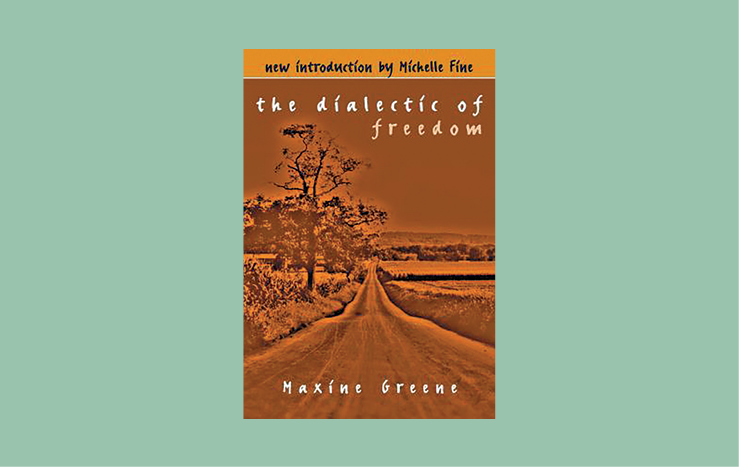
The Dialectic of Freedom
By Maxine Greene (Teachers College Press, 1988)
The educational philosopher Maxine Greene (1917-2014) believed deeply in human solidarity, democracy, and the power of education to liberate human genius. She asked us to wake up to the gifts we have been given. Her 1988 book The Dialectic of Freedom opened my eyes to the potential of human creativity, inventiveness, and goodness. For Greene, schools are meant to be “communities grounded in trust, flowering by means of dialogue, kept alive in open spaces where freedom can find a place” (p. 134).
Greene was a brilliant, gentle, forgiving, honest, direct person who loved life. As the William F. Russell Professor in the Foundation of Education at Teachers College, Columbia University, she inspired generations of students to think of education as a joyous journey open to all and to “remind people of what it means to be alive with others” (p. xvii.) Greene lived her message of mutuality and possibility in ways that were deeply human, humble, and healing. She concluded The Dialectic of Freedom with these stirring words: “There is a need for a wild patience. And, where freedom is the question, it is always a time to begin” (p. 135).

ABOUT THE AUTHOR
Peter W. Cookson Jr.
Peter W. Cookson Jr. is a senior research fellow with the Learning Policy Institute, Palo Alto, California, and teaches education policy at the McCourt School of Public Policy, Georgetown University, Washington, D.C. He is the author of School Communities of Strength: Strategies for Educating Children Living in Deep Poverty (Harvard Education Press, 2024).