A look back
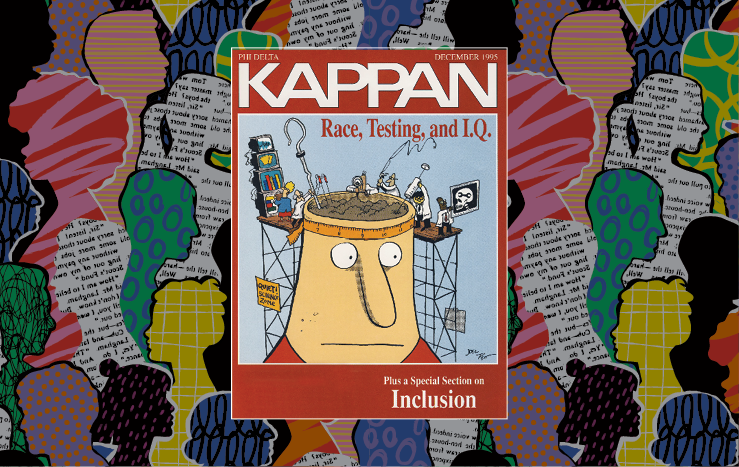
The real challenge of inclusion: Confessions of a ‘rabid inclusionist’
By Dianne L. Ferguson, December 1995, pp. 281-287
In this 1995 Kappan article, Dianne L. Ferguson uses the lens of special education to deeply examine what true inclusion looks like. As an education professor and parent of a child with multiple and severe disabilities, Ferguson shares how her research and personal experiences changed — and expanded — the way she views the complex phenomenon of inclusion in K-12 education. Students of all ability levels are best served, she argues, when they are granted “social and learning membership” within the classrooms where they are placed. But for students with disabilities, “too much of inclusion . . . seems to succeed in primarily relocating ‘special’ education to the general education classroom along with all the special materials, specially trained adults, and special curriculums and teaching techniques.”
The result? Students are “in” a class, but still exist on the periphery, unable to truly become part of the established classroom community. A better solution, Ferguson asserts, is to rethink our approach to inclusion and “build the tools and strategies for achieving inclusion from the center out rather than from the most exceptional students in.” Indeed, achieving inclusion may mean rethinking the traditional classroom setting altogether, she posits. “If all students work in a variety of school and community places, the likelihood that any particular students will be stigmatized because of their learning needs, interests, and preferences will be eliminated. All students will benefit from such variety in teaching approaches, locations, and supports.”
“A lot of work is needed to create an inclusive environment where students feel like they belong. It is not an event that can be checked off and done, but rather is sustained by being continuously mindful of belongingness.” — Orrin Murray, principal researcher at the American Institutes for Research, IES blog, December 2022.
Conversation piece
This issue examines how schools can help all students feel like part of the school community. Use these questions to reflect on the issue with your colleagues.
- Why is it so essential to ensure that all students feel included at school?
- What are some of the specific practices that you’ve seen in your school that promote inclusion? How effective are they, and how can they be improved?
- What do you see as some of the barriers to creating an inclusive school community? What ideas do you have for addressing these barriers?
PDK members have access to discussion guides related to specific articles in each issue of Kappan. Log in to the member portal and access the discussion guides at https://members.pdkintl.org/PDK_Member_Discussion_Questions.
Research connections
A sense of belonging for Native students
Indigenous youth often struggle to feel a sense of belonging in their schools. A case study in a Minnesota school sought to determine how learning about the culture and history of the Dakota people would impact Native students in grades 6 and 10. The intervention incorporated curriculum on the Dakota language, sacred history, ceremonial cycle, and land. Although some European American students had a negative response to the curriculum and complained about learning the material — reactions that adversely impacted Native students — the overall results were positive for Indigenous students who finally saw themselves reflected in the curriculum. Specifically, researchers found the intervention supported positive relationships between teachers and Native youth with the students feeling support, respect, encouragement, and acceptance when staff members “defended them and respected and acknowledged aspects of their Dakota culture.”
Source: Peters, H.J., Peterson, T.R., & the Dakota Wicohan Community. (2024). A Dakota cultural intervention’s influence on Native students’ sense of belonging: A CBPR case study. AERA Open, 10 (1), 1-17.
“Our schools must furnish a diverse platform to teach all students how to intellectually navigate a world full of profound challenges and an assortment of competing ideas, perspectives, cultures, religions, languages, and philosophies.” — Gregory M. Anderson, professor at Temple University’s College of Education and Human Development. Learning for Justice Magazine, Fall 2023.
Relationship-centered schools
A report from the Learning Policy Institute shares the stories of two school districts in California that have embraced a youth-led effort to transform schools into relationship-centered places of learning and belonging. The three principles of the school improvement effort are to: 1) create space for relationship-building, 2) value student voice, and 3) invest in staff. Although the work is ongoing, both districts report positive initial results, especially for youth experiencing the effects of poverty, racism, trauma, and other forms of discrimination. Practices adopted were varied and included breaking students into smaller “houses” or academies, instituting student-teacher orientation programs, and creating homeroom advisory periods. Increased staff training in relationship-centered practices, such as restorative justice, also were influential. A goal of the campaign includes hiring and retaining a diverse teacher workforce.
Source: Hernandez, L.E. & Rivero, E. (2024, February). Striving for relationship-centered schools: Insights from a community-based transformation campaign. Learning Policy Institute.
Factors that influence ‘fitting in’
Where do students feel they fit in? A group of students photographed specific places within their middle school and used the photos to discuss their perceptions with researchers. “Students experienced the greatest insecurity in their sense of belonging at times when they felt that help was either not available or not effective,” researchers noted. These places of insecurity included the hallways and lunchroom, where adult supervision was focused on maintaining order rather than providing assistance or companionship to students. “When students sensed their peers or adults were either not nearby or were ineffectual in their efforts to help, their feelings of safety were diminished,” researchers noted.
Source: Walls, J. & Louis, K.S. (2023). The politics of belonging and implications for school organization: Autophotographic perspectives on “fitting in” at school. AERA Open, 9 (X), 1-15.
School climate and discipline
It starts as early as preschool. Students of color, those from low-income backgrounds, English learners, students with disabilities, and LGBTQ+ students are disproportionately affected by exclusionary discipline policies. Research shows these harsh and unfair practices can create a negative school climate and derail students’ academic, social, and emotional growth. Guidance released last year by the U.S. Department of Education identifies five guiding principles and suggests actions schools and districts can take to create inclusive, safe, supportive, and fair learning environments.
Source: U.S. Department of Education. (2023, March). Guiding principles for creating safe, inclusive, supportive, and fair school climates.