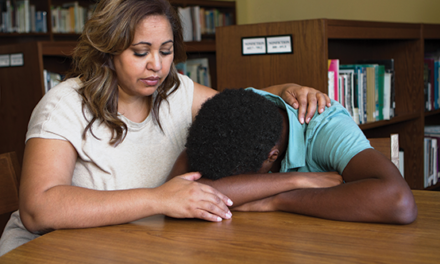
I recently received an email from Jack, one of my students, who said that he graduated from university and became a teacher in a secondary school. He is passing on the same love and warmth that his teacher gave him to his 32 students. This letter took me back 15 years.
One afternoon in April, I walked into the classroom as usual to guide my students in their reading program, when an eight-year-old boy named Jack suddenly caught my attention. On his desk were scissors, glue, and a lot of colored paper, which he was carefully folding. Jack was an introverted, dyslexic child who rarely spoke. He was slow to remember words, wrote even the simplest numbers incorrectly, and often missed words in his reading. He never got passing grades and didn’t like to interact with people, so he shut himself off.
When I saw Jack at work with his paper, scissors, and glue, I didn’t disturb him but quietly watched to see what he was making. After a while, a beautiful paper plane emerged, then he wrote something on the wings with a pen, smiling happily. As soon as the bell rang, he rushed out of the classroom, tightly holding the paper plane in his hand. He went to the playground and threw the paper plane with all his might. Jack ran back and forth on the playground with excitement and shouted, “I did it, I did it.” This was the first time I’d seen Jack happy.
In the following week, I began to observe Jack quietly and found that he carried a small bag in which there were many different kinds of paper planes, from pointy ones to long-tailed ones to wide-winged ones. Every day after school, he would go to the playground and fly his planes, each with different words written on the wings. These observations showed me that Jack had strong hands-on abilities and a rich imagination. I felt that there was a huge potential hidden in his little body. How could I use this knowledge to build his confidence?
Dreams taking flight
I bought some origami books for him and started flying paper planes with him after school. Jack told me that his dreams were written on the wings of each plane: I want to be a good astronaut. I want to go to space. And so on. He said that every time he flew a plane, his dream would be one step nearer to realization.
I started working with Jack every day to find out what style of small plane would fly higher and farther. I guided Jack to record the altitude and distance of different planes in his notebook, so as to improve and perfect them. Due to his dyslexia, Jack had particular difficulty in writing, but he worked hard to overcome it and kept learning and practicing.
As the first term was coming to an end, I announced in class on a Thursday afternoon that we would have a paper plane competition on Friday, and Jack jumped up and down with excitement. On Friday, I came to the classroom early; put scissors, glue, paper, and other tools on each table; and waited for the students to arrive. The competition started. The students chose their favorite colored paper and started folding the paper planes and wrote their wishes on the planes with pens.
After the students finished making the paper planes, I took them to the playground. I told them that the competition was a straight-line distance race. Whoever threw their paper plane the farthest would be the winner, and their wish on the plane would come true. As the differently shaped paper planes flew out, weaving a beautiful arc in the air, the playground runway suddenly became a wonderful “paper plane world.”
Jack stomped the ground with his left leg, rotated his waist and stomach, and threw his paper plane at full force, making a beautiful arc upward. The plane sailed through the air and landed at a distance of 15.12 meters. The children cheered and congratulated Jack for being the winner.
Another student, David, ran over to pick up Jack’s paper plane to see what his dream was. On the wings of the plane, he had written, “I want to be a good teacher.” I saw Jack’s eyes glistening with tears and a happy smile on his face. He gestured a love heart to me. From then on, Jack became more and more confident, smiled more and more, and was willing to open his heart and communicate with everyone.
Make every star shine
As Auguste Rodin is credited with saying, “It is not that there is a lack of beauty in life, but that there is a lack of eyes to discover it.” Every child has their own unique beauty, which we need to observe with our hearts to find, rather than labeling children as “problem children.” Howard Gardner teaches us that there are many different ways to be intelligent. There is verbal intelligence, mathematical and logical intelligence, musical intelligence, and so on. As educators, we can maximize the development of an individual’s latent intelligence so that each one can freely and fully exercise their talents.
With this idea in mind, in the second semester of that year, I announced to the children that each month we would select a group of Outstanding Stars, such as the Star of Painting, the Star of Music, the Star of Sports, the Star of Creativity, the Star of Dance, and so on. By the end of the school year, each of the 26 children in the class would have a chance to fully display their strengths and shine with their own unique light.
Mary, the Star of Music, taught other students how to play the guitar. John, the Star of Painting, taught other students how to draw a panda. Mark, the Star of Sports, taught other students how to play tennis. Jack, the Star of Craft, taught other students how to make a super paper plane. And Sam, the Star of Dance, taught street dance. All students learned how to become learners and teachers.
Many students told me that they were very happy to share their knowledge and skills with their buddies because they liked being able to help and learn from others. Sharing in this way transmits warmth and wisdom. If you have a specialty and I have a specialty, and we share them with each other, we will gain infinite wisdom. School becomes not just a place for students to learn, but a cozy home where they can grow up happily, sharing and growing together.
What is good education? I think it should be lighting up the hearts of students and allowing children to develop holistically and with individuality. Every child is the brightest star, and we have to create the right sky for them, so that they all shine.
This article appears in the December 2023/January 2024 issue of Kappan, Vol. 105, No. 4, p. 58-59.

ABOUT THE AUTHOR

Shanshan Wang
Shanshan Wang is the director of the China Academy of Science and Education Evaluation, Hangzhou Dianzi University.