When teachers face trauma, schools must do more to support their well-being and sense of safety.
High school math teacher Veronica Kennedy was in the middle of a lesson when a student, Luca, knocked on her closed classroom door and asked to retrieve something he had left behind earlier. (All names in this article are pseudonyms.) Veronica invited him in while she continued teaching. But instead of collecting his belongings, Luca made a beeline for Karl, another student, and started assaulting him. Veronica and the other students were caught off-guard; she later described the fight as “so freaking traumatic, outrageous, throwing punches, throwing bodies.” Luca ran into the hallway — with Karl close behind — where the fight continued. Veronica pleaded with them to stop and yelled for help from neighboring colleagues, whose doors were closed. Students scrambled to call the front office using the classroom phone but could not find the right extension. Veronica was without support for a terrifyingly long time as the brawl escalated in front of her. After the fight ended and the boys were escorted away, she was left with a classroom full of scared and traumatized students.
This incident, which occurred in early 2022, was the result of a collision of multiple forces, including Luca’s and Karl’s social and emotional challenges in the aftermath of the COVID-19 pandemic. These students are not alone in their struggles with mental health. A 2021 survey revealed that more than a third of U.S. high school students reported poor mental health during the pandemic, and almost half said that they had felt sad or hopeless in the previous year (Centers for Disease Control and Prevention, 2023). Educators have seen more dysregulated behavior as students act out in schools (Belsha, 2021).
Student trauma — and how educators should respond — has been well documented (Thomas et al., 2019; Venet, 2021), leading to increased calls for trauma-informed instruction. Indeed, trauma is a term that has come into increased use, sometimes losing its precise meaning. For our purposes, we refer to traumatic events as physically harmful, emotionally harmful, or life-threatening experiences that have the potential for lasting adverse effects on a person’s mental, physical, social, or emotional well-being (Substance Abuse and Mental Health Services Administration, 2012, p. 7).
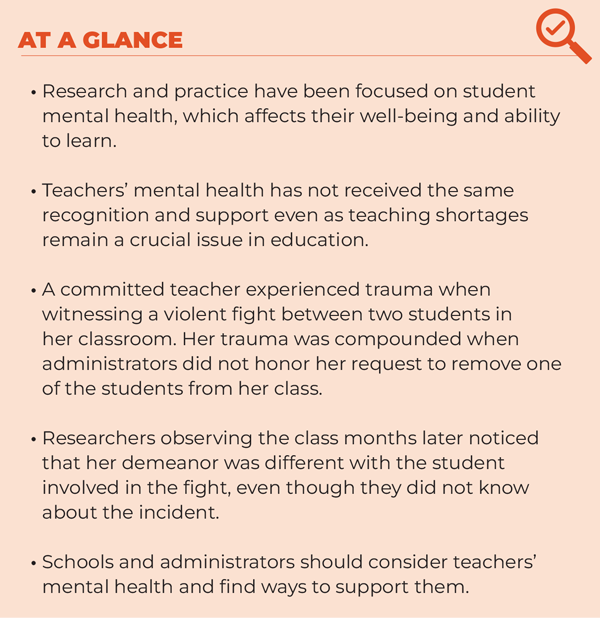
Although much attention has been paid to student trauma, relatively little attention has been paid to teacher trauma. And discussions that have occurred have often focused on educator self-care, rather than the systems within schools that work against teacher mental health.
Although much attention has been paid to student trauma, relatively little attention has been paid to teacher trauma. And discussions that have occurred have often focused on educator self-care, rather than the systems within schools that work against teacher mental health (Stark, Daulat, & King, 2022). As Veronica’s story reveals, educators also experience trauma — both in their personal lives and in their work — that can change how they show up to school and in their relationships with students. This reality becomes even more complicated when a student is an additional source of a teacher’s distress. Trauma can affect their instruction; retention at their school (or even within the profession); and their own well-being (Sutcher et al., 2019; Swider & Zimmarman, 2010).
In Veronica’s case, a lack of support from the school administration stressed her even further (Sutcher et al., 2019). After the incident, Veronica grappled with emotional exhaustion while balancing the need to teach math to Luca — alongside the rest of her students — and avoid another traumatic event (Swider & Zimmerman, 2010).
What might it look like for schools to focus on educators’ emotional well-being as much as they do on students’ social and emotional needs?
A case of classroom trauma
Veronica’s experience offers what anthropologists call a “telling case” (Mitchell, 1984): She has many qualities and resources that presumably support her resilience. She is a reflective, highly committed secondary mathematics teacher with more than 10 years of experience. In the seven years we have worked with her, she has shown high levels of emotional intelligence and a keen awareness of the social dynamics in her classroom. She has a strong community of colleagues who share her vision of ambitious and equitable instruction and who offer her rich resources for her ongoing professional learning. Yet the incident with Luca reverberated within her for the rest of the school year, impacting her instruction and her well-being.
Our research team works with a professional development organization in a large U.S. city. The organization recruits experienced secondary mathematics teachers in school-based teams. All the teachers have at least five years of teaching experience. Our team, the organization, and the teachers share a commitment to supporting teachers’ ambitious mathematics instruction in urban schools. Based on a need expressed by the teachers, we develop ways to give teachers formative feedback on their instruction. We do this by asking teachers what they are working to improve in their instruction, filming lessons, and then debriefing relevant instructional moments with them and their colleagues. We have multiple opportunities to visit their schools and delve into the details of their teaching with them.
In May 2022, our research team observed and filmed a geometry lesson in Luca’s class. We had not yet heard the story about Luca, nor did we know the complex emotions Veronica was grappling with. But when we reviewed the video, two things stood out. First, while students were working in small groups, Veronica’s movement around the room seemed fairly hurried compared to how she moved in other classes. Second, when Luca’s group struggled with the task, Veronica used more directive and leading questions than she did with other groups. With most students, Veronica met their questions with guidance and clarification but left more of the cognitive work to the students (Smith & Stein, 1998). But with Luca’s group, she did the mathematical heavy lifting, asking lower-level questions and connecting the dots for them. In addition, she spent significantly longer periods hovering over Luca’s group in comparison to other groups. After filming, our team brought these observations to Veronica in a debriefing session.
During this session, we mentioned that there were some stark differences in how Veronica monitored one of the student groups. When Veronica realized which group was different, she clasped her hands in front of her, leaned in a bit, and asked, “You guys — you guys want the context on Luca?”
Administrative (non)intervention
In the seven minutes that followed, we heard the full story of the fight Luca had instigated. Before Luca came to Veronica’s door that day, school counselors had been pacing outside her classroom. Veronica asked them what was going on, but they dismissed her questions — even though they were aware of a brewing conflict between Luca and Karl. As Veronica told the story, she revealed that she felt betrayed by Luca, who lied to her and broke her trust. She also felt betrayed by the school counselors who left her in the dark about a potential conflict and the school’s administrators who failed to respond quickly or conscientiously. Where were the counselors when the fight started? Veronica said, “They didn’t stick around. They weren’t there. Nobody was there.” This added to Veronica’s trauma. She “felt like [she] was screaming for other teachers to witness and help,” but many minutes passed before anyone came to her aid.
After the incident, administrators returned Luca to her classroom “literally that next day,” even though Karl was “removed from the school.” Perhaps because of student privacy protections, Veronica had no information on why Karl was removed and Luca stayed. Luca had clearly been the aggressor, though she described Karl as a student with “a lot of social and emotional and behavioral needs.”
Veronica asked that Luca be assigned to another teacher because of the violation of her trust. She even found another teacher willing to take Luca into their geometry class during the same period. However, administrators insisted that he remain in her class. They appealed to her generosity and deep acceptance of her students by saying that Luca “feels discarded by adults that he previously thought cared about him, and [we’re] asking you, please don’t throw this kid away.” The administrators believed they were showing care and sensitivity to Luca. But, from Veronica’s perspective, she was being asked to compartmentalize her feelings and continue teaching Luca as though nothing had happened. She had no time or support to heal from her trauma, which led to her feeling devalued.
In the lesson that we observed, the emotions Veronica described — betrayal, violation of trust, a breach in the physical safety of her classroom — were not immediately apparent during her interactions with Luca. A veneer of calm belied her inner experience. As she described, when Luca first came back to her room:
There was a solid two weeks where I was like, “I’m watching only his body because I can’t trust his body to go get supplies anymore, because all you were doing [when you started the fight] was getting a supply.” And I was just, like, super anxious and had a high heart rate.
Despite this ongoing anxiety and vigilance, Veronica’s outward attitude toward Luca remained positive and supportive. She revealed no clear traces of animus or resentment.
The cost of coping
Veronica’s account of the event revealed that maintaining such a calm demeanor was taking a toll on her emotionally. She attributed her “zooming” around the classroom to the anxiety she felt around Luca. She also said that she did not trust Luca and his group to respond well to being pushed into a space of what mathematics educators like to call “productive struggle” (Hiebert & Grouws, 2007), which is why she asked lower-level questions. She was coping with the traumatic event while maintaining her commitment to inclusive teaching. Because Veronica put her students’ needs first, her needs came second. Additionally, Veronica, just like her students, was still dealing with the impact of the pandemic and its aftermath.
During the debrief, Veronica pointed out how her body language in the video revealed her tension in subtle ways. For example, in addition to her constant motion, there was a tentativeness that we had not fully registered. As Veronica described it, she was “careful” in how she approached Luca when interacting with his group. She explained, “I’m really purposeful, trying to, like, rebuild a relationship with him, even though …” As her voice trailed off, we heard the weight of her trauma and how it played on her strengths as a teacher. She was committed to cultivating a welcoming classroom — even for a student who betrayed her trust — which required her to mask her trauma. Her commitment, combined with her trauma, manifested in her making different instructional decisions for Luca and others in his group.
We wondered what an outside evaluator would think about her interactions, not knowing the backstory. Veronica’s colleagues emphasize maintaining cognitive demand (Wilhelm, 2014) and supporting students’ productive struggle, yet her concern for her own and her other students’ emotional safety made this dangerous terrain. Without understanding the broader context, an observer might critique Veronica’s interactions with Luca’s group as inadequate — a judgment that would add insult to injury.
Ultimately, Veronica’s approach was successful for Luca. At the end of the school year — about a month after our visit — she sent us a photo of a note Luca wrote to her. It said, “I wanna say thank you for always caring despite anything that went on. I could wish that all teachers were caring like you and again, a big sorry for my actions.”
Veronica’s approach was successful for Luca. But was it successful for Veronica?
Supporting teacher well-being
This story illuminates important issues about supporting teacher well-being. Veronica’s deep commitments — both to teach all students who enter her room and to ensure that her class is a safe and welcoming space — were put into conflict by this incident. In a sense, the administration, recognizing Veronica’s capacity to make room for all, may have exploited this commitment at the cost of her mental health and well-being. At the same time, they were not entirely wrong: Luca’s note at the end of the school year shows that he did feel cared for by staying in her class.
Veronica’s deep commitments — both to teach all students who enter her room and to ensure that her class is a safe and welcoming space — were put into conflict by this incident.
What kinds of supports might have alleviated some of Veronica’s distress without neglecting Luca’s needs?
First, if administrators and counselors had caught wind of a brewing conflict, they could have done more to warn Veronica without violating student privacy. At the very least, they could have encouraged her to keep her door closed and not let any outsiders into the classroom. While that might have caused her anxiety for a day, it would have prevented the fight in her classroom. In the meantime, counselors could have initiated some restorative work between Luca and Karl.
Second, when such incidents happen, teachers should have opportunities to discuss their concerns with the administration and be heard. We recognize that the capacity for administrators to do this work is limited. As they add social workers to their staff to support students, they might also consider adding counselors to support teachers. Or, given the increasing difficulties with finding adequate mental health support in schools — administrators could coordinate referrals to mental health providers in the community whose services are covered by the faculty insurance plans. Moreover, having on-staff floating substitutes would allow teachers to take mental health days in the aftermath of traumatic events at school.
Finally, although our visit to Veronica’s class was in a collaborative spirit of learning together, we shudder to imagine what the result of a formal evaluation visit using a generic rubric might have been, given the evidence that she did not adequately push Luca and his group during the lesson. Instruction is always built on relationships, and Luca’s end-of-year note reveals that Veronica’s soft touch and wide berth helped him remain engaged and feel supported in her classroom. Evaluations should thus involve dialogue rather than mere judgment: Whoever is observing a lesson needs to have a chance to understand the context, both instructional and emotional, that might be informing instructional decisions.
Such changes could go a long way to address concerns about teacher shortages. When teachers report on why they are leaving, stressful working conditions — often due to managing student behavior — are the most common reason (Doan et al., 2023). And nearly one in three teachers planning to leave the profession cite a lack of support from school administration as a cause, and one in six cite concerns for their physical safety (Doan et al., 2023).
Teachers like Veronica — compassionate and experienced teachers with a commitment to ambitious and equitable teaching — are precisely the kinds of people we would want to have working with the children in our own lives. They feel called to the profession, dedicating their lives to supporting students’ academic and personal growth, despite often experiencing their own trauma. To retain them, however, school and district leaders must support teachers’ well-being and sense of safety, just as they strive to for students.
References
Belsha, K. (2021, September 27). Stress and short tempers: Schools struggle with behavior as students return. Chalkbeat.
Centers for Disease Control and Prevention. (2023, February). The Youth Risk Behavior Survey: Data summary & trends report: 2011–2021.
Doan, S., Steiner, E.D., Pandey, R., & Woo, A. (2023). Teacher well-being and intentions to leave: Findings from the 2023 State of the American Teacher Survey. RAND Corporation.
Hiebert, J. & Grouws, D.A. (2007). The effects of classroom mathematics teaching on students’ learning. In F.K. Lester (Ed.), Second handbook of research on mathematics teaching and learning (pp. 371-404). National Council of Teachers of Mathematics.
Mitchell, J. (1984). Typicality and the case study. In R. Ellen (Ed.), Ethnographic research: A guide to general conduct (pp. 237-241). Academic Press.
Stark, K., Daulat, N., & King, S. (2022). A vision for teachers’ emotional well-being. Phi Delta Kappan, 103 (5), 24-30.
Smith, M.S. & Stein, M.K. (1998, February). Selecting and creating mathematical tasks: From research to practice. Mathematics Teaching in the Middle School, 3, 344-350.
Substance Abuse and Mental Health Services Administration. (2012). Trauma-informed care in behavioral health services.
Sutcher, L., Darling-Hammond, L., & Carver-Thomas, D. (2019). Understanding teacher shortages: An analysis of teacher supply and demand in the United States. Education Policy Analysis Archives, 27, 35.
Swider, B.W. & Zimmerman, R.D. (2010). Born to burnout: A meta-analytic path model of personality, job burnout, and work outcomes. Journal of Vocational Behavior, 76 (3), 487-506.
Thomas, M.S., Crosby, S., & Vanderhaar, J. (2019). Trauma-informed practices in schools across two decades: An interdisciplinary review of research. Review of Research in Education, 43 (1), 422-452.
Wilhelm, A.G. (2014). Mathematics teachers’ enactment of cognitively demanding tasks: Investigating links to teachers’ knowledge and conceptions. Journal for Research in Mathematics Education, 45 (5), 636-674.
Venet, A.S. (2021). Equity-centered trauma-informed education. W.W. Norton.
This article appears in the November 2023 issue of Kappan, Vol. 105, No. 3, p. 14-19.

ABOUT THE AUTHORS

Christine E. Hood
CHRISTINE E. HOOD is a senior instructional designer at the University of Denver, CO.
Ilana Horn
ILANA HORN is a professor of math education at Vanderbilt University, Nashville, TN.
Katherine Schneeberger McGugan
KATHERINE SCHNEEBERGER MCGUGAN is a professional development specialist with the Metro Nashville Public Schools, TN.
Karen Underwood
KAREN UNDERWOOD is a graduate researcher at Vanderbilt University, Nashville, TN.
Jessica Smith
JESSICA SMITH is a post-doctoral researcher at Vanderbilt University, Nashville, TN.
Brette Garner
BRETTE GARNER is assistant professor of mathematics education at the Morgridge College of Education, University of Denver.